
Vandaag of morgen in huis

Kwaliteit gegarandeerd

Welkomstaanbiedingen ontgrendelen: GRATIS bezorging | Tot 80% korting | Gratis 30 dagen JoyPlus-proefperiode
Download de app
A coloured pen and marker set might seem straightforward to pick, but the options vary enormously. A set with lots of colours isn’t automatically handy for school, journaling or drawing. Some pens have tips that quickly lose their shape, while others bleed through thin paper. Caps can also go missing, causing markers to dry out faster.
With this guide, you can compare colour pens, felt-tip pens, fineliners, gel pens and brush pens based on verifiable features. That way, you avoid paying mostly for eye-catching packaging.
A set of 50 colours sounds appealing, but you should also check what you actually want to use the pens for. For notes and colour-coding, a set of 8 to 15 colours may be enough. For illustrations or hand lettering, multiple colour shades and different tip shapes are more practical.
Also pay attention to the ink information. Water-based, gel, acrylic and alcohol inks behave differently on paper. A water-based felt-tip pen is usually suitable for paper and card, whereas an acrylic marker may also be intended for materials like glass, wood or ceramic.
Fineliners are designed for thin, controlled lines. A 0.4 mm metal tip, like the one on the STABILO point 88, works differently from a felt-tip pen with a line width of around 1 mm. For large areas of colour, a broad or flexible tip is more efficient. For diagrams, small lettering and drawings, a fineliner offers more control.
Brush pens produce varying line thicknesses thanks to their flexible tip. This does require some pressure control. A standard felt-tip pen is often easier for children or for quick colouring.
A cap that doesn’t close properly can shorten a marker’s lifespan. Check that the cap clicks on firmly and that the set comes with a practical storage box. For children, a cap ring can be handy. The STABILO Cappi range, for example, has a ring that caps can be attached to.
Store fineliners according to the product information, often lying flat in the box. Gel pens are also best stored horizontally. Close acrylic markers immediately after use and follow the activation instructions.
Choose the tip based on the task:
A larger tip isn’t necessarily better. On thin writing paper, a broad tip can release more ink and therefore bleed through more quickly.
Pay attention to the combination of ink and material:
For children, age recommendations and small parts are important. Various sets state a minimum age and a warning for children under 3 years. Products with an EN 71 marking have been tested within the relevant toy safety standards, according to the product information. A CE marking is also product information, but it doesn’t mean a pen is suitable for every application.
Also check the instructions on the packaging. Acrylic markers, for example, often need to be shaken and activated with a pump mechanism. Use them in a suitable, well-ventilated area and avoid contact with eyes and mouth.
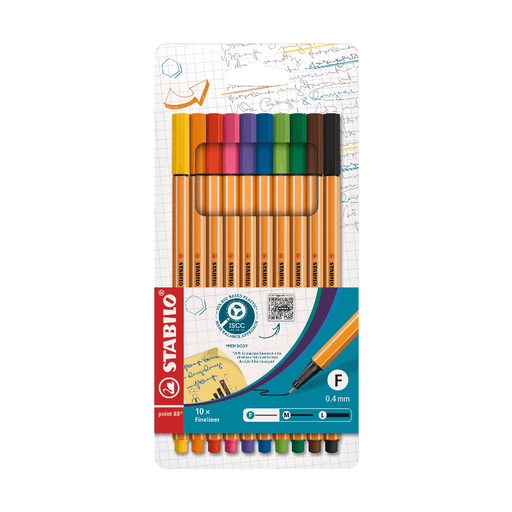
Why this fits the profile: A set of 10 colour pens is clear and manageable for school, diaries, underlining and first drawing projects.
The 0.4 mm metal tip makes the line more precise than that of broad felt-tip pens. The resealable packaging helps keep the set organised.
Water-based ink, 10 assorted colours and a tip that, according to the product description, is suitable for writing, drawing, colouring and sketching.
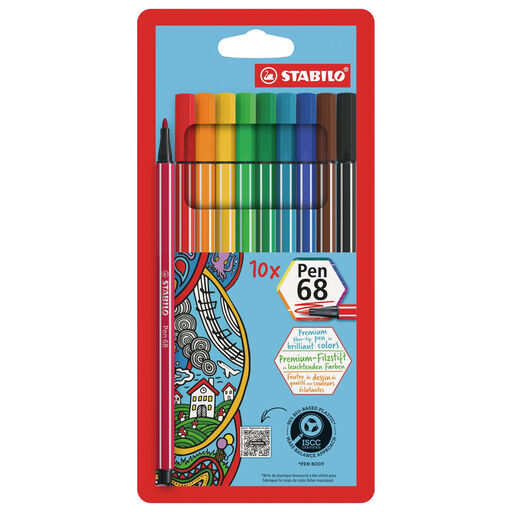
Why this fits the profile: This set suits users who want to complement colouring pencils with sturdy felt-tip pens for drawing and colouring.
The product description mentions a pressure-resistant tip of approximately 1 mm and water-based ink. That gives more reassurance than just a claim about bright colours.
Line width of approximately 1 mm and, according to STABILO’s own information, suitable for watercolour effects with a wet brush.

Why this fits the profile: Suitable for creative projects where you want to work not only on paper but also on surfaces like wood, glass or ceramic.
The set specifies the surfaces and has an ink level indicator. This means you can better assess beforehand whether the marker suits your project.
6 colours, water-based acrylic ink according to the product information and two tip sizes of 1 mm and 3 mm.
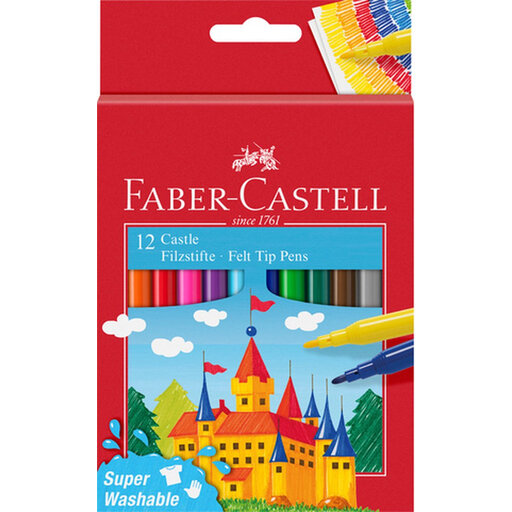
Why this fits the profile: A compact set for colouring and drawing on paper, card and, according to the product description, also wood.
The sturdy tip is designed for children, according to the product information. The stated washable ink can help reduce the risk of permanent stains, but do treat stains immediately.
12 assorted colours, recommended age from 4 years and an EN 71 marking in the product details.
We’ve put together a full, up-to-date list of products that fully meet these strict selection criteria and current European safety regulations.
For journaling, fineliners and gel pens are often practical. A 0.4 mm fineliner is suitable for small text and border decoration. A 0.5 or 0.7 mm gel pen gives a fuller line for titles, colour-coding and notes. Check the drying time for both types and test on your paper.
Close each cap immediately after use and store the set in the box provided. Avoid heat and direct sunlight. Some products state that the pen can be left uncapped temporarily, but that doesn’t mean leaving it open for long periods is a good idea.
No. Only use them on surfaces mentioned in the product description or packaging. Test on a small area first. The Faber-Castell set lists paper, metal, ceramic, glass, wood and canvas, among others. Adhesion, coverage and drying time can vary depending on the material.
