
Vandaag of morgen in huis

Kwaliteit gegarandeerd

Welkomstaanbiedingen ontgrendelen: GRATIS bezorging | Tot 80% korting | Gratis 30 dagen JoyPlus-proefperiode
Download de app
A coloured pen and marker set might seem simple to pick, until you have to decide which ink, tip and surface suit your needs. A set for school requires different features than acrylic markers for wood or pens for journaling.
Many poor purchases come down to three recurring pitfalls:
The surface you’re working on also plays a big role. Standard felt-tip pens and brush pens are usually designed for paper. According to the product information, acrylic markers are suitable for multiple surfaces, but coverage and adhesion can vary depending on the material.
For school, colouring pages and simple craft kits, water-based or food colouring inks are often sufficient. These are practical for paper, and some variants are described as washable in the product description.
For glass, wood, metal, ceramic, canvas or plastic, acrylic markers are the more logical choice. Look out for:
The Faber-Castell acrylic markers in this selection use, according to the product information, pigmented, opaque acrylic ink on a water base. The manufacturer lists use on paper, metal, ceramic, plastic, glass, textile, stone, canvas and wood, among others. That’s a product specification, not a guarantee that the marking will remain equally durable on every surface.
The tip determines what you can do with a set:
With dual-tip markers, you often get two applications in one pen. A brush tip is suitable for lettering and details; a chisel tip works faster on larger areas. This saves space, but check that both tips suit the age and motor skills of the user.
For young children, washable markers, ventilated caps and a sturdy, easy-to-grip holder are practical points to look for. Always check the recommended age and warnings about small parts.
A CE mark or EN 71 reference indicates information about applicable European product or toy requirements. It doesn’t replace reading the instructions for use. Store markers with the cap firmly closed. With gel pens, it’s wise to retract the tip when you’re finished; with markers, a properly closed cap prevents drying out.
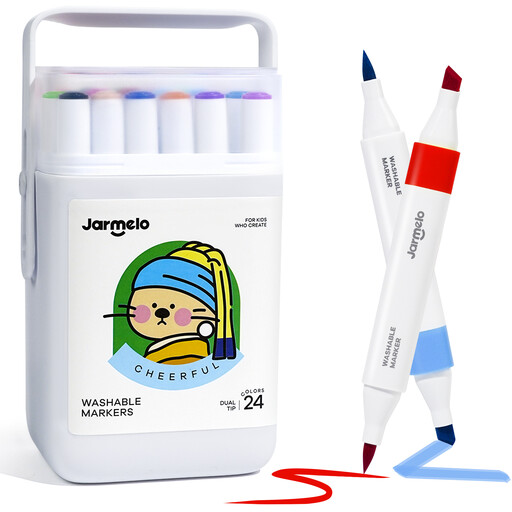
Why this fits the profile: The set combines 24 colours with a brush tip and chisel tip. This means children and beginners can colour, sketch and practise simple lettering without buying multiple sets.
The product description mentions water-based ink and 90% washability from skin and most fabrics. Do check marks straight away and test on a scrap piece first.
24 colours, two tip shapes and a storage box with handle. The description mentions ventilated caps.
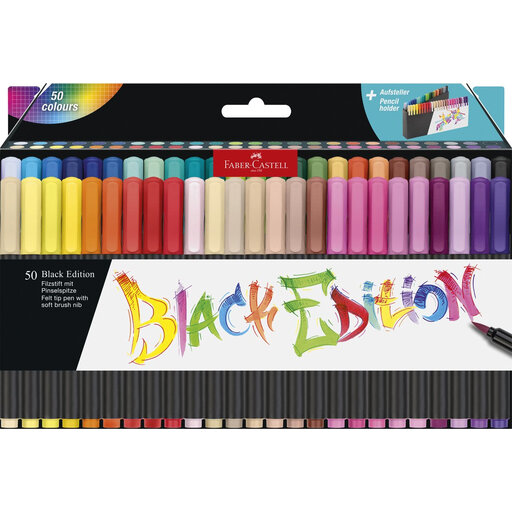
Why this fits the profile: This large set is aimed at adults, students and artists who want plenty of colour choice for text, small illustrations and colour coding.
The product information explicitly states that the pens are intended for light paper and not for black paper. This helps you avoid a wrong purchase for dark surfaces.
50 brush pens, washable ink according to the product description and EN 71 reference. The brush tip supports thin and thick lines.

Why this fits the profile: Suitable for creative hobbyists and artists who want to work with metallic colours on different materials.
The set has a 1 mm and 3 mm tip per marker. This means you’re not limited to one fixed line width. The markers do need to be shaken and primed first.
Six metallic colours, water-based acrylic ink and an ink level indicator. The product description lists paper, wood, glass, metal and canvas as possible surfaces.
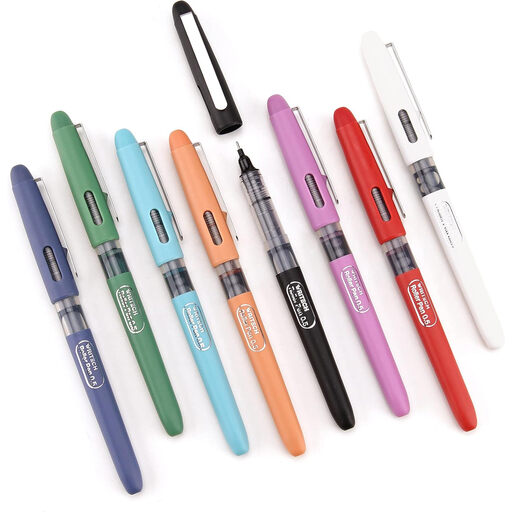
Why this fits the profile: The fine tip and eight vintage colours suit journaling, notes, sketches and colour coding in a diary or study planner.
The transparent casing makes the ink level visible. The product description mentions quick-drying ink, but paper and drying time affect the final result.
0.5 mm extra fine tip, eight colours and a liquid ink system. The pens are intended for drawing, writing and sketching.
We’ve put together a full, up-to-date list of products that fully meet these strict selection criteria and current European safety regulations.
Look at the recommended minimum age, ventilated caps, small parts and the type of ink. A set with washable markers can be practical for home or school, but “washable” is no guarantee of complete removal of every mark. For creative craft sets with beads or decorations, adult supervision is advisable.
Gel pens are mainly intended for writing, notes and journaling. Brush pens create variable lines and are suitable for hand lettering and small drawings. Felt-tip pens are generally simpler for colouring and broad markings. For non-porous surfaces, acrylic markers or specialist drawing pens are more suitable than standard felt-tip pens.
After each use, replace the correct cap and press it on firmly. Store markers according to the product instructions, ideally in a cool, dry place. With acrylic markers, follow the activation steps; with gel pens, retracting the tip helps. This limits unnecessary ink loss and extends the usable life of your stationery.
