
Vandaag of morgen in huis

Kwaliteit gegarandeerd

Welkomstaanbiedingen ontgrendelen: GRATIS bezorging | Tot 80% korting | Gratis 30 dagen JoyPlus-proefperiode
Download de app
A set of coloured markers and pens may seem straightforward to choose. However, felt-tip pens, fineliners, brush pens, gel pens and coloured pencils differ considerably in use. A wide range of colours, for example, says little about the tip, ink or suitability for children.
If you focus only on the number of colours or eye-catching packaging, you could end up with markers that dry out quickly, bleed through paper or feel uncomfortable to write with. Use these practical checks to compare sets based on verifiable product specifications.
A 50-colour set sounds appealing, but it is not automatically suitable for your project. A thick fibre tip is useful for filling in large areas, while a 0.4 mm fineliner is better suited to notes, outlines and technical drawings. For hand lettering, you need a flexible brush pen.
So first decide what you will use the set for:
Washable markers can make cleaning easier, but the result depends on the fabric, drying time and treatment method. According to the product description, STABILO power and Cappi markers can be washed off hands with water and soap; pre-treatment is recommended for clothing. Faber-Castell states that, for certain children’s markers, the ink can be washed out of most fabrics at 30 degrees.
Treat this as product information, not a guarantee for every stain. When dealing with clothing, test the product on an inconspicuous area first and treat ink as quickly as possible.
A box may look compact, but prove inconvenient for everyday use. Consider the following:
The STABILO Cappi, for example, uses a cap ring. This allows the caps to be connected to one another, which can be useful for children and when using the pens on the go.
The tip determines how much control you have. The 0.4 mm metal tip on the STABILO point 88 is designed for precise writing, drawing and working with a ruler or template. According to the product specification, a STABILO Pen 68 has a tip of approximately 1 mm, producing a broader, more visible line.
Brush pens work differently: the pressure and movement change the line thickness. This makes them suitable for hand lettering, but they require more control than a fixed-tip fineliner.
Water-based ink is common in felt-tip pens and fineliners. The result varies depending on the type of paper. Thin printer paper can allow ink to bleed through, particularly when colouring intensively. For watercolour effects with a STABILO Pen 68, the product information recommends thicker paper or card.
Gel pens are suitable for smooth writing and colour coding. The WRITECH sets have a 0.5 mm fine tip and a retractable design. When journalling, however, check that the ink does not smudge or show through your paper.
For children, a sturdy tip, comfortable grip and clear age information are important. Some sets mention CE or EN 71 in the product information. These markings do not replace supervision and do not mean that a pen is suitable for every age group.
Also look out for warnings about small parts. The product descriptions for various sets state that they are not suitable for children under 3 years old. Always check the age recommendation on the product page before ordering.
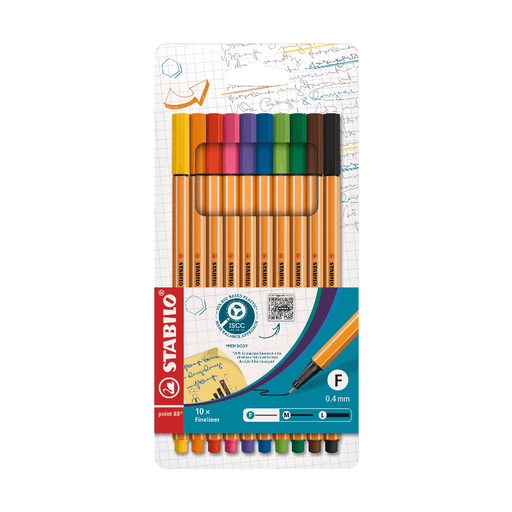
Why it suits this profile: A set of 10 colours is easy to manage and suitable for school notes, planners, simple sketches and colour coding.
The 0.4 mm tip makes this set more purpose-built than a large box of colours without any precision information.
Water-based ink, metal tip and resealable packaging according to the product description.
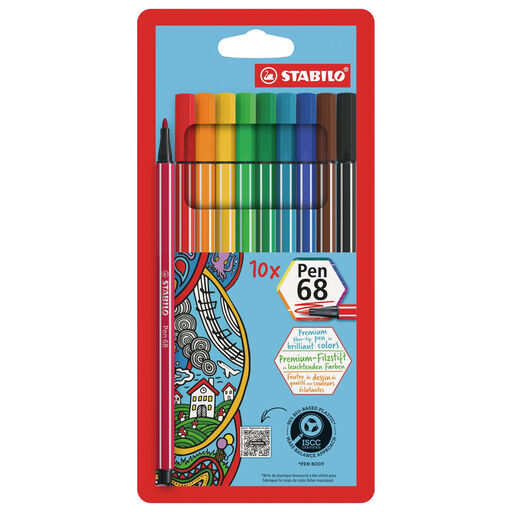
Why it suits this profile: Suitable for adults and older children who want to combine coloured areas, illustrations or watercolour effects.
The product information states that it has a robust tip of approximately 1 mm and water-based ink that can be used with water to create effects.
Approximately 1 mm line width, pressure-resistant tip and, according to the description, can be left uncapped for up to 24 hours without drying out.
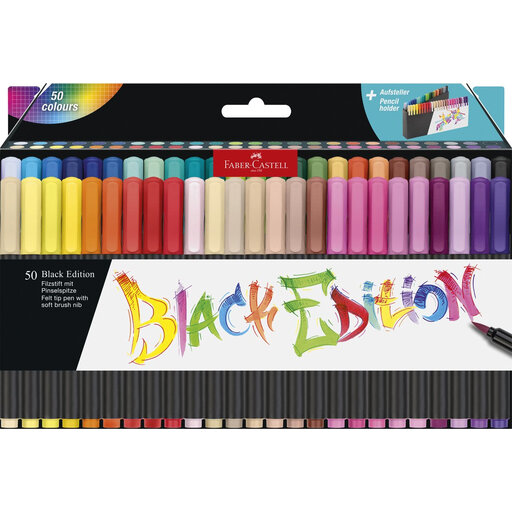
Why it suits this profile: The brush pens are designed for hand lettering, small drawings and text where you want to alternate between thin and thicker lines.
The flexible brush tip offers greater variation in line width than a fixed-tip fineliner. According to the product information, the set is intended for light paper, not black paper.
50 colours, washable ink according to the product description and a cardboard box for storage and carrying.
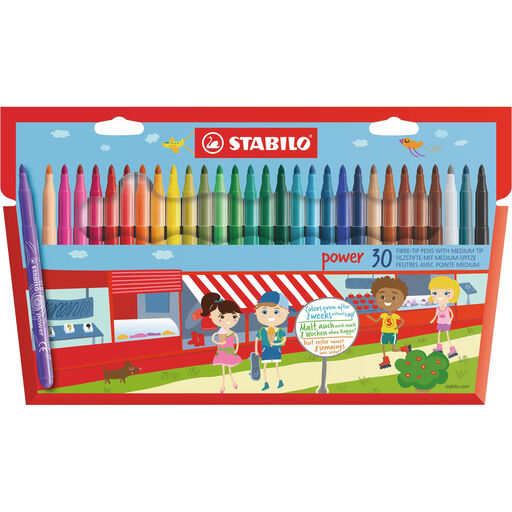
Why it suits this profile: A colour set for children and adults who want to fill in large areas quickly and do not always replace the cap straight away.
The product description states that it has a 2 mm medium tip, a pressure-resistant tip and ink that, according to the manufacturer, can continue writing for up to eight weeks without a cap.
30 colours, medium line and washable ink according to the product information; suitable for larger areas.
We have compiled a complete, up-to-date list of products that fully meet these strict selection criteria and the applicable European safety regulations.
For coloured pencils, consider the hardness of the lead, the shape of the pencil and how the pigment is distributed across the paper. According to the product information, the Faber-Castell Black Edition set of 24 has a 5 mm soft core, an ergonomic triangular shape and break-resistant bonding.
If you want decorative accents, metallic markers are an option. The STABILO Trio Deco has an XL tip measuring 3 mm and eight metallic colours. The product information recommends storing these markers horizontally. Metallic ink generally shows up more clearly on light or coloured paper than on every dark surface, so check the recommended paper type.
Look for a sturdy or pressure-resistant tip, a comfortable grip, washable ink and a clear age recommendation. Sets such as STABILO power, STABILO Cappi and certain Faber-Castell felt-tip pens mention these features in their product information. Keep small parts in mind and use the age limit as a guideline.
Replace the cap immediately after use and check that it is firmly closed. Store the pens according to the product instructions, usually horizontally or upright. Avoid heat and direct sunlight. If a pen temporarily writes less well, test it on scrap paper first; pressing hard will damage the tip more quickly.
A fineliner usually has a fixed, narrow tip for precise lines. A gel pen writes smoothly with gel ink and is practical for notes and journalling. A brush pen has a flexible tip that changes the line thickness depending on pressure and direction. Choose based on how you intend to use it, rather than simply on the number of colours in the set.
