
Vandaag of morgen in huis

Kwaliteit gegarandeerd

Welkomstaanbiedingen ontgrendelen: GRATIS bezorging | Tot 80% korting | Gratis 30 dagen JoyPlus-proefperiode
Download de app
Buying a new set of colour and writing supplies might seem straightforward. Yet many shoppers end up with pens that dry out quickly, markers that bleed through paper, or pencils that don’t suit the technique they had in mind. A large number of colours sounds appealing, but it says little about how usable the materials actually are.
So don’t just focus on the packaging, brand name or promotional copy. Instead, pay close attention to the ink type, nib shape, surface, age recommendation and storage options. That way, you can make a more informed choice for school, the office, hand lettering, drawing or crafting.
A set with dozens of colours isn’t automatically right for every project. For small lettering you need a fine tip, while larger areas are quicker to fill with a broad nib. With brush pens, the flexibility of the nib is also key to achieving the difference between thin and thick lines.
So check before you buy:
A dual-tip marker, for example, can combine a brush nib and a chisel nib. That’s handy for colouring, sketching and simple hand lettering, but it’s not the same as an alcohol marker for professional blending techniques.
Water-based and washable ink are useful features for children and home use. However, that doesn’t mean every mark on every fabric will disappear without a trace. With the Jar Melo dual-tip markers, the product description states that the ink is washable from 90% of skin and most fabrics. Treat that as a product specification, not a guarantee for every surface.
If in doubt, test on a scrap of fabric first and clean up marks quickly. Use alcohol markers only on suitable surfaces and be aware that they can bleed through thin paper.
Acrylic pens with a pump mechanism usually need to be shaken and activated first. With the Faber-Castell Shake & Paint markers, that means: keep the cap on, shake 20 to 30 times, and press the nib onto paper until the ink flows through.
Even ordinary felt-tip pens, fluorescent highlighters and pastel markers dry out faster if the cap isn’t properly closed. Store pens in a dry place, away from direct sunlight, and always with the cap firmly on.
The ink largely determines the application:
Bear in mind that performance claims come from the brand’s product information. According to Faber-Castell’s own information, the Goldfaber markers are fast-drying and smudge-proof; the final result also depends on the paper, pressure and technique.
A chisel nib is handy for broad marks and fine lines. The STABILO BOSS ORIGINAL has writing widths of 2 and 5 mm according to the product specifications. The STABILO swing cool uses a nib with 1 and 4 mm, making it suitable for underlining and highlighting.
A fine fineliner nib is better for details. A brush nib allows you to vary line thickness by changing the pressure. A sponge applicator on dot markers is designed for dots, simple patterns and filling larger areas.
For alcohol markers, thick marker paper or specialist sketch paper is often more practical than standard printer paper. Watercolour techniques work better on heavier paper that is less likely to buckle.
For children, the following details are relevant:
A CE marking or EN 71 reference is not proof that a product is suitable for every age. Always follow the age recommendation and safety information on the packaging.
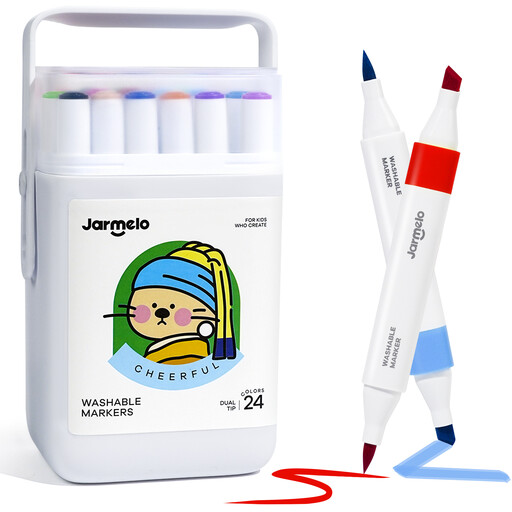
Why this fits the profile: The set combines 24 colours with a brush nib and a chisel nib. That makes it useful for colouring, simple sketches and hand lettering at home or at school.
The two nib shapes mean you don’t immediately need separate sets for broad and fine lines. The caps are ventilated and the ink is water-based.
24 colours, brush and chisel nib, carry case and, according to the product information, 90% washable ink on skin and most fabrics.
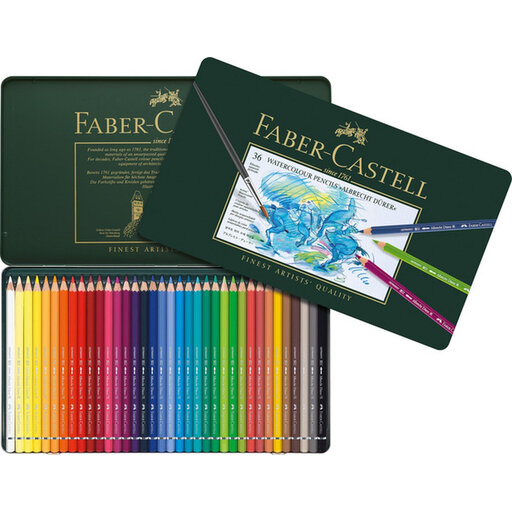
Why this fits the profile: This set is designed for colouring with pencil and water. It suits adults, students and creative hobbyists who want to sketch, blend and build up layers.
The 3.8 mm thick lead core and SV bonding are concrete specifications for everyday use. According to the product information, the pencils are completely water-soluble.
36 colours, wooden casing, metal storage tin and a lightfastness rating indicated per colour according to the manufacturer.

Why this fits the profile: These acrylic pens are designed for projects on various surfaces, such as wood, canvas, glass, ceramic and metal.
The two nib sizes of 1 and 3 mm give you more control than a marker with just one fixed nib. The ink level indicator helps you keep track of usage.
6 standard colours, water-based acrylic ink, two nibs and a shake-and-pump mechanism.
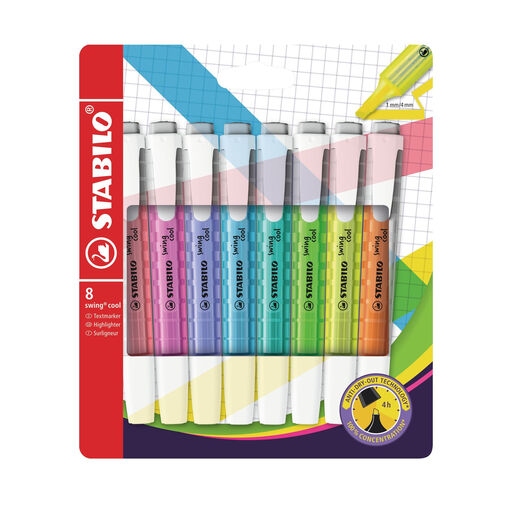
Why this fits the profile: The slim design with a clip fits in a pencil case or bag. The combination of neon colours and two writing widths works for notes, planners and summaries.
The nib offers 1 mm for underlining and 4 mm for highlighting. The clip stops the highlighter from rattling around loose in a bag.
Water-based ink, 8 fluorescent colours, anti-slip zone and, according to the product information, up to 4 hours without the cap without drying out.
We’ve put together a full, up-to-date list of products that fully meet these strict selection criteria and comply with current European safety regulations.
For young children, water-based felt-tip pens, dot markers and dual-tip markers with an appropriate age recommendation are practical options. Check the safety information, ventilated caps and any CE or EN 71 marking. Don’t let children draw on skin or furniture with markers, even when the ink is described as washable in the product description.
Brush pens have a flexible nib for variable line thicknesses. Felt-tip pens usually use a fixed fibre nib for colouring and writing. Alcohol markers contain alcohol ink and are designed for quick, even colour areas and blending techniques. They can bleed through thin paper and are therefore less suitable for ordinary school exercise books.
Put the cap back on firmly after each use and don’t store markers for long periods in direct sunlight or extreme heat. Sort sets into the supplied box or case so that caps and colours stay together. With acrylic pens, you also need to follow the activation instructions before using the marker.
