
Long sessions reading outdoors
You regularly read geography books in the sun and want to know whether the text remains readable without distracting reflections.


If you mainly read outdoors for long periods and the page fits comfortably on a smaller screen, a colour e-reader is worth considering; the Consumentenbond highlights reading in sunlight without screen reflections as an advantage of e-readers. For large map PDFs, quick zooming and study apps, a tablet is usually more practical. Before buying, try a page from your own book: screen size, colour key, file permissions and reflections all affect whether the option you choose will work for you.
You regularly read geography books in the sun and want to know whether the text remains readable without distracting reflections.
You use fixed-layout pages with small place names or tables and want to zoom in and move around maps quickly.
You need to distinguish colours on maps and want to know whether colour e-ink shows enough detail.
Start with the layout of your own book: a fixed-layout map PDF has different screen requirements from a flowing ePub.
| What to consider | What to look for | Who should pay more attention to this? |
|---|---|---|
| Readability in daylight | Compare your own book outdoors, in both sun and shade; check for reflections, contrast and heat build-up. | If I often read outdoors, I want to follow the text without constantly moving around. Around 36% of consumers prioritise reading comfortably for long periods in bright daylight. |
| Fixed-layout map PDFs | Open a representative page and test place names, the key, zooming and moving around. | When a fixed-layout page has small labels, I want to view map details without having to zoom in awkwardly all the time. Around 29% of consumers prioritise the readability of large maps and fixed-layout PDF pages. |
| Colour and map keys | Check whether the original page actually uses colour, and test small or closely similar colour shades. | If colours convey meaning, I want to be able to distinguish the key and map areas clearly. Around 21% of consumers prioritise colour differentiation and fine map details. |
| Other study tasks | Check which apps you need and whether the weight, screen size and any stylus suit the way you use the device. | If I want to use study apps as well as read books, one device for several tasks is practical. Around 14% of consumers say versatile study use is their main reason for buying. |
A colour display doesn’t tell you enough about how small coloured map labels will look. PocketBook lists 150 dpi in colour for the InkPad Color 3, compared with 300 dpi in greyscale.
Test a page with the smallest place names and map key, not just the cover.
A fixed-layout PDF page may require a lot of zooming and moving around on a small screen. The Consumentenbond points out that many PDF files are laid out for A4.
Try the actual PDF on the screen you’re considering and see whether a larger screen or a conventional tablet would work better for navigating maps.
Reflections and heat build-up are separate things to consider. Apple warns that an iPad screen may dim if the device gets too hot.
Compare screens in the conditions you’ll read in, and follow the temperature guidance for the model you choose.
Kobo’s straightforward transfer method applies to unprotected PDF and ePub files; it doesn’t necessarily work in the same way for DRM-protected files.
Before buying, check the file format, DRM terms and transfer method for your book.
The Libra Colour is a compact colour e-reader with page-turn buttons and Kobo Stylus 2 support. It’s worth considering if reading outdoors is your priority.
According to PocketBook, the InkPad Color 3 has a 7.8-inch non-reflective colour e-ink screen and supports PDF and ePub.
According to BOOX, the Note Air6 C combines a 10.3-inch colour electronic paper screen with Android apps and PDF features, making it worth considering for larger study pages.
The Galaxy Tab S10 FE is a conventional tablet for anyone looking to combine colour, zooming and other apps.
According to Apple, the 11-inch iPad Air is a conventional tablet with a fully laminated screen and an anti-reflective coating.
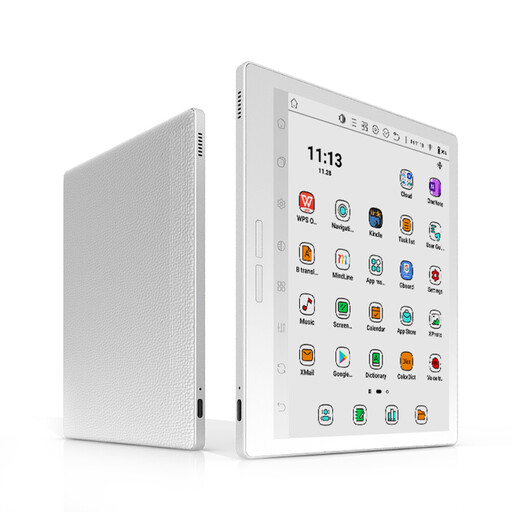
These Joybuy products are compact colour e-readers for reading outdoors and viewing colour pages. Bear in mind that a fixed-layout map PDF may require more zooming and moving around on a small screen.
 No image available
A colour e-reader for reading outdoors and viewing colour pages; a fixed-layout A4 PDF may require a lot of zooming and moving around on this screen.
The product name lists a 7-inch colour e-ink screen, 4+64GB, 300 ppi and 36-level Frontlight.
According to the product description, a power adapter is not included.
 No image available
This model is suited to reading on a compact colour e-ink screen; its small display may mean more zooming and moving around when viewing fixed-layout map PDFs.
The product name lists a 6.13-inch e-ink screen, Android 14 and 8GB+256GB.
The product description lists 150 PPI for colour content compared with 300 PPI for black and white, so test fine coloured map details using your own file.
View a representative map page on the screen size you’re considering. The Consumentenbond points out that many fixed-layout A4 PDFs are difficult to zoom in on with smaller e-readers; a tablet may be more practical. Also check whether the file permissions allow you to transfer it to the device.
According to Rakuten Kobo, you can add an unprotected PDF or ePub using a computer. The same straightforward method doesn’t necessarily work for a file with DRM; check the permissions and follow the instructions for your file.
Yes. Apple says the screen may dim or turn black if the iPad gets too hot. Avoid prolonged exposure to direct sunlight and don’t leave the device in a hot car; this is Apple’s usage guidance for iPads.
Electronic equipment needs a CE mark when the applicable harmonised EU rules require one. The EU’s Your Europe guidance lists electrical and electronic equipment as a product group covered by such rules. Check the documentation for the exact model when buying; a CE mark is not an assessment of reading performance.
According to the Dutch government, when you buy from a business at a distance, you will usually have a 14-day cooling-off period, with some exceptions. There is no fixed statutory guarantee period in the Netherlands: you’re entitled to a product that meets the required standard and, if there’s a relevant fault, an appropriate solution.