
Players who focus on maps and details
Want to keep track of both your colony and small text, icons and menus on a large screen? Don’t just look at the resolution: check the usable scaling settings in your games too.


When choosing a monitor for colony management games, it really comes down to what you want to see at a glance on a large screen. 4K on a 16:9 monitor gives you plenty of pixels for the map and interface, while an ultrawide monitor gives you extra width. With either option, check how your games handle resolution and interface scaling, and whether your PC can cope with your chosen resolution. Choose OLED mainly if you also value its distinctive picture quality, and take into account how you’ll manage interface elements that stay on screen for long periods.
Want to keep track of both your colony and small text, icons and menus on a large screen? Don’t just look at the resolution: check the usable scaling settings in your games too.
If you want more horizontal space for the map or to view several elements side by side, check how each game displays its interface and scaling settings on an ultrawide monitor. Philips Netherlands describes the Evnia 34M1C5500VA/00 as a 34-inch screen with 3440 × 1440 pixels.
If you also play games where contrast or smooth motion matters to you, weigh these features against how you use static menus. LG warns that displaying the same image for a long time on OLED monitors can cause faint marks; check the terms and conditions for the exact model.
A good fit if: you want plenty of pixel space for map details and the interface on one large screen.
The trade-off: a higher resolution can demand more from your PC, and doesn’t guarantee that text will be readable without adjustment.
A good fit if: your main priority is extra horizontal space for your map or visible game elements.
The trade-off: the game needs to support the wider display and interface properly. Factorio Forums describes a user report of interface details being hidden when interface scaling was used; this doesn’t tell you how every game works.
A good fit if: OLED’s distinctive picture quality is also a factor in your choice for other games.
The trade-off: LG warns that displaying the same image for a long time can cause faint marks; check the instructions and terms and conditions for the exact model.
First decide whether readability, extra width or picture quality matters most to you. Then use the checks below to see whether your choice also suits your games, PC and desk.
| What to consider | What to check before buying | Who will care most about this? |
|---|---|---|
| Map details and interface | Check the screen resolution and test text and interface scaling in the games you play. | If I want to read both the colony and small menus on one large screen, readability comes first. Around 33% of consumers put map and interface readability at the top of their list. |
| Horizontal overview | Check ultrawide support and interface scaling for each game, and measure the available desk space. | If I want more room beside my map or to view elements side by side, how my own games display is the deciding factor. Around 27% of consumers prioritise a wider view. |
| Resolution and PC performance | Compare 3840 × 2160 and 3440 × 1440 with your PC’s performance in the games you play; check your connections too. | If I want to match the screen resolution to what my PC can handle in my games, I look at that combination. Around 20% of consumers give PC performance top priority. |
| Picture quality and other games | Compare the panel type and stated refresh rate; for OLED, read the care instructions and terms and conditions. | If I also play other genres, I may give contrast or refresh rate more weight than I would for games with lots of menus. Around 13% of consumers put picture quality and versatile use first. |
| Positioning and long-term use | Measure your desk and viewing position, and assess adjustability, reflections and readability from where you normally sit. | If I’m mainly looking for a screen that suits my desk and seating position, I check these points beforehand. Around 7% of consumers prioritise positioning and long-term use. |
A 34-inch ultrawide and a 31.5-inch 16:9 monitor distribute screen space differently. Screen size alone doesn’t tell you how much horizontal space you’ll have or how the pixels are spread across the screen.
Compare the size, aspect ratio and resolution, and check the interface at the scaling level you want to use.
Whether the extra width works as you’d like depends on the support and interface scaling of the specific game. Factorio Forums describes a case where scaling hid interface details; this isn’t a conclusion about all games or versions.
Check the games and versions you play before making extra screen width the deciding factor.
A high stated refresh rate doesn’t automatically answer whether OLED is suitable for game interfaces that stay visible for long periods. LG warns that displaying the same image for a long time on OLED monitors can cause faint marks.
Read the care instructions and terms and conditions for the exact model, and weigh up OLED against an LCD monitor.
Dell Netherlands lists the S3225QS as a 31.5-inch 16:9 monitor with 4K and a refresh rate of up to 120 Hz. This model is an example of a large 4K option; these specifications don’t automatically apply to other Dell monitors.
Philips Netherlands lists the Evnia 34M1C5500VA/00 as having a curved 34-inch screen with 3440 × 1440 pixels and a refresh rate of up to 165 Hz. This model is an example of an ultrawide option.
LG lists the 32GX870A-B as having a 32-inch 4K OLED panel and a dual mode with a refresh rate of up to 240 Hz in 4K. This description applies to this model only; it isn’t a statement about the whole product range.
AOC lists the AG326UD as a 31.5-inch 4K QD-OLED monitor with a refresh rate of up to 165 Hz. These are manufacturer specifications for this model.
This selection includes ultrawide monitors for anyone looking for more horizontal space while gaming. Check whether each model’s size and resolution suit your games, PC and available desk space.
 Image unavailable
An option if you’re looking for a large ultrawide display; check how your own games show the interface and handle scaling.
34 inches, 3440 × 1440 pixels and LCD, as stated in the product name.
 Image unavailable
An option if you’re looking for a wide view on one large screen; measure the available space beforehand.
The product name lists Dual QHD, a VA panel, a KVM switch, a USB-C dock and RJ45 (LAN).
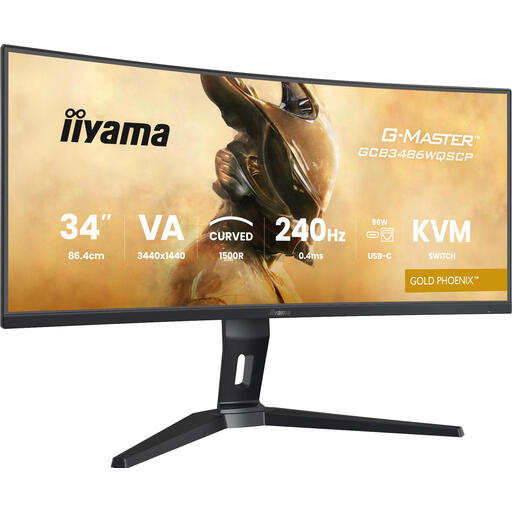 Image unavailable
An option if you’re looking for a curved ultrawide monitor with a KVM switch; check how your own games display on screen.
The product name lists a 240 Hz refresh rate, a 0.4 ms response time and a KVM switch.
 Image unavailable
An option if you’re looking for a wide screen for gaming and other tasks; check how your games display the extra width.
34 inches and 3440 × 1440 pixels, as stated in the product name.
 Image unavailable
An option if you want an extra-wide panoramic gaming view; plan the positioning and mounting carefully.
The product name lists DQHD 5120 × 1440, 165 Hz, a 32:9 aspect ratio and a VA panel. The product information says you’ll need a desk or VESA mount that can support at least 15 kg, and that two people are needed for installation.
No, the product specifications mentioned don’t automatically make this a requirement. Dell lists a maximum of 120 Hz for the S3225QS, while Philips lists a maximum of 165 Hz for the Evnia 34M1C5500VA/00. Also consider what your PC and other games can make use of, alongside readability and screen format.
From your usual sitting position, check that text and symbols are readable, reduce distracting reflections and adjust the screen position where the stand allows. Arboportaal lists small symbols, reflections and an awkward working posture as factors to consider when using a display; this workplace guidance isn’t necessarily a rule for gaming at home.
Follow the care instructions for your exact model. LG explains that displaying the same image for a long time on OLED monitors can cause faint marks, and suggests using the monitor settings to run a screen-cleaning function; this doesn’t guarantee that every mark will disappear.
According to the Dutch government, when buying at a distance you’ll often have a 14-day cooling-off period; check the terms that apply to your purchase. If there’s a problem with the product, the seller is your point of contact for the legal guarantee. A manufacturer’s guarantee or an additional service plan doesn’t replace this legal right.
Yes. EU rules for electronic displays cover monitors and include requirements for energy labelling and product information. For a specific model, compare its product information sheet; an energy label alone doesn’t tell you how readable a game interface is.