What should you look for when buying?
First decide how large you need the smallest details to appear in the image, and how much room you’ll need for your light. Then compare a compact camera with built-in close-up modes against a mirrorless camera with a suitable macro lens.
| What to consider |
What should you check? |
Who considers this important? |
| Reflections and colour under artificial light |
Can you position the camera and light separately, and set the white balance manually? |
I want to manage reflections and colour casts on shiny coins by being able to adjust the direction of the light. Around 29% of consumers prioritise control over light and colour. |
| Small coin details |
Compare the maximum magnification of the exact lens and its compatible mount. |
If small inscriptions and mint marks need to appear large in the image, lens magnification is a deciding factor for me. Around 29% of consumers prioritise these details. |
| Sharpness across the coin |
Check that the camera and coin can be kept steady, and that focus bracketing or focus stacking works with the combination. |
I want to capture whole coins and their relief consistently in sharp focus with a fixed setup. This is the top priority for around 24% of consumers. |
| A complete setup |
Check whether you’re buying a body, a kit or a camera with a fixed lens, and whether you’ll need a macro lens. |
If you want to get started with as few separate purchases as possible, check what’s actually included in the offer. Around 18% of consumers prioritise a simple, complete purchase. |
Camera and lighting bundle at Joybuy
This Joybuy selection is a camera and lighting bundle. Check whether the combination suits the close-up view and lighting control you want for photographing coins.
 No image available
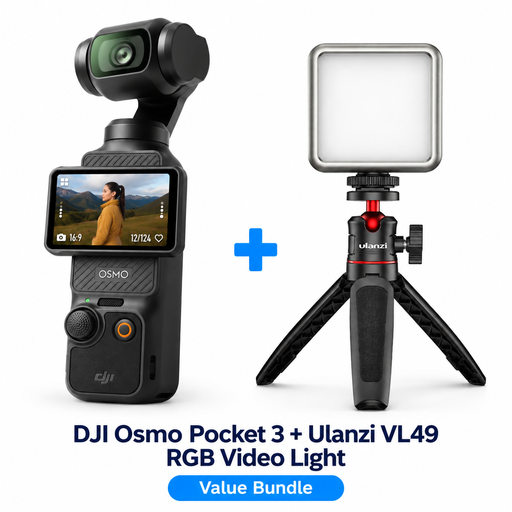
DJI Osmo Pocket 3 + Ulanzi VL49 RGB LED Video Light
This bundle may suit you if you want to consider a camera and additional lighting together; the product name mentions photography and vlogging.
According to the product name, the bundle includes a DJI Osmo Pocket 3 and a Ulanzi VL49 RGB LED Video Light.
Joybuy
Frequently asked questions
Does a short focusing distance mean there’s enough room for a light?
No. The distance at which a lens can focus isn’t the same as the free space in front of the lens. Check the working distance if you want to position a light around a coin.
Should I use a ring light for coins?
Not necessarily. Keep the camera and coin fixed, then change the direction of the artificial light to see how reflections and surface details change. Check each coin to make sure your chosen position doesn’t create distracting reflections.
What can I do if the whole coin isn’t in focus?
First check that the camera and coin are steady and facing each other squarely. At high magnification, you can combine shots taken at different focus positions if your camera and lens support it. Check specifically whether the lens is compatible with in-camera focus stacking.
Is a kit lens enough for small coin details?
Don’t assume a kit lens offers the same magnification as a macro lens. For example, Canon lists 0.5× for the RF 85mm F2 Macro IS STM, while Nikon lists 1:1 for the NIKKOR Z MC 50mm f/2.8. Check that the exact lens is compatible with your camera.
Do I always have 14 days to change my mind when buying online?
When a consumer buys from a business at a distance, a 14-day cooling-off period applies in many cases. According to the Dutch government, buying online from a private individual doesn’t count as a distance purchase in this sense. So check who the seller is and which terms and conditions apply.


