
Vandaag of morgen in huis

Kwaliteit gegarandeerd

Welkomstaanbiedingen ontgrendelen: GRATIS bezorging | Tot 80% korting | Gratis 30 dagen JoyPlus-proefperiode
Download de app
A coffee table might seem like a straightforward purchase, but the wrong choice can quickly become a nuisance. It could take up too much floor space, wobble on an uneven surface or offer less storage than the product photos suggest. Materials and weight limits aren’t always described consistently either.
So don’t focus only on colour and shape. Check the dimensions, construction, care instructions and intended use. That way, you can find a modern coffee table to suit your living room, flat, home office or patio.
A 120 cm tabletop might look compact on a product page, but the legs and any extra shelf take up more space. Measure the full length, width and height, and leave enough room to move between the sofa, table and cabinet.
For a round coffee table, the diameter matters. An 80 cm-wide model gives you a useful surface, but it can still take up a lot of floor space in a small seating area. A rectangular coffee table often works better with a long sofa, while a round design has fewer sharp corners in a compact room.
A coffee table with storage doesn’t automatically have drawers or a cupboard. An open lower shelf is useful for books, baskets and ornaments, but the contents remain on show. Check whether the layout includes an open shelf, several levels or a concealed compartment.
A coffee table with a shelf is practical for everyday use, as long as there’s enough clearance between the levels for the things you want to store.
A wooden coffee table might be made from solid wood, MDF, chipboard or engineered wood with a wood-effect finish. These materials differ in weight, care requirements and resistance to moisture. Even a surface described as water-resistant or scratch-resistant still needs careful use. Use coasters and wipe up spills straight away.
Some models are described as having metal frames with adjustable feet or protective pads. When your table arrives, check that these parts are included and adjust them to suit your floor.
Measure the space and, if helpful, use masking tape to mark out the area you want the table to occupy. Check:
In a flat or studio, a multifunctional table may be more efficient than a separate coffee table and side table. A lift-top coffee table can raise the work or dining surface, but check that the mechanism can move fully without hitting the sofa.
Don’t just look at the tabletop material. Stability also depends on the joints, base and how the legs are attached. Product details might specify a metal frame, a particular board thickness or a maximum weight capacity.
The Tribesigns three-tier model has a stated weight capacity of up to 13.6 kg. That makes it suitable for books, a lamp and lightweight home accessories, but not necessarily for heavy equipment. The product description also mentions 1.5 cm E1 chipboard shelves and adjustable foot pads. E1 is an emissions classification for board materials; it’s not a general guarantee of the complete piece of furniture’s lifespan or stability.
In a living room, a laminated or melamine-faced surface is easy to wipe clean with a soft, slightly damp cloth. Avoid abrasive cleaners, even if the manufacturer describes the finish as scratch-resistant.
A metal side table for the patio should be suitable for the conditions you plan to use it in. The Ambiance model is described as being made from powder-coated carbon steel, with a weight capacity of 20 kg and dimensions of 45 × 50 cm. The description says it’s suitable for outdoor use, but prolonged exposure to rain can affect metal parts. If the weather is poor, it’s best to put the table somewhere sheltered and follow the care instructions.
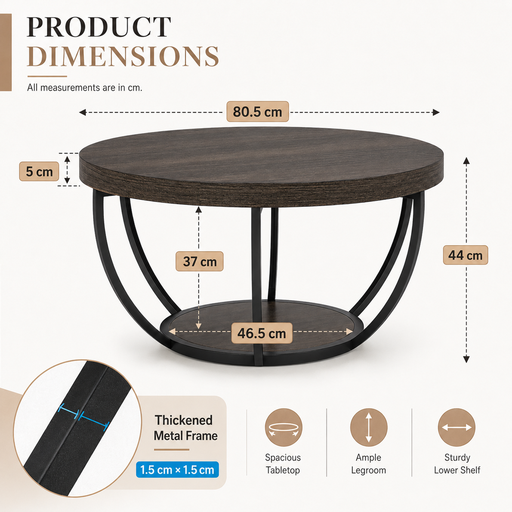
Why it suits this profile: The round shape and two tiers provide a neat layout for a living room, flat or reception area. The dimensions are clearly specified as 80 × 80 cm.
The lower shelf makes it clear that storage is open and everything is within easy reach. The product description also mentions a metal base and assembly instructions.
Two storage tiers, a 5 cm-thick engineered wood tabletop and a design with six curved metal elements, according to the product information.
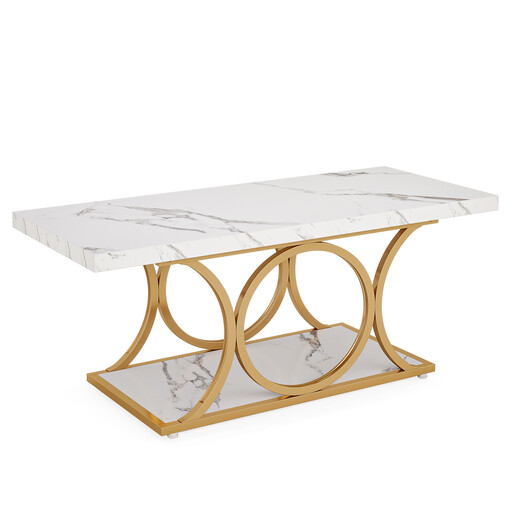
Why it suits this profile: This model works well with a longer sofa and in an interior where appearance and an easy-to-clean surface matter. Its dimensions and materials are clearly specified.
The product description lists a lower shelf, a metal base and a faux-marble top made from E1 chipboard. This makes it clear which parts the table is made up of.
Approximately 118 cm long, with two tiers and a melamine finish described as water-resistant and scratch-resistant.
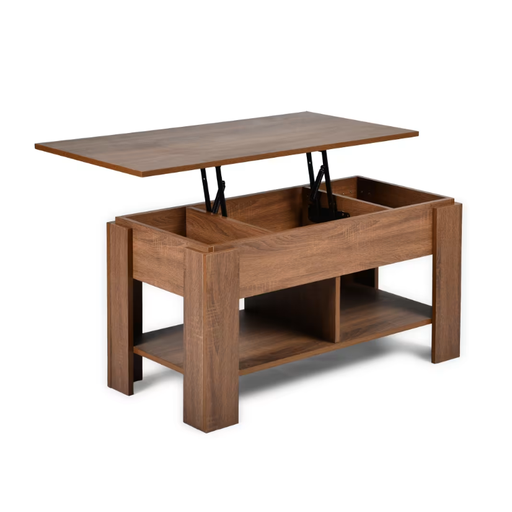
Why it suits this profile: The lift-top is designed for working or eating on the sofa, or for using your belongings at a higher level. This makes the table a useful option for small homes and home offices.
The height is specified as 48 to 63 cm. The description also mentions two open shelves and a concealed storage compartment. Check the mechanism during assembly and keep fingers clear of moving parts.
Lift-top with adjustable height, two open compartments and a closed storage section, in a 96 × 50 cm size.
We’ve put together a full, up-to-date list of products that meet these strict selection criteria and current European safety regulations.
First, measure your sofa and the available walking space. A tabletop around two-thirds the length of your sofa can look well-proportioned, but the space you have available will ultimately determine your choice. Check the full dimensions, including the base and shelf.
It can be, especially in a flat or living room without a separate workspace. Consider the adjustable height, the stability of the mechanism and the space between the table and sofa. Don’t exceed the recommended weight capacity.
Its lifespan depends on the materials, assembly, load and care. Tighten the joints properly after assembly, use protective pads on hard floors and don’t put damp or extremely heavy items on the tabletop. Product details may specify features such as board thickness and weight capacity, but everyday use also affects how well the table holds up over time.
