
Host catering for different tastes
You want to offer both white and wholemeal rolls at your coffee morning, without assuming that all your guests like the same things.


If your guests have different tastes, choose a small mix of white and clearly labelled wholemeal rolls. Wholemeal gives guests who look for it an obvious choice, while white offers an alternative for anyone who prefers its flavour or texture. Check the preparation instructions, allergen information and availability for each product before deciding how many to buy.
You want to offer both white and wholemeal rolls at your coffee morning, without assuming that all your guests like the same things.
You’re looking for a roll that is genuinely wholemeal. According to the Netherlands Nutrition Centre, the word ‘wholemeal’ on bread tells you more than just its brown colour or the presence of seeds.
You want to know how many rolls you can bake at once and whether your chosen varieties will be ready in time. The instructions on the packaging and what’s available in store both matter.
First, decide whether your guests mainly want wholemeal, prefer white or would appreciate both options. Then check the product descriptions and preparation instructions for the rolls you’re actually buying.
| What to look for | What to check when buying | Who is this most important for? |
|---|---|---|
| Wholemeal option | Look for the word ‘wholemeal’ on the packaging; don’t rely on colour or seeds alone. | If I want to offer guests an obvious wholemeal option, I need to be able to distinguish it from brown or multigrain bread. This wholemeal choice is the most important factor for around 50% of consumers. |
| Different tastes | Check whether you can buy white and wholemeal rolls separately, and how many are in each pack. | If I don’t know my guests’ preferences, I don’t want to limit them all to the same type of bread. Different flavours are the main reason for choosing for an estimated 33% of consumers. |
| Preparation and planning | Read the baking and storage instructions for each product; also check what the shop currently has available. | If I want to serve the rolls warm, the preparation needs to fit my oven capacity and serving time. Practical planning comes first for around 17% of consumers. |
A brown colour, grains or seeds on the outside don’t prove that a roll is wholemeal. You could end up taking home something other than the wholemeal option you had in mind.
Check that the product description says ‘wholemeal’. According to the Netherlands Nutrition Centre, this is the key term to look for on bread.
Wholemeal tastes different from white, as the Netherlands Nutrition Centre points out. Offering just one variety gives your guests less choice.
If you don’t know what your guests prefer, buy white and wholemeal rolls separately and make it clear which is which when you serve them.
Preparation varies depending on the product. For example, the instructions for PLUS Korenlanders White Rolls say to bake for 6–8 minutes at 220 °C; don’t use the same time and temperature for other rolls.
Read the instructions for both varieties in advance and, if necessary, plan to bake them in more than one batch.
Baking in several batches takes extra time and may mean you can’t serve all the rolls warm at the same time.
The words ‘white’ and ‘wholemeal’ don’t give you a full list of ingredients and allergens. The Netherlands Food and Consumer Product Safety Authority highlights the requirement to list allergens among the ingredients.
If any guests have an allergy, check the current packaging for every product you choose, including any warnings about possible cross-contamination.
Albert Heijn has separate product pages for AH White Rolls and AH Wholemeal Rolls.
Jumbo offers different types of bake-at-home rolls, including white and wholemeal rolls.
Lidl’s oven-fresh rolls include a white roll and a wholemeal bun.
ALDI offers individual white rolls and also lists white and wholemeal bake-at-home rolls in its range.
PLUS offers white and multigrain rolls. If you’re putting together a mixed selection, you can compare the product information for each variety.
Dirk’s product range includes white and brown rolls, as well as packs of multigrain rolls.
These white rolls make a handy addition to a coffee morning with guests who have different tastes. To serve them alongside a wholemeal option, you’ll also need rolls that are clearly labelled as wholemeal.
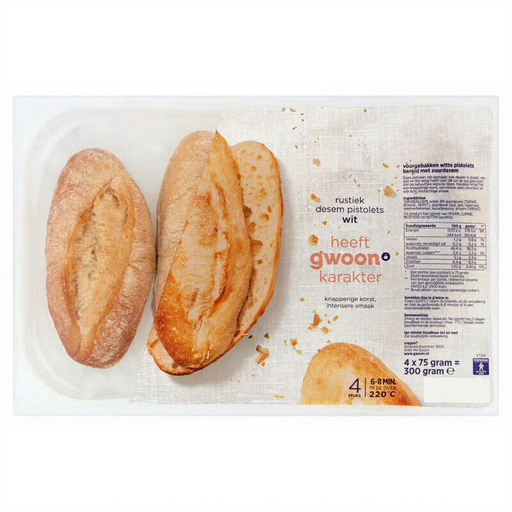 Image unavailable
A white option for guests who prefer white bread, alongside a separately chosen wholemeal roll.
Pack of 4. Check the baking instructions and current allergen information on the packaging before serving the rolls.
No. According to the Netherlands Nutrition Centre, wholemeal bread is made from 100% wholemeal flour. So check that the packaging says ‘wholemeal’, rather than relying on the colour or the word ‘multigrain’.
Don’t assume this based on the type of bread. The Netherlands Food and Consumer Product Safety Authority explains that iodine compounds may be present in bread and other bakery products through the use of baker’s salt, up to a maximum of 65 mg of iodine per kg of salt. Check the ingredients list for the rolls you choose.
Follow the storage instructions on the packaging of the rolls you choose. Jumbo recommends storing bake-at-home rolls in the fridge, freezer or cupboard, depending on the variety, so don’t assume all products should be kept in the same place.
Check the current ingredients list on each pack before serving the rolls. The Netherlands Food and Consumer Product Safety Authority explains how allergens must be listed on labels; also check for warnings about possible cross-contamination if they’re relevant to any of your guests.