
Vandaag of morgen in huis

Kwaliteit gegarandeerd

Welkomstaanbiedingen ontgrendelen: GRATIS bezorging | Tot 80% korting | Gratis 30 dagen JoyPlus-proefperiode
Download de app
Fresh coffee starts with properly ground coffee beans. However, a coffee grinder is not automatically suitable for every brewing method. A simple blade model can be perfectly adequate for the occasional cup of coffee, but gives you less control for espresso. A manual coffee grinder is compact and quiet, while an electric coffee grinder is particularly convenient when you are making several cups one after another.
The right choice therefore depends on more than just wattage or appearance. Pay particular attention to the grinding mechanism, adjustment options, capacity and maintenance requirements.
A 200-watt motor may sound powerful, but it says little about how evenly it grinds. In blade models, the coffee is mainly broken down by rotating blades. This can result in particles of different sizes. That is less suitable for espresso or pour-over, where an even grind affects the brewing time.
A coffee bean grinder with burrs works differently: the beans are finely ground between two burrs. Do check whether the burrs are adjustable and how much control the manufacturer actually specifies.
A coffee grinder for espresso needs a fine setting. For French press and cold brew, you need a coarse grind instead. A model with only a few settings may therefore be limiting. Look at the difference between fixed grind settings and stepless adjustment. With a coffee grinder offering defined settings, figures such as 14, 28 or around 36 steps are specific, verifiable specifications; “precision” without further explanation is not.
For one or two cups, a small dosing capacity is often sufficient. An office, family or café needs more capacity. A large hopper is practical, but coffee beans left in the container for a long time gradually lose their aroma. For everyday use, weighing out each portion is often a sensible approach.
For an electric model, also check the safety instructions. Some appliances may only run for short periods at a time and must then be allowed to cool down.
For espresso, moka pot and filter coffee, a burr coffee grinder generally offers more adjustment options than a blade model. A conical burr often takes up little space and is found in both electric and manual coffee grinders. A blade grinder has a simpler design, but the grind is usually controlled by holding down the button for longer.
For example, the De’Longhi KG210 uses stainless steel blades and has three grind settings. This suits users who mainly want convenience and do not need an especially fine adjustment.
Do not just look at the number of settings, but also at the range. A coffee grinder for espresso must be able to grind finely enough without the appliance becoming blocked. For filter coffee, French press and cold brew, a consistent coarse setting is important.
A manual coffee grinder such as the TIMEMORE Chestnut C3S Pro lists around 36 adjustable levels and a 38 mm conical burr. According to the product description, the model is designed for everything from espresso to French press. Always check the instructions for your chosen brewing method and start with small adjustments.
A model for home use does not need the same capacity as a professional coffee grinder for an office or café. Consider the following:
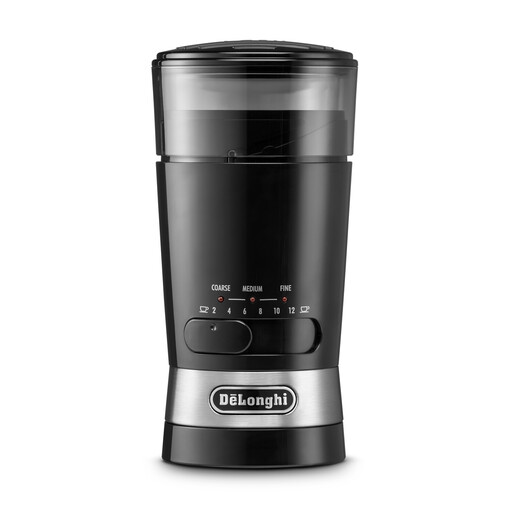
Why it suits this profile: A compact electric model for everyday use, with a 90 g container and a 170 W motor according to the product information.
The specifications list three grind settings, so you do not have to rely solely on an arbitrary pulse duration. It is still a blade grinder, so it is less suitable for highly precise espresso settings.
170 W power, a 90 g container and a compact design. The stated statutory EU warranty lasts at least two years.
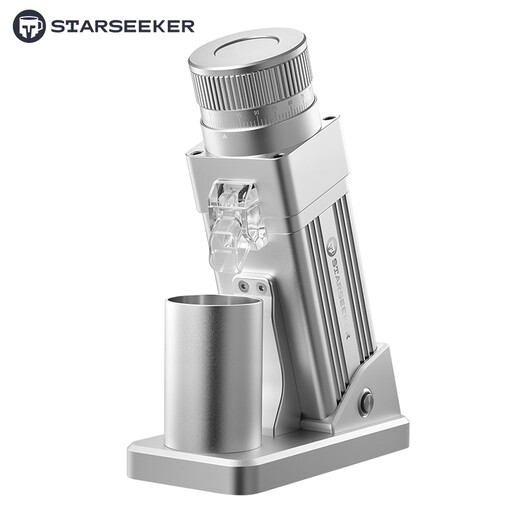
Why it suits this profile: For home baristas who want to dial in espresso and pour-over using stepless grind adjustment.
The product description lists 55 mm titanium-alloy conical burrs and stepless fine adjustment. This lets you make small changes instead of being restricted to a handful of settings.
55 mm conical burrs, a 72 W motor, a metal housing and a magnetically detachable coffee outlet according to the product details.
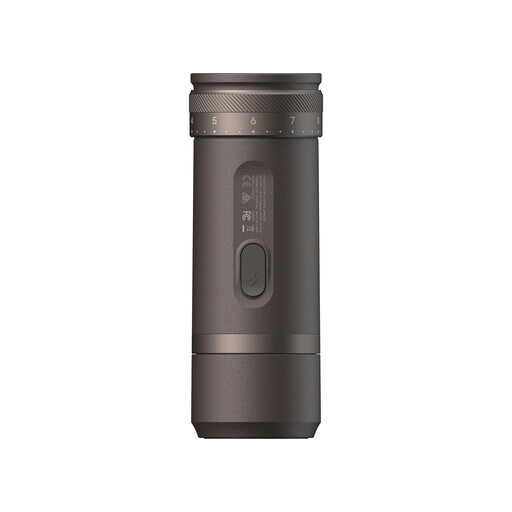
Why it suits this profile: A portable coffee grinder for home, the office, travel and outdoor use, without needing a power socket while grinding.
The product description lists 28 clear settings plus stepless micro-adjustment. The maximum dosing capacity is 25 g, making this model particularly suitable for individual portions.
690 g weight, a 38 mm conical burr, USB-rechargeable battery and support for espresso, moka pot, pour-over, cold brew and French press according to the product specifications.
We have put together a complete, up-to-date list of products that fully meet these strict selection criteria and the applicable European safety regulations.
A coffee grinder will remain usable for longer if you remove ground coffee regularly. Preferably use a dry brush for the burrs and grinding chamber. Do not pour water over the motor housing, cable, plug or battery module. With electric models, always unplug the appliance before cleaning it.
Blade grinders should not be run continuously for too long. For example, the product information for the Cecotec TitanMill 200 specifies a maximum continuous operating time of one minute, followed by a cooling period. The Butler grinder specifies a maximum of 30 seconds per cycle. Always follow the instructions for the model you have chosen.
Not necessarily, but a burr model generally gives you more control over the grind. For espresso, a fine, as even as possible grind is important. Check whether the manufacturer explicitly lists espresso as a suitable brewing method and whether the grinder can be adjusted finely enough.
Ideally, remove loose coffee grounds after every few grinding sessions. How often you need to clean it more thoroughly depends on how much you use it: if you grind coffee every day, you can clean the grinding chamber with a dry brush once a week. Do not use water on parts that the instructions say are not water-resistant.
A manual coffee grinder does not use electricity and generally has no charging costs. On the other hand, you have to turn the handle yourself, and larger quantities take more time. For one or two portions while travelling, this can be practical; for several cups, an electric coffee grinder is usually more convenient.
