Who is this guide for?

A lighter snack with a savoury flavour

You want to keep the crunchy snack you enjoy with drinks, while keeping an eye on the fat and calories in the portion you actually eat. To compare products, look at the nutritional values per 100 g as well as the amount you serve yourself.

Putting protein first

You want to know how much protein your snack contributes to your diet. Check the amount per portion and consider a separate source of protein if that better suits your needs.

Comparing products mindfully in the supermarket

You compare specific varieties using up-to-date product information, without automatically assuming that a supermarket own-brand or a familiar brand name is the better nutritional choice.

What should you look for when choosing?

First decide whether you’re mainly looking for less fat per 100 g, a suitable amount of protein per portion or more control over how much you eat. Each of these goals calls for different checks on the label.

What to consider What should you check? Who is this relevant for?
Fat content Compare the fat per 100 g of the exact variety. For solid foods, the European Commission sets a maximum of 3 g of fat per 100 g for the ‘low fat’ claim. If I want to eat less fat without simply reducing my portion, I check the nutritional composition of the variety. Around 38% of consumers make reducing fat their top priority.
Protein per portion Check the protein per 100 g and calculate how much that means for the weight of your planned portion. If I want to know how much protein my snack actually contributes, I calculate it based on the amount I eat. Around 38% of consumers put protein first.
Portion size Weigh the amount you plan to eat and calculate the fat, protein and calories for that same portion. If I want to keep the savoury flavour but control how much I eat, I weigh my portion. Around 24% of consumers make portion control their top priority.

Common pitfalls

  • Assuming a lower fat content means ‘low fat’

    A product may contain less fat than a comparable variety and still not meet the separate requirements for the ‘low fat’ claim. For solid foods, the European Commission sets a maximum of 3 g of fat per 100 g for this claim.

    Compare the fat values per 100 g and assess the claim separately from the difference between products.

  • Confusing protein per 100 g with the amount in your portion

    The nutritional value per 100 g doesn’t tell you how much protein you’ll get from the amount you actually eat. A larger portion of the same product also provides more fat and calories.

    Calculate the protein, fat and calorie values for the same weighed portion before comparing varieties.

Brands to consider

Duyvis

Duyvis offers several varieties, including Cocktail, Poesta, Oriental and Provençale.

  • The product names make it easier to compare different flavours as separate options.
  • A flavour or brand name alone doesn’t prove that a product has less fat or provides more protein.

Albert Heijn

Albert Heijn lists its own varieties, such as Oriental and Cocktail, alongside branded products.

  • The product pages identify specific flavours.
  • Albert Heijn warns that ingredients, nutritional values and allergen information may change. Check the packaging of the variety you buy.

Jumbo

Jumbo lists Cocktail Nuts among its own product varieties.

  • The product information describes the variety as peanuts with a crunchy coating.
  • Check the nutritional values of this specific variety; don’t assume they apply to all Jumbo cocktail nuts.

Lidl

Lidl sells cocktail nuts, but the shop name isn’t necessarily the brand name on the packaging.

  • The product page can help you identify the current variety and its packaging.
  • The shop name alone doesn’t tell you anything about the fat content or protein contribution.

ALDI

ALDI sells cocktail nuts under the TRADER JOE’S product name in several flavours.

  • The flavour and packaging information help you distinguish between specific varieties.
  • A retailer’s test mention isn’t a nutritional comparison and doesn’t prove that a product has less fat.

PLUS

PLUS lists varieties such as Ham and Cheese Cocktail Nuts as a distinct flavour option.

  • The product information makes the flavour easy to identify.
  • A flavour name or nutrition label doesn’t prove that this variety contains less fat or meets your snack’s protein needs.

Cocktail nuts on Joybuy

This Joybuy product selection is for anyone who wants to keep the savoury flavour and weigh out a portion of regular cocktail nuts.
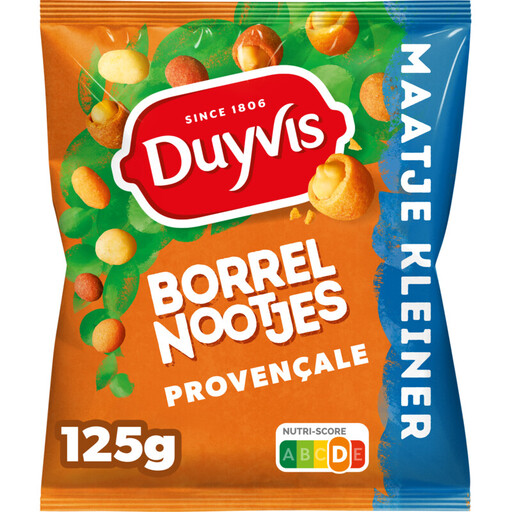
Duyvis Bran Nuts Provencale, 125 g

Duyvis Bran Nuts Provencale, 125 g

Suitable if you want to keep the savoury flavour and weigh out your portion in advance; check the nutritional values on the exact packaging.

Joybuy

Frequently asked questions

Does ‘low fat’ mean the same as ‘less fat’?

No. For solid foods, the European Commission sets a maximum of 3 g of fat per 100 g for the ‘low fat’ claim. Having less fat than another product doesn’t in itself prove that this requirement has been met.

Does everyone who wants to eat a high-protein diet need to have extra protein snacks?

Not necessarily. The Voedingscentrum recommends an average of 0.83 g of protein per kilogram of body weight per day for adults and notes that some groups need more. This general guidance doesn’t determine your personal target; consider your overall diet.

If I’m allergic to peanuts or wheat, can I rely on the flavour name alone?

No. The ingredients in Duyvis Borrelnoten Oriental 275 g include peanuts and wheat. The Netherlands Food and Consumer Product Safety Authority states that allergen information must appear on the label of prepacked products. Always check the packaging of the exact variety.

How should I store an opened bag of cocktail nuts?

Follow the storage instructions on the packaging for your variety. For Duyvis Cocktail bulk packs, HANOS recommends storing them in a cool, dry place and putting an opened bag in a light- and airtight container. For its Cocktail variety, Jumbo recommends storing it in a cool, dry, dark place.
