Which packaging option is right for you?

Parents who need to pack lunchboxes quickly

You’re looking for individual bags you can set aside in advance, and want to check that the contents are suitable for the occasion and comply with school rules. The Netherlands Nutrition Centre highlights taste and how practical a food is to store and eat at school.

Parents who want to portion snacks themselves

You want to decide how much to serve and are comparing a resealable bag with a larger bulk pack. Bear in mind that you’ll need to weigh out the portions yourself and seal the bag securely.

Parents who put suitability for school first

First, check the school’s rules, the allergen information and any choking warnings on the specific packaging. The Netherlands Food and Consumer Product Safety Authority explains the rules on allergen information; schools may also have their own policies.

What should you look for when choosing?

Individual bags

Choose these if: you want to have sealed bags ready without having to weigh out portions each time.

Bear in mind: each Duyvis bag contains 45 g. This is not a recommended portion for children, and the contents include peanuts and wheat.

Resealable bag

Choose this if: you want to decide how much to put in each lunchbox.

Bear in mind: the 250 g AH pack is not a multipack of individual lunch bags, so you’ll need to portion it yourself.

Larger bulk bag

Choose this if: you want to portion out snacks for several occasions from one pack.

Bear in mind: the 500 g Jumbo pack is a single bulk bag. The twenty 25 g portions listed on the label are not twenty individual bags.

No cocktail nuts

Choose this if: the school’s rules, allergens or your child’s individual circumstances make the product unsuitable.

Bear in mind: choose a different snack instead. The Netherlands Nutrition Centre describes foods from the Wheel of Five as part of a school lunch.

What to consider What should you check? Who should pay particular attention?
School rules and safety Check your school’s rules, the allergens present and any choking warnings on the specific packaging. If you need to clarify school rules and food safety first, check the product before buying it. Around 33% of consumers prioritise suitability for school and safety.
Individual bags Check the number of individual sealed bags and the weight of each one. If you want to fill lunchboxes without weighing portions first, look for genuinely individual bags. Around 25% of consumers prioritise convenient packaging.
Quantity and lunch choices Check the contents of each bag and the nutritional information on the current packaging; a portion listed on the label is not a recommendation for children. If you want to decide how much to pack and how the snack fits into the whole lunch, pay attention to the quantity. Around 25% of consumers prioritise this consideration.
Stock and use Compare the total weight, the number of individual bags and the amount you actually want to portion out. If you want a bulk pack to suit the occasions you’ll use it, consider the convenience of portioning it yourself. Around 17% of consumers prioritise buying in bulk.

Common buying mistakes

  • Assuming sealed bags are exempt from school rules

    An individually wrapped bag still contains peanuts if they’re an ingredient in the product. OBS De Venen is one example of a school with its own policy on peanuts and nuts; that policy does not automatically apply to other schools.

    Check your own school’s rules before buying or packing the bags.

  • Reading ‘twenty portions’ as ‘twenty bags’

    The 500 g Jumbo pack lists twenty 25 g portions on the label in a single bulk bag. The Duyvis 20-pack contains individual 45 g bags.

    Check both the number of separate packs and the weight of each one.

    Portioning snacks yourself takes preparation and a suitable way to pack them.

  • Treating a portion on the label as a recommendation for children

    The contents of a bag, a portion listed on the label and the amount an individual child needs are different things. The reference intake on the Jumbo product page is for an average adult.

    Don’t let the fixed bag size determine how much you pack; consider the whole lunch.

  • Looking only at the total weight

    Packs vary in total weight and in the number of individual bags they contain. A larger bulk bag is not the same as a multipack.

    Compare the type of packaging with the amount you actually want to use, and distinguish between portioning it yourself and choosing individual bags.

Brands and packaging options at a glance

Duyvis

The Provençale pack of 20 × 45 g is a clear example of individual bags. Albert Heijn also lists a Kaas & Mosterd 4-pack.

  • The Provençale 20-pack contains twenty 45 g bags.
  • A 45 g bag is not a recommended portion for children; the product information lists peanuts and wheat.
  • The listing of four items for the Kaas & Mosterd 4-pack does not confirm that they are four small lunch bags.

Albert Heijn

The 250 g AH Borrelnoten cocktail is an option if you want to portion the contents yourself.

  • Albert Heijn lists resealable packaging and 25 g portions on the label.
  • The pack does not contain individual lunch bags; the variant reviewed lists peanuts, wheat and milk, among other ingredients.

Jumbo

The 500 g Cocktail Borrelnoten Value Pack is a larger bulk bag for portioning yourself.

  • Jumbo lists twenty 25 g portions on the label.
  • These are not twenty individual bags; the reference intake on the product page is for an average adult.

Lidl

The Dutch Lidl product listing is for Duyvis Borrelnootjes in a 200 g pack.

  • The listing gives a specific pack size in this category.
  • A 200 g bag is not, by itself, a multipack of individually wrapped lunch portions.

ALDI

Under the TRADER JOE’S label, cocktail nuts are listed in 300 g bags, in oriental, provençale or cocktail flavours.

  • These flavours are examples of larger packs that you can portion yourself.
  • The bags listed are not individual lunch bags.

PLUS

PLUS Borrelnoten Mild, 300 g, is a supermarket own-brand option in a bulk bag.

  • The product information includes storage advice.
  • The variant reviewed lists peanuts, wheat, milk and celery, among other ingredients; ‘Mild’ does not mean the product is allergen-free.

Cocktail nuts at Joybuy

The Joybuy option shown is a 275 g Duyvis pack. Treat it as a single pack, not a multipack of individual lunch bags.
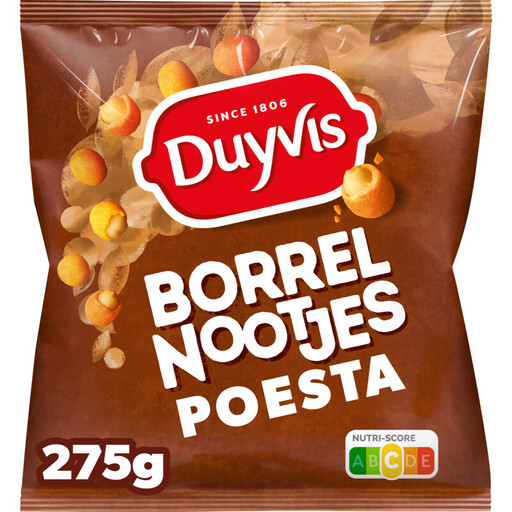
Duyvis Borrelnootjes Poeta 275 g

Duyvis Borrelnootjes Poeta 275 g

This pack is a good fit if you’re looking for Duyvis cocktail nuts and want to decide how much to serve yourself.

The product name specifies 275 g. The product description states that it contains 51% peanuts and lists milk, gluten and wheat, and celery. It also mentions possible traces of soya, mustard and other nuts.

View at Joybuy

Frequently asked questions

Is a pack with twenty portions the same as twenty individual bags?

No. The Duyvis Provençale 20-pack contains 45 g bags; the 500 g Jumbo Cocktail Borrelnoten lists twenty 25 g portions on the label in a single bulk pack.

Is 45 g a recommended amount for a school-age child?

No. 45 g is the contents of a Duyvis bag, not an established recommendation for children. The reference intake on the Jumbo product page is for an average adult and is not a guideline for children.

Are cocktail nuts suitable for young children?

The Duyvis, AH and PLUS product pages warn that young children may choke on peanuts and nuts. A small pack does not, by itself, mean the product is suitable for a young child.

Do allergens have to be listed on packaging in the Netherlands?

Yes. According to the Netherlands Food and Consumer Product Safety Authority, allergen information must appear on the label of prepacked foods. Since 1 January 2026, the NVWA has also been checking the rules on warnings about the unintentional presence of allergens due to cross-contamination. This does not mean a product is automatically allowed at school.

What should you do if allergen information is missing or contradictory?

Check the current packaging and contact the retailer if you have questions. The AH product information warns that ingredients and allergy information can change. The NVWA also provides a way to report missing allergen information at a shop or food business.
