What should you look for when choosing?
First decide which ingredient you need to avoid and check the exact variant. Then choose packaging that suits how you plan to take the snack with you.
| What to look for |
What should you check? |
Who is this important for? |
| Gluten in the coating |
Check for a gluten-free claim and the ingredients in the exact variant, including the coating. |
If I need to avoid gluten, I check all the product information for my lunch snack. Around 36% of consumers put avoiding gluten at the top of their list when shopping. |
| Specific allergen |
Look for the relevant allergen in the ingredients and read any relevant cross-contamination warnings too. |
When I need to avoid a specific allergen, I want to check both the ingredients and the warnings. Around 29% of consumers put allergen avoidance first. |
| Lactose or milk protein |
Distinguish between information about lactose and information about milk ingredients; these relate to different dietary concerns. |
If I limit lactose, I need different information than if I have a milk allergy. Around 14% of consumers put limiting lactose at the top of their list when shopping. |
| Packaging and storage |
Compare the pack size with the amount you want to take with you, and follow the storage instructions for that variant. |
If I’m taking a snack with me, I want to choose a practical amount to carry and store the rest properly. Around 21% of consumers put convenience on the go first. |
Cocktail nuts at Joybuy
This selection features standard cocktail nuts containing peanuts. Consider a variant only if peanuts and the listed ingredients are suitable for your diet.
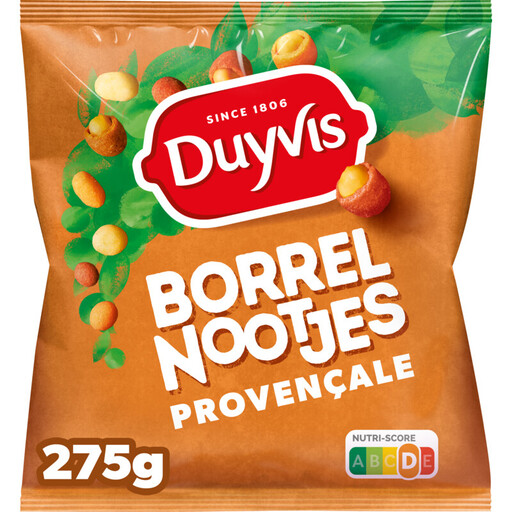 Image unavailable
Duyvis Provençal Cocktail Nuts 275 g
Only consider this snack if peanuts and wheat aren’t ingredients you need to avoid.
The product description mentions a crunchy coating with Provençal onion and garlic flavour.
Pack size: 275 g.
Contains peanuts and wheat; may contain milk, nuts, soya and mustard.
Store tightly closed after opening.
Joybuy
Frequently asked questions
Does lactose-free mean suitable for someone with a milk allergy?
No. Lactose intolerance affects the digestion of milk sugar, while a milk allergy is a reaction to milk proteins. So check the information relevant to your dietary concern; choosing a lactose-focused product doesn’t automatically answer questions about milk protein.
What do the Dutch cross-contamination warnings mean since 2026?
Since 1 January 2026, new rules have applied in the Netherlands to cross-contamination warnings, also known as PAL warnings. The NVWA lists the statements ‘May contain X’ and ‘Not suitable for people with an X allergy’. These warnings appear alongside information about allergens present as ingredients.
Is ‘gluten-free’ just a marketing term?
No. Implementing Regulation (EU) No 828/2014 sets requirements for claims such as ‘gluten-free’; the European Commission states that the regulation has applied since 20 July 2016. A gluten-free claim doesn’t automatically tell you whether other allergens are present.
Can I buy a different flavour from the same brand without checking the information again?
Check the information for every flavour and pack again. The Dutch Coeliac Society points out that cocktail nuts are usually not gluten-free, and Albert Heijn advises customers to read the packaging because product information can change.
Is a 45 g bag a recommended lunch portion?
No. The 45 g listed for a Duyvis Provençale pack is the pack size, not an established nutritional recommendation for portion size, nor proof that the snack replaces a complete lunch.


