
Mindful portion eaters
You want to enjoy cocktail nuts at a birthday party while keeping track of how much you actually eat. Both portion size and the nutritional value of the variety you choose matter.


If you want to eat fewer calories from cocktail nuts, compare the energy per 100 g of the exact varieties and weigh the amount you serve and eat. The Netherlands Nutrition Centre gives 133 kcal per 25 g as an example for the category; a smaller portion reduces your calculated energy intake, but doesn’t change the product’s energy content per 100 g. Choose a pack size to suit your gathering, and check allergens separately.
You want to enjoy cocktail nuts at a birthday party while keeping track of how much you actually eat. Both portion size and the nutritional value of the variety you choose matter.
You want to compare varieties by energy content, not by flavour name or a healthy-sounding image. Compare like-for-like weights, and check the exact variety and current recipe.
You’re buying for several guests and want to open suitable quantities, store leftovers and take allergens into account. Net weight and the information on the packaging can help you plan. The Netherlands Food and Consumer Product Safety Authority (NVWA) states that allergen information for prepacked products must appear on the label.
First compare the energy per 100 g of the exact variety, then decide on your portion and how much to buy. The Netherlands Nutrition Centre gives 133 kcal per 25 g of cocktail nuts as an example for the category, not as the value for every branded product.
| What to consider | What should you check? | Who is this more relevant to? |
|---|---|---|
| Calories per portion | Weigh your portion and use the kcal value on the pack you’ve chosen. To calculate calories using the value per 100 g, multiply that value by the weight eaten and divide by 100. | If I mainly want to know how much energy I’m eating during the party, I pay attention to both my portion and the label. Around 36% of consumers say the amount they eat is their first consideration. |
| Energy for the same weight | Compare the kcal per 100 g for the exact varieties; don’t confuse a value per portion with one per 100 g. | If I’m looking for a variety with a lower energy content for the same amount of product, I compare the nutrition tables. Around 29% of consumers put this comparison first. |
| Allergens for guests | Check the ingredients and cross-contamination warnings on each pack you choose. Don’t rely on information for another flavour. | If a guest has a food allergy, I want to check the exact pack before serving anything. Around 21% of consumers start by considering whether a product is suitable for guests with an allergy. |
| Packaging and leftovers | Choose a net weight that suits how much you want to open, and follow the storage advice on the pack. | If I’m buying for several guests, I want to plan practically for how much to open and any leftovers. Around 14% of consumers look at this first. |
Eating fewer grams reduces the calculated energy in that portion, but doesn’t change the nutritional value per 100 g.
Keep portion size and energy content separate. When choosing a product, compare values on the same weight basis.
The Netherlands Nutrition Centre gives 164 kcal per 25 g for unsalted nuts and 133 kcal per 25 g for cocktail nuts. These are examples for two product categories, not values for every individual product. Less salt and fewer calories are two different comparisons.
Check calories and salt separately on the packaging of the products you’re considering.
A 125 g pack contains several 25 g portions; pack size and portion size aren’t the same thing.
Weigh the amount you’re serving and choose a pack size based on how much you want to keep in stock.
A pack may contain more than you want to open for the portions you’ve planned.
Ingredients and warnings can differ between products or flavours. Product information can also change.
If you’re serving guests with a food allergy, check the ingredients and warnings on every pack you choose.
The brand, flavour name and pack size don’t tell you how many kcal a product contains per 100 g. For that, check the current nutrition table for the exact variety.
Duyvis lists Cocktail cocktail nuts in a range of pack sizes.
AH offers Provençale cocktail nuts, among other varieties; the variety and storage advice are worth considering when you choose.
Jumbo lists cocktail nuts in 300 g and 500 g packs.
Lidl lists a product in the cocktail nuts category.
The ALDI product page lists TRADER JOE’S cocktail nuts in bacon and cheese, poesta or paprika flavours.
PLUS lists Borrelnoten Mild, among other products, in a 300 g bag.
These product picks are Duyvis cocktail nuts in 275 g packs. The stated pack size helps you plan how much to buy, but doesn’t determine how many kcal you eat per 100 g or per portion.
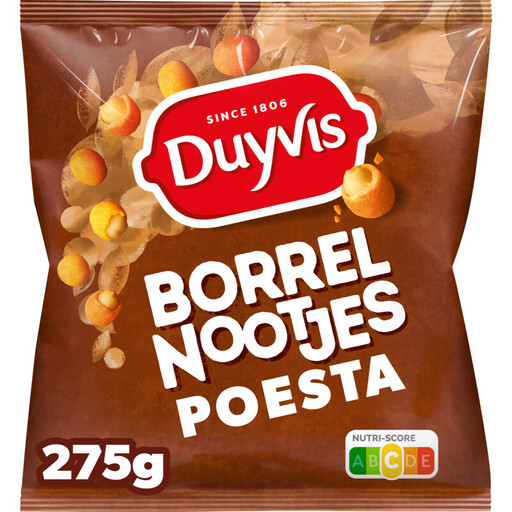 No image available
The product title identifies these as cocktail nuts; the pack contains 275 g.
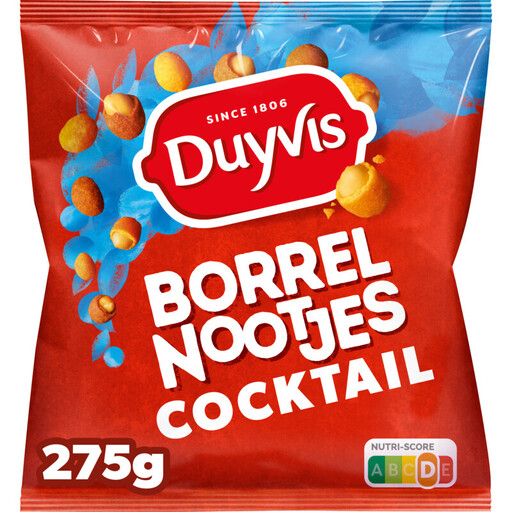 No image available
The product description says these cocktail nuts are made for sharing and gives a portion size of 30 g.
The description lists around 9–10 portions per pack. It lists peanuts, milk and cereals containing gluten; the product may contain traces of nuts, soya and mustard.
Multiply the kcal per 100 g by the weight eaten in grams, then divide the result by 100. Use the nutritional value on the exact pack. The Netherlands Nutrition Centre gives 133 kcal per 25 g as an example for cocktail nuts; this isn’t a universal value for every brand.
No, the word ‘unsalted’ doesn’t tell you that. The Netherlands Nutrition Centre gives 164 kcal per 25 g for unsalted nuts and 133 kcal per 25 g for cocktail nuts. These are examples for product categories, not values for every individual product; salt and calories are separate properties.
Follow the advice on the packaging for the variety you’ve chosen. For AH Provençale, Albert Heijn advises storing the product in a sealed tin after opening. Don’t automatically apply this advice to other products.
Check both the ingredients and cross-contamination warnings on the exact pack. According to the NVWA, allergen information for prepacked products must appear on the label. Potential allergens vary from product to product.
No, the pack size only tells you how much product it contains. A smaller portion means eating less product, but it doesn’t change the energy content per 100 g. According to the European Commission and the NVWA, a nutrition claim must meet the conditions that apply to that claim.