
Calorie-conscious afternoon snackers
You’re looking for a savoury snack and want to know how much energy your portion provides. Compare the same portion size, and don’t mistake a relatively lower figure for a ‘low calorie’ claim.


If you want to keep enjoying coated peanuts while keeping an eye on your energy intake, compare the stated kcal per 100 g, then decide on a portion size that works for you. The four variants checked provide 527–542 kcal per 100 g, so they are not low in calories. At 25 g, the difference between the lowest and highest value is 3.75 kcal. Portion size, flavour, salt and allergens are therefore important factors to consider too.
You’re looking for a savoury snack and want to know how much energy your portion provides. Compare the same portion size, and don’t mistake a relatively lower figure for a ‘low calorie’ claim.
You want to enjoy the coated peanut and a flavour you like, while also keeping an eye on portion size and pack contents.
As well as energy, you compare salt, ingredients and any allergens. This information can vary between products, even within the same brand.
First decide what matters most to you. Then compare products on the same basis and check the label on the exact pack you’re buying.
| What to consider | What should you look for? | Who might find this important? |
|---|---|---|
| Energy per portion | Compare kcal per 100 g, then weigh your portion. You can work it out using: kcal per 100 g × portion weight in grams ÷ 100. | If I want to know how much energy my afternoon snack provides, I look at the amount I’ve weighed out. Around 42% of consumers prioritise energy per portion. |
| Flavour and crunchy coating | Check the exact flavour variety; a different flavour doesn’t automatically mean fewer calories. | If I want to keep the flavour and crunchy coating of my favourite coated peanuts, I choose accordingly and adjust the amount if needed. Around 25% of consumers prioritise keeping the same flavour. |
| Salt and allergens | Compare salt per 100 g and read the ingredients and allergen information for the variety. | If I need to consider salt or manage my allergies, I check the pack for that exact variety. Around 17% of consumers prioritise label requirements. |
| Packaging and storage | Check the number of portions, the portion size and the storage instructions after opening. | If I want to use the bag for several afternoon snacks, I look at how easy it is to portion and store the rest properly. Around 16% of consumers consider practical portioning the most important factor. |
The four variants checked contain 527–542 kcal per 100 g. For solid foods, the European Commission sets a maximum of 40 kcal (170 kJ) per 100 g for the ‘low energy’ claim.
Compare the stated values on the same basis, and don’t describe a variety as ‘low calorie’ if it doesn’t meet that limit.
Albert Heijn and Jumbo list portions of 25 g; for Duyvis Borrelnootjes Provencale 125 g, the average portion is 30 g. So a difference between the values per labelled portion may simply be down to the amount.
Convert the values to the same weight before comparing varieties, then decide how many grams you’ll have.
According to the product information, a 125 g pack of Duyvis Borrelnootjes Provencale contains four to five average portions of 30 g. Albert Heijn and Jumbo list twelve portions of 25 g for their 300 g packs.
Check the pack size and number of portions on the label, then serve the amount you want to eat into a bowl beforehand.
Of the four variants checked, the one with the lowest stated energy doesn’t also have the lowest salt content. Allergen information also varies by product.
Compare salt on the same basis and read the current ingredients and allergen information for the exact variety you’re buying.
There are several flavours to choose from. The 125 g Provencale pack checked is an option if you’re looking for an onion and garlic flavour.
AH Borrelnoten cocktail 300 g is a variety for which you can use the stated 25 g portions as a guide.
Jumbo Borrelnoten Cocktail 300 g lists nutritional values per 100 g and per 25 g portion.
PLUS Borrelnoten Shanghai 300 g has an onion and garlic flavour. Compare salt and ingredients as well as energy.
Lidl stocks coated peanuts. Assess a specific pack using the nutritional information on its label.
ALDI lists 300 g bags of coated peanuts in oriental, provençale and cocktail flavours.
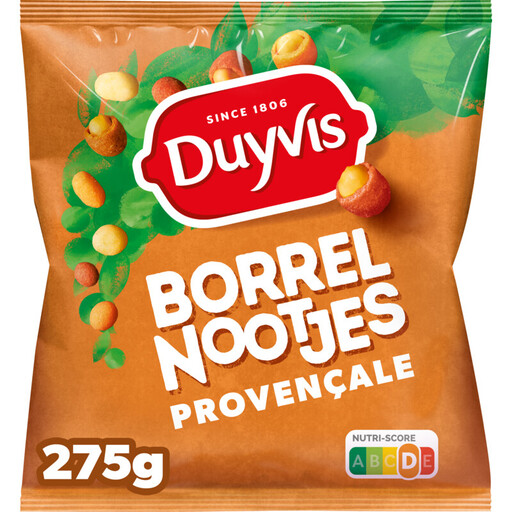
This Joybuy selection is a good fit if you’re looking for coated peanuts with a Provençal flavour. Check the nutritional values on the pack if energy per portion matters to you.
 No image available
An option if you’re looking for coated peanuts in a Provençal variety; check the portion size and nutritional values on the pack.
Pack size: 275 g.
For solid foods, the European Commission sets a maximum of 40 kcal (170 kJ) per 100 g for the ‘low energy’ claim. None of the four variants checked meets this limit.
Use the kcal per 100 g for the exact variety and calculate the value for the same portion weight. At 25 g, the four variants checked provide a calculated 131.75–135.5 kcal; the per-100 g values come from Jumbo, PLUS and Albert Heijn.
Follow the instructions on the pack. Albert Heijn advises sealing the pack well and storing it in a cool, dark, dry place; for Duyvis Borrelnootjes Provencale, an airtight, light-proof container is recommended after opening.
Read the current allergen information for the exact variety and note the difference between ‘contains’ and ‘may contain’. The four variants checked list peanuts and wheat; AH Cocktail lists milk as an allergen it contains, while Duyvis Provencale lists milk under ‘may contain’. The Netherlands Food and Consumer Product Safety Authority says allergen information must appear on the label of prepacked foods.
Not necessarily. The 125 g pack of Duyvis Borrelnootjes Provencale lists four to five average portions of 30 g. Check the number of portions and weigh out the amount you want to eat.