Compare coated peanuts by their total fat and energy per 100 g, then calculate the figures for the amount you plan to eat. The claim ‘low fat’ doesn’t simply mean relatively less fat: according to the European Commission, solid foods must contain no more than 3 g of fat per 100 g to qualify. Weighing out a portion changes how much you eat, not the product’s composition.
Who is this choice relevant to?
Shoppers looking for lower-fat options
You want coated peanuts with less total fat, and you want to know whether a label makes an absolute claim or simply shows a relative difference. For solid foods, the European Commission sets a maximum of 3 g of fat per 100 g for the claim ‘low fat’.
TV snackers mindful of portion sizes
You want to decide for yourself how much you eat while watching TV. So you compare the nutrition information per 100 g and take the weight of your own bowl into account. The Netherlands Nutrition Centre uses 25 g as a reference portion for average coated peanuts; this is not personal dietary advice.
Flavour-focused shoppers looking for smaller packs
You’re looking for a seasoned snack in a pack that suits eating alone or sharing. A small pack doesn’t, by itself, tell you anything about the fat content or nutritional values.
What should you look for when choosing?
When choosing coated peanuts for a lighter TV night, it helps to decide what matters most to you: ingredients, how much you eat, salt or convenient packaging.
| What to consider |
What should you check? |
Who is this most important to? |
| Total fat |
Compare fat per 100 g and check what any claim is based on. |
If I mainly want less total fat, I check the nutrition table and the precise wording of the claim. Around 36% of consumers prioritise total fat. |
| Energy in your portion |
Compare kcal per 100 g and calculate the amount for the weight you eat. |
I want to know how much energy is in my own bowl, not just in 100 g. Around 29% of consumers prioritise energy per amount eaten. |
| Salt |
Compare salt per 100 g and calculate the amount in your portion too. |
If I want to take salt into account separately, I compare that figure alongside fat and energy. Around 21% of consumers prioritise salt. |
| Packaging convenience |
Check the net weight, the flavour you want and the storage instructions once opened. |
Whether I’m spending the evening alone or with others, I want a pack that suits the amount I plan to eat. Around 14% of consumers prioritise packaging convenience. |
Common buying mistakes
-
Assuming a relatively lower fat content means ‘low fat’
A product can contain less fat than another product and still exceed the limit for the ‘low fat’ claim. For solid foods, the European Commission sets a maximum of 3 g of fat per 100 g.
Check the nutrition table per 100 g and assess any claim against that limit, not just by comparing it with another flavour.
-
Automatically treating a small pack as one portion
Pack size and portion size are not the same. Duyvis lists 40 g and 200 g packs of Lay’s Patatje Joppie; the Netherlands Nutrition Centre uses 25 g as a reference portion for average coated peanuts.
Decide in advance how much you want to eat, then calculate the nutritional values using those of the product you’ve chosen. The Netherlands Nutrition Centre’s reference portion is not personal advice.
-
Prioritising a dietary preference over checking for allergens
A lower fat content doesn’t change the ingredients or the allergens present. Coated peanuts are made with peanuts, which matters if you have a peanut allergy.
Check the ingredients list and allergen warnings for the exact flavour and pack. If you have a peanut allergy, don’t choose a product made with peanuts.
Brands to consider
Duyvis
The range includes various flavours of coated peanuts, including Cocktail, Provencale, Poesta and Oriental.
- Duyvis lists 40 g and 200 g packs of Lay’s Patatje Joppie.
- Descriptions of flavour and crunch are product descriptions, not independent taste assessments or evidence of a lower fat content.
Albert Heijn
Albert Heijn’s range includes AH Borrelnoten cocktail, a supermarket own-brand option.
- The product page clearly identifies the own-brand option.
- Albert Heijn advises checking the current pack, as ingredients and nutritional information can change.
Jumbo
Jumbo Borrelnoten Cocktail is an own-brand product featuring a crispy dough coating around the peanuts.
- The product description identifies the product type and gives storage advice.
- The product description alone doesn’t substantiate a nutritional claim about fat.
PLUS
PLUS lists products including Borrelnoten Mild and Borrelnoten Oriëntaalse stijl.
- The product pages distinguish between the varieties and provide storage instructions.
- The Nutri-Scores shown are no substitute for comparing the fat content per 100 g.
Lidl
Lidl has a Dutch product page for coated peanuts.
- The product category is easy to identify on the Dutch page.
- A product title or category name alone doesn’t show that a variety contains less fat.
Aldi
Aldi Netherlands lists coated peanuts from the TRADER JOE’S product range, including bacon-cheese, poesta and paprika.
- The range information distinguishes between flavours and lists a pack size of 300 g.
- This refers to the product range listed by Aldi Netherlands, not the range of the American supermarket Trader Joe’s.
Joybuy products for portioning in advance
These are regular coated peanuts to weigh out yourself; their inclusion here doesn’t mean they meet the ‘low fat’ claim.
 No image available
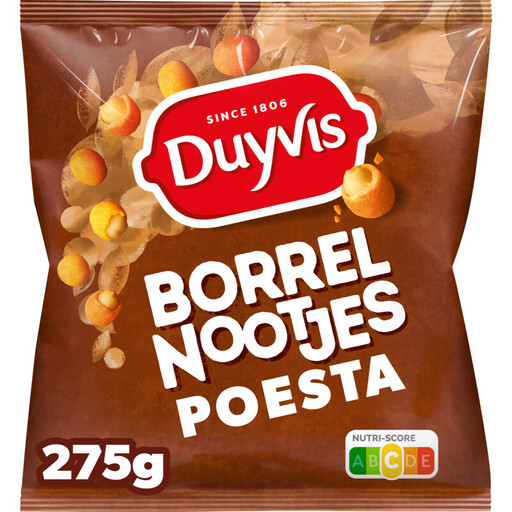
Duyvis Borrelnootjes Poeta, 275 g
An option if you want to weigh out regular coated peanuts for a TV snack bowl.
Pack size: 275 g. Contains peanuts; not suitable for people with a peanut allergy.
View at Joybuy
 No image available
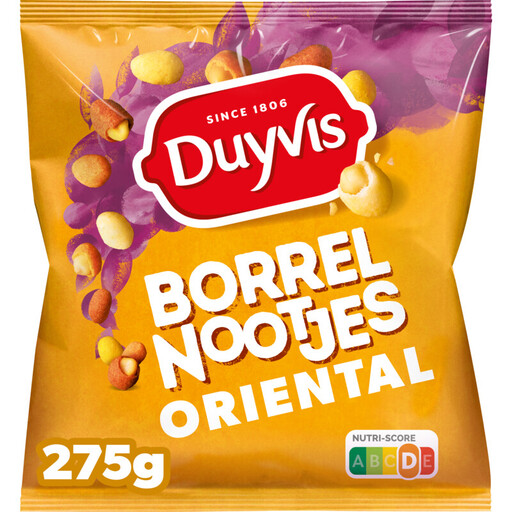
Duyvis Oriental Borrelnootjes, 275 g
This flavour could suit you if you want to weigh out seasoned coated peanuts for a TV night.
Pack size: 275 g. The product description mentions a mild curry flavour. Contains peanuts.
View at Joybuy
 No image available
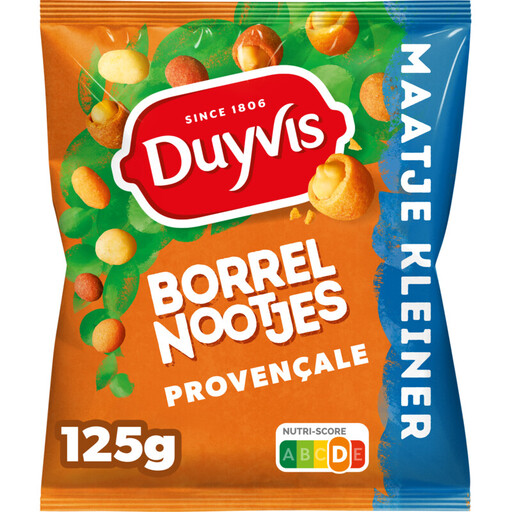
Duyvis Bran Nuts Provencale, 125 g
The smaller pack could be handy if you want to keep a limited amount in stock and weigh out your own portion.
The product information lists 30 g portions and 4–5 portions per pack. Per 100 g, the nutrition table lists 33 g of fat and 527 kcal. This means the product does not meet the European Commission’s limit of no more than 3 g of fat per 100 g for the ‘low fat’ claim.
Contains peanuts.
View at Joybuy
 No image available
Duyvis Coated Peanuts Provençal, 275 g
A regular variety to weigh out yourself if you want to compare its nutritional values with those of other flavours.
Pack size: 275 g. Per 100 g, the nutrition table lists 35 g of fat. That’s above the European Commission’s limit of no more than 3 g of fat per 100 g for the ‘low fat’ claim.
Contains peanuts.
View at Joybuy
 No image available
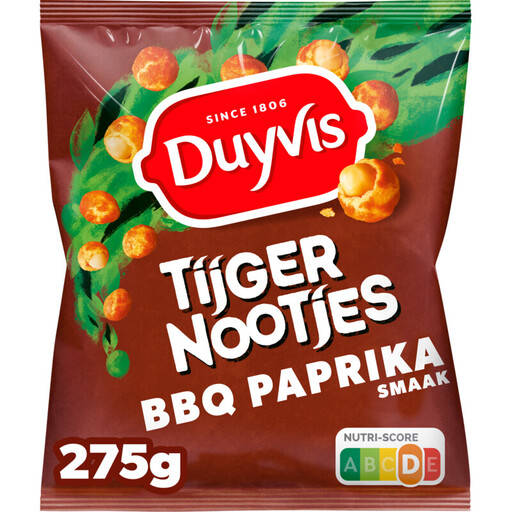
Duyvis Tigernut BBQ Paprika, 275 g
This flavour is an option if you’re after a seasoned snack and want to choose the amount yourself.
Pack size: 275 g. The product description mentions a double coating. Contains peanuts.
View at Joybuy
Frequently asked questions
Does ‘low fat’ mean the same as slightly less fat?
No. For solid foods, the European Commission sets a maximum of 3 g of fat per 100 g for the ‘low fat’ claim. A relative difference between two products doesn’t prove that either product meets this limit.
How do I calculate the nutritional values for my own bowl?
Multiply the value per 100 g by the weight of your bowl in grams, then divide by 100. Use the figures for the product you’ve chosen; the Netherlands Nutrition Centre’s 25 g reference portion is an average for this product category.
How should I store an opened bag of coated peanuts?
Follow the storage instructions on the pack. For Duyvis Borrelnootjes Provencale, Albert Heijn recommends storing an opened bag in a light- and airtight container. Jumbo Cocktail and the PLUS varieties mentioned advise storing in a cool, dry and dark place.
What should I check if I have a food allergy?
Check the ingredients list and allergen warnings for the exact flavour and pack. The NVWA explains that the 14 allergens specified by law must be listed on the label. If you have a peanut allergy, don’t choose peanut-based coated peanuts, regardless of their fat content.


