If you want to reduce your fat intake by choosing a different product, compare the fat content per 100 g and check what any reduced-fat claim is based on. If your main aim is to limit the amount of your lunch snack, measure out a portion; a smaller portion does not change the product’s composition. Baking in an oven or stating ‘no added fat’ does not, by itself, prove that a product is low in total fat.
Who might find this choice relevant?
If you compare fat content
If you want to have coated peanuts with lunch and are mainly looking for less fat in the same quantity, compare the fat content per 100 g. A reduced-fat claim, a ‘low fat’ claim and a description of how the product is prepared do not mean the same thing.
If you want to measure your lunch portion
If you want to take or serve a set amount, check the portion weight and divide up the snack yourself. The number of portions on the pack is a guide for working out quantities, not necessarily the amount you’ll eat.
If you need to consider a dietary requirement
If peanuts, wheat or milk matter to your choice, check the ingredients and allergen information for the exact flavour. For loose portions from a canteen, ask for the relevant information before buying.
What should you look for when buying?
First decide whether you want to compare the product’s composition or mainly control your portion size. Then check the nutritional information and allergen details for the exact variety.
| What to consider |
What to look for |
Who should consider this? |
| Fat content and claims |
Compare fat per 100 g and check what a claim is being compared with. ‘No added fat’ does not tell you how much total fat the product contains. |
If your main aim is to have less fat in the same quantity of coated peanuts, look at the product’s composition rather than just how it is prepared. Consumers whose top priority is reducing the product’s fat content are estimated to make up around 40%. |
| Amount per lunch |
Weigh your chosen portion and convert the values per 100 g to match that amount. A portion suggestion on the pack is not personal advice. |
If you want to take regular coated peanuts with you but limit how much you have at lunch, measuring out a portion in advance can help. Consumers who prioritise portion control are estimated to make up around 30%. |
| Dietary suitability |
Check the ingredients, allergens and warnings for the exact flavour. For unpackaged portions, ask for the information before buying. |
If a dietary requirement determines your choice, the information must match that exact variety; a flavour name or dietary label does not replace allergen information. Consumers who prioritise dietary suitability are estimated to make up around 20%. |
| Packaging and storage |
Check the net weight, the number of portions stated, whether the pack can be resealed and the storage instructions after opening. |
If you want to spread a bag over several lunches, think about how you’ll seal and store the rest. Consumers whose top priority is convenient packaging are estimated to make up around 10%. |
The percentages are scenario-based estimates of primary buying priorities, not measured student or market shares.
Common pitfalls
-
Assuming ‘no added fat’ means low total fat
The preparation description does not tell you how much fat is naturally present in the peanuts. Duyvis describes Oven Baked Peanuts Original as being made without added oil or fat; that does not prove that its total fat content is low.
Compare the total fat per 100 g on the latest product information, and consider how much you eat too.
-
Reading a reduced-fat claim as ‘low fat’ or as meaning less salt and energy
The historical Duyvis Oven Roasted Herbs&Onion pack stated 21 g fat, 476 kcal and 2 g salt per 100 g. Albert Heijn lists this variety as discontinued, so those figures do not represent a current buying option.
Compare fat, energy and salt separately, using the same weight basis. The European Commission sets a maximum of 3 g fat per 100 g for a ‘low fat’ claim on solid foods; a comparative reduced-fat claim is not the same thing.
-
Treating a multi-portion bag as one lunch portion
The number of portions on a bag describes a suggested amount for working out quantities. If you only want some of a multi-portion bag with lunch, you’ll need to divide it up yourself.
Pour out your chosen amount before eating, then reseal the pack according to the label.
A multi-portion bag needs to be divided up after opening and stored between lunches.
-
Using a dietary label instead of checking allergen information
A vegan label does not mean a product is free from peanuts or wheat. Allergens can vary between flavours and packs.
Check the information for the exact variety. For loose portions from a canteen, ask for allergen information before buying; the NVWA explains that this must be available for unpackaged foods before purchase.
Brands and product ranges for reference
Duyvis
Duyvis sells both coated peanuts and separate peanut product ranges. Keep the product type distinct from the preparation claim.
- The historical Herbs&Onion coated peanuts carried a specific 30% less fat claim.
- Albert Heijn lists that historical variety as discontinued. Duyvis describes the current Oven Baked Peanuts Original as made without added oil or fat; this is not an independent measurement of total fat.
Albert Heijn
AH Borrelnoten cocktail is a standard own-brand variety with portion information and resealable packaging.
- Albert Heijn states a portion size of 25 g and 10 portions in the 250 g pack.
- The nutritional information and allergens listed apply to this specific variety, not to all coated peanuts.
Jumbo
Jumbo Borrelnoten Cocktail is a standard variety with nutritional information per 100 g and per portion.
- Jumbo states 32.7 g fat per 100 g and 12 portions in the 300 g pack.
- The portion table helps you work out quantities, but it is not a reduced-fat claim.
Lidl
Lidl lists coated peanuts in several varieties; the Dutch product page describes a 300 g pack.
- The product page states that it is sold in store.
- The product information given does not support a specific reduced-fat positioning; check the current pack for its nutritional values.
ALDI
Under its Trader Joe’s product brand, ALDI lists oriental, provençale and cocktail coated peanuts in 300 g packs.
- The product page describes several flavours in the range.
- An ALDI test claim is not an independent test result or nutritional ranking. The information given does not support a reduced-fat claim.
PLUS
PLUS Borrelnoten Provençaals is a standard own-brand variety that the retailer describes as vegan.
- PLUS states 32.23 g fat and 1.563 g salt per 100 g.
- The variety also lists peanuts and wheat. A vegan label does not replace checking for allergens.
Coated peanuts at Joybuy
These Joybuy products are standard coated peanuts for anyone wanting a measured portion with lunch; the fat values shown do not support a reduced-fat claim.
 No image available
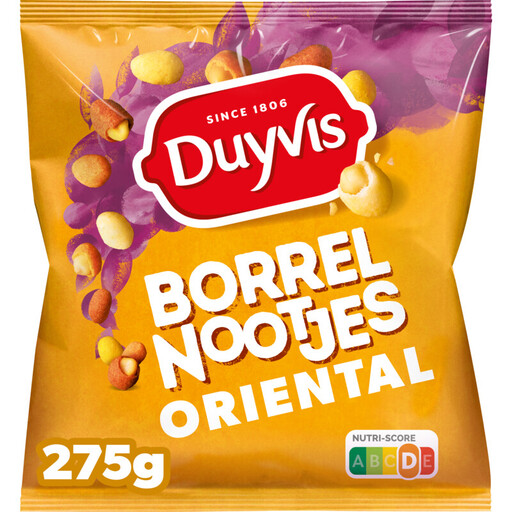
Duyvis Oriental Coated Peanuts, 275 g
A seasoned peanut snack with a crunchy coating, ideal for measuring out a portion of your choice.
Fat: 34 g per 100 g. This value does not support a comparative reduced-fat claim.
View at Joybuy
 No image available
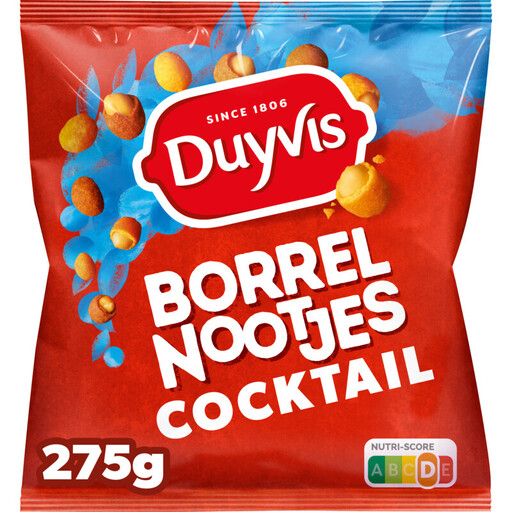
Duyvis Cocktail Nuts, 275 g
A crunchy-coated peanut snack; the product description gives a portion size of 30 g.
Fat: 34 g per 100 g. This value does not support a comparative reduced-fat claim.
View at Joybuy
 No image available
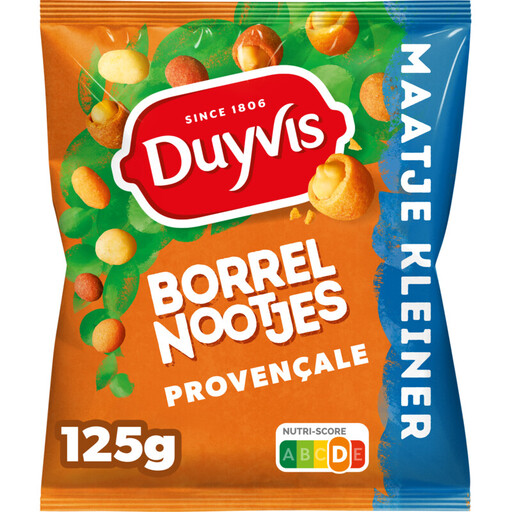
Duyvis Bran Nuts Provençale, 125 g
A crunchy-coated peanut snack with a Provençal flavour; the product description gives a portion size of 30 g.
Fat: 33 g per 100 g. This value does not support a comparative reduced-fat claim.
View at Joybuy
 No image available
Duyvis Coated Peanuts Provençal, 275 g
A crunchy peanut snack that, according to the product description, can also be served as a side dish.
Fat: 35 g per 100 g. This value does not support a comparative reduced-fat claim.
View at Joybuy
 No image available
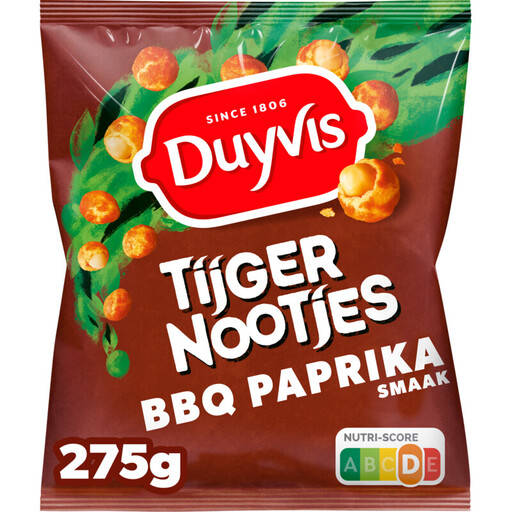
Duyvis Tigernut BBQ Paprika, 275 g
A seasoned coated peanut snack, described as suitable for sharing or enjoying on your own.
Fat: 33 g per 100 g. This value does not support a comparative reduced-fat claim.
View at Joybuy
Frequently asked questions
Does ‘low fat’ mean the same as ‘reduced fat’?
No. For solid foods, the European Commission sets a maximum of 3 g fat per 100 g for a ‘low fat’ claim. A comparative reduced-fat claim refers to a reduction against a comparison product and is not synonymous with ‘low fat’.
Is 25 g always the right portion for my lunch?
No. 25 g is the portion basis used on some product pages, not personal advice about what to have for lunch. Use the table on the exact pack to work out the nutritional values for the amount you choose.
What must a canteen tell you if it sells coated peanuts loose?
The seller must provide information about any allergens before purchase. The NVWA explains that this information must be directly available for unpackaged foods; ask for it before you buy.
Can I choose any flavour from the same brand if I’m avoiding milk or wheat?
No. Check the ingredients and allergens for the exact flavour. AH Borrelnoten cocktail lists milk and wheat; other varieties have their own ingredients and warnings. For loose portions, ask for the details of the product actually being offered.
How should I store an opened bag for another lunch?
Follow the storage instructions on the pack you choose. For AH Borrelnoten cocktail, the advice is to store it in a cool, dark and dry place and close the pack securely after use; Jumbo Borrelnoten Cocktail should be stored in a cool, dry and dark place.


