
Shoppers who pay attention to portion size
You want to serve a weighed-out portion of coated peanuts after school and distinguish between fewer calories per portion and a product that genuinely meets the criteria for a low-calorie claim.


A small portion of coated peanuts isn’t automatically low in calories. Compare the exact varieties per 100 g, then calculate the values for the portion you’ve weighed out. The fairest way to identify the variety with the lowest energy content is to compare nutritional information on the same basis. For an everyday snack, the Netherlands Nutrition Centre also suggests vegetables, fruit, unsalted nuts or wholemeal bread. Bear allergens and your child’s age in mind, too.
You want to serve a weighed-out portion of coated peanuts after school and distinguish between fewer calories per portion and a product that genuinely meets the criteria for a low-calorie claim.
You want to consider nutritional quality when choosing something for after school, rather than looking only at the calorie count or a product claim.
Your choice may depend on a peanut allergy, other allergens or young children sharing the snack. The Netherlands Nutrition Centre advises against whole nuts and peanuts for children under 4 because of the risk of choking.
Choose this when: you specifically want a seasoned, crunchy snack and peanuts are suitable given any allergy requirements and the rules at the place where they’ll be eaten.
Bear in mind: a smaller portion doesn’t change the product’s composition or its eligibility for a claim. The Netherlands Nutrition Centre gives 133 kcal per 25 g as an example for this product category, not as a recommended portion for children.
Choose this when: the nutritional quality of an everyday snack matters more than the particular flavour and texture of coated peanuts. The Netherlands Nutrition Centre suggests vegetables, fruit, unsalted nuts and wholemeal bread, among other options.
Bear in mind: an alternative won’t offer the same seasoned, crunchy snacking experience. Whole nuts are also unsuitable for children under 4.
Compare varieties on the same weight basis, and check the packaging, ingredients and where the snack will be eaten.
| What to consider | What to look for | Who might this matter more to? |
|---|---|---|
| Energy per portion | Compare kcal per 100 g and calculate the value for the actual weight you’ve measured out; use the nutritional information for the exact variety. | If I want to give a smaller amount after school, I want to know how much energy that portion contains. Around 39% of consumers prioritise the energy content of a portion. |
| Everyday food choices | As well as energy, check salt and ingredients, and distinguish between a snack and an everyday option. | When I’m looking for something for every school day, I want to consider nutritional quality more broadly than just kcal. Around 23% of consumers prioritise this everyday consideration. |
| Allergens and age | Check the allergen information on the packaging and the rules at the school or childcare setting; peanuts and tree nuts are separate allergen categories. | If allergens, young children or rules at a particular location are a factor, suitability must come before flavour and calories. Around 23% of consumers prioritise suitability and safety. |
| Portioning and storage | Check the net weight and the storage and use-by instructions; the contents of a bag aren’t a recommended portion. | For anyone who wants to portion snacks in advance and store them, practicality is the key consideration. Around 15% of consumers prioritise this. |
A smaller amount contains less energy than a larger amount of the same product, but that doesn’t make the product itself low in calories.
Compare the nutritional information for the exact variety per 100 g, then use the amount you actually weigh out to work out the value for your portion.
Duyvis says its Borrelnootjes Provencale are made without artificial colourings. That alone says nothing about their energy content. The Netherlands Nutrition Centre points out that a nutrition claim doesn’t automatically make a product healthy.
Consider energy, salt and ingredients alongside individual claims, and think about how often you plan to serve the snack.
Peanuts and tree nuts are separate allergen categories. A peanut allergy can cause severe reactions.
Check the allergen information on the packaging. If you’re taking the snack to school or childcare, ask about the rules at that specific setting.
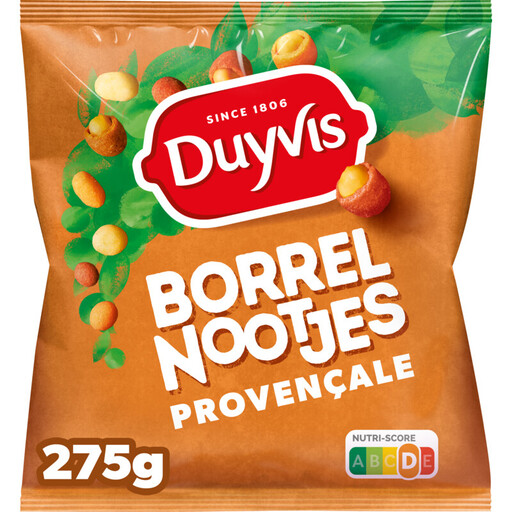
Duyvis describes its Borrelnootjes Provencale as peanuts with a crunchy coating and onion and garlic flavour.
Albert Heijn lists AH Borrelnoten cocktail as one of its own-label products.
Jumbo describes Borrelnoten Cocktail 300 g as peanuts with a crunchy dough coating.
Lidl Netherlands lists coated peanuts as part of its range.
ALDI lists Trader Joe’s Borrelnoten in 300 g bags, in bacon and cheese, poesta or paprika flavours.
PLUS lists Borrelnoten Ham Kaas as an own-label variety in a 300 g bag.
The product featured below is Duyvis Borrelnootjes Provencale, for anyone specifically looking for a crunchy snack with onion and garlic flavour.
 No image available
For anyone specifically looking for peanuts with a crunchy coating and onion and garlic flavour; the stated energy content means this isn’t a low-calorie choice.
Contains 50% peanuts.
Stated energy: 542 kcal per 100 g. According to the European Commission, solid foods must contain no more than 40 kcal per 100 g to qualify for the ‘low energy’ claim.
Stated salt content: 1,3 g per 100 g.
Contains peanuts and wheat; may also contain milk, tree nuts, soya and mustard.
Keep the packaging closed after opening.
For solid foods, the European Commission sets a maximum of 40 kcal (170 kJ) per 100 g for the ‘low energy’ claim. This is a requirement for using the claim, not a recommended portion for a child. So a smaller portion of coated peanuts doesn’t automatically meet that requirement.
No. The Netherlands Nutrition Centre uses 25 g as an example quantity in general nutritional information for coated peanuts, not as a personal portion recommendation. According to the Netherlands Nutrition Centre, how much a child can eat between meals depends, among other things, on their age and sex.
The Netherlands Nutrition Centre advises against giving children under 4 whole nuts or peanuts because of the risk of choking. It suggests bread with nut butter that has no added sugar or salt as an alternative; be sure to take any allergies into account.
No. The Netherlands Food and Consumer Product Safety Authority (NVWA) lists peanuts and tree nuts as separate allergen categories. The Food Allergy Foundation explains that peanuts are legumes and that a peanut allergy can cause severe reactions. Always check the allergen information on the exact product packaging.
Follow the instructions on the packaging for the exact variety. Jumbo and PLUS advise storing their products in a cool, dry, dark place; the Joybuy product page for Duyvis Provencale 275 g advises keeping the packaging closed after opening.