
Organic comes first
You want a snack for the street festival with organic credentials you can verify. You’re open to unroasted nuts without a coating if the certification matters more to you than the classic coated-peanut crunch.


Choose according to what matters most to you: a verifiably organic snack, the crunchy coating on coated peanuts or a mix that also works at breakfast. Then check the packaging and allergen information; a claim such as ‘no artificial colourings’ is no substitute for organic certification.
You want a snack for the street festival with organic credentials you can verify. You’re open to unroasted nuts without a coating if the certification matters more to you than the classic coated-peanut crunch.
You’re looking for a suitable pack and want to check the ingredients and allergens before sharing or serving snacks. Selling food or offering it unpackaged at an event comes with additional information and hygiene requirements.
You want to use the same organic mix as a snack and with yoghurt or cereal. A date and nut mix suits both purposes, but it isn’t a savoury coated-peanut option.
First decide whether certification, a crunchy coating, allergens or using the product both as a snack and for breakfast matters most to you.
| What to consider | What to look for | Who is this important to? |
|---|---|---|
| Organic certification | Check the EU organic logo and inspection code on the exact product packaging. The European Commission states that the logo may only be used on certified products. | If I want to be able to verify that a product is organic, certification matters more than a general claim. Around 29% of consumers make certification their main requirement. |
| Allergens | Read which allergens are present and which may be present; check each flavour and pack separately. | If I’m sharing snacks, I want to know in advance which allergens may be involved. Around 24% of consumers put allergen information first. |
| Packaging and storage | Compare the net weight and follow the storage and resealing instructions on the packaging. Choose an amount that suits taking along and sharing. | For a festival, I want to take an amount that suits how I’ll serve and store the snacks. This is the top consideration for around 23% of consumers. |
| A snack and a breakfast option | Check the ingredients and see whether the mix works with yoghurt or cereal. Assess total and added sugars separately. | If I’m looking for one mix to enjoy as a snack and at breakfast, I consider its ingredients and how I’ll use it. Around 12% of consumers prioritise this dual use. |
| Cost and quantity | Compare prices on the same weight basis and check the net weight and any delivery charges. | I want to weigh up the cost against the amount I actually need. This is the main priority for around 12% of consumers. |
A claim such as ‘no artificial colourings’ doesn’t, by itself, tell you whether a product is organically certified.
Check the organic product description and certification details on the packaging. Assess any other claims separately.
Organic nut mixes may contain nuts and may also carry warnings about the possible presence of other allergens.
Read the label on the exact mix. If you sell unpackaged snacks, make sure allergen information is available before purchase.
Albert Heijn states that AH Biologisch Dadel & notenmix ongebrand contains an average of 0 g of added sugars, but 25 g of total sugars per 100 g.
If you’re using it for breakfast, check the full nutrition table and keep the two figures separate.
Once opened, the pack should be stored according to the instructions and sealed properly. If the quantity doesn’t suit your needs, you may need to portion it out and reseal it more often.
Choose an amount that suits your plans and follow the storage and resealing instructions on the packaging.
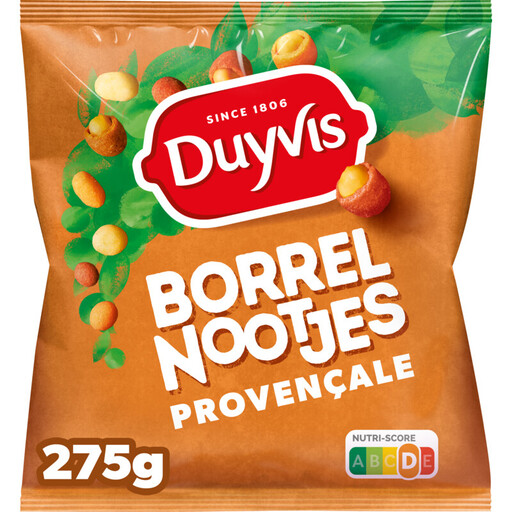
According to Duyvis, its Provencale range consists of peanuts with a crunchy coating and onion and garlic flavour.
Its organic product pages describe unroasted nuts, cashews, and a date and nut mix as separate alternatives to coated peanuts.
The coated peanut range described includes own-brand varieties such as Cocktail and Provençal, alongside Duyvis.
The organic range and the Duyvis coated-peanut listing appear as separate product listings.
The TRADER JOE'S Coated Peanuts listing describes 300 g bags in bacon and cheese, poesta or paprika flavours.
PLUS describes its Borrelnoten Ham Kaas variety as peanuts with a crunchy coating and bacon and cheese flavour.
This Joybuy selection is for crunchy, savoury coated peanuts, for anyone who doesn’t require organic certification.
 No image available
A good choice if you’re after peanuts with a crunchy coating and onion and garlic flavour; this is the classic coated-peanut option, not an organic one.
Pack size: 275 g.
Contains peanuts and wheat; may contain milk, nuts, soya and mustard.
No. Duyvis uses this claim for Provencale, but organic certification needs to be verified separately. The European Commission says that the EU organic logo may only be used on certified products; also check the inspection code and information about the origin of the agricultural raw materials.
If you sell food at a market or event, the NVWA requires you to prepare, sell and store it safely and hygienically. This doesn’t in itself give you general permission to have a stall: check the requirements for the specific event separately.
You must tell consumers about any allergens present before they buy. The NVWA says this information can be provided in writing or electronically. It can be given verbally under certain conditions: the information must be available immediately before purchase, also be available in writing or electronically to staff and inspectors, and clearly state that customers can ask for it.
Follow the instructions on the packaging of the specific mix. For AH Biologisch Notenmix ongebrand, Albert Heijn advises storing the mix in a cool, dark and dry place and resealing the pack properly after use. The date and nut mix has a limited shelf life once opened, so follow the instructions on the packaging.
Albert Heijn suggests using AH Biologisch Dadel & notenmix ongebrand with yoghurt and cereal. It’s a mix of fruit, seeds and almonds, not a savoury coated-peanut option. The claim of 0 g added sugars doesn’t mean the mix contains no total sugars.
No, don’t assume they are. On the organic nut pages reviewed, Albert Heijn warns that young children can choke on nuts. Bear this in mind if young children will be eating with you.