
Careful snack packers
You want to pack coated peanuts as an extra snack, so you compare the nutrition information per 100 g with the amount going into the lunchbox. The European Union explains that nutrition information is given per 100 g.


Start by comparing coated peanuts by kcal per 100 g, then calculate the amount based on the weight you’ll actually pack. A smaller pack doesn’t make the product itself low in calories. Duyvis Provençal 275 g lists 542 kcal per 100 g, above the European Commission’s threshold of 40 kcal per 100 g for a ‘low energy’ claim. The available information isn’t enough to identify the lowest-calorie option across all the brands mentioned.
You want to pack coated peanuts as an extra snack, so you compare the nutrition information per 100 g with the amount going into the lunchbox. The European Union explains that nutrition information is given per 100 g.
You’re looking for a suitable lunch for a growing secondary-school pupil. The Netherlands Nutrition Centre highlights variety and getting enough energy; choosing the lowest-calorie option isn’t the only consideration.
You need to take account of a peanut or tree nut allergy, or school rules. The Netherlands Food and Consumer Product Safety Authority treats peanuts and tree nuts as separate allergens, so check the exact product and its packaging.
When coated peanuts are an extra snack in a secondary-school lunch, the amount, allergens, the rest of the lunch and how easy they are to pack all matter in different ways.
| What to consider | What to look for | Who it matters most to |
|---|---|---|
| Energy per amount | Compare kcal per 100 g, then calculate based on the weight you’re packing. | If I want to weigh up the energy in an extra snack, I check the exact product and the portion I’m packing. Around 36% of consumers making this lunch choice prioritise energy per amount packed. |
| Allergens and school rules | Check the ingredients, allergens and warnings on the packaging. | If allergies or school rules are a factor, I want to know whether the specific product is suitable. Around 29% of consumers making this lunch choice prioritise allergens and relevant rules. |
| The whole lunch | Consider the snack alongside the rest of the lunch and the pupil’s needs. | I want the snack to fit into a varied lunch for a growing pupil, rather than replace it. Around 21% of consumers making this lunch choice prioritise the quality of the lunch. |
| Packing and storage | Check the pack weight, the amount you’ve chosen and the storage advice. | If I want to pack something convenient or store an opened bag, I check the packaging and product advice. Around 14% of consumers making this lunch choice prioritise ease of packing. |
A small pack contains less product, but that says nothing in itself about the energy per 100 g. HANOS lists Duyvis Provençal at 45 g and 542 kcal per 100 g; that makes the bag 243.9 kcal.
First compare the nutrition information per 100 g, then calculate based on the actual bag or portion weight. For solid food, the European Commission sets a maximum of 40 kcal (170 kJ) per 100 g for a ‘low energy’ claim.
Peanuts and tree nuts are separate allergens. The Duyvis Provençal descriptions checked list peanuts; the information for the 45 g bag also lists wheat and the possible presence of other allergens.
Check against the specific allergy and school requirements, and read the ingredients and warnings on the packaging. A different flavour doesn’t, by itself, mean a product is suitable.
The Netherlands Nutrition Centre describes a school meal in terms of foods from the Dutch Wheel of Five, and highlights variety and getting enough energy as important for teenagers.
Plan the lunch as a whole first, then decide whether an extra snack fits in.
Flavours, product varieties and packaging can differ. Nutrition information for another product therefore may not apply to the pack you want to send along.
Compare the exact product and packaging on the same weight basis, and check the nutrition information on the product itself.
Duyvis sells coated peanuts in a range of flavours and pack sizes.
The AH own-brand range includes Provençale and Oriental varieties.
Jumbo lists Borrelnoten Cocktail in a 300 g pack.
Lidl lists coated peanuts and presents Alesto as a range that includes nuts and party snacks.
ALDI lists Trader Joe’s Borrelnoten in oriental, provençale and cocktail flavours, in a 300 g pack.
PLUS lists products including Borrelnoten Ham Kaas and Borrelnoten Provençaals in 300 g bags.
These Joybuy products are coated peanuts, allowing you to compare nutrition information per 100 g and pack weights side by side.
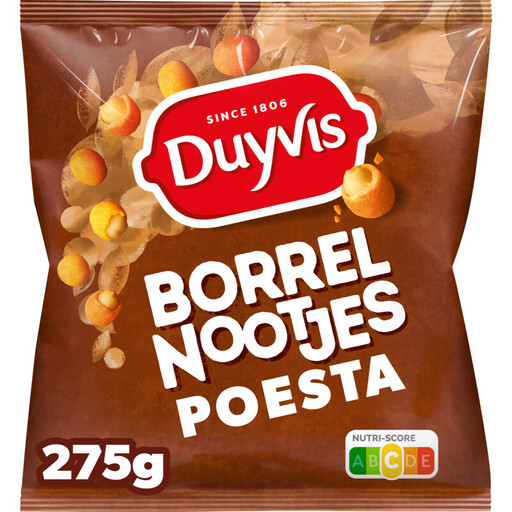 No image available
The listed nutrition information per 100 g lets you compare this product with others on the same weight basis.
539 kcal per 100 g. Contains peanuts, milk, wheat and celery; may contain traces of soya, mustard and other nuts.
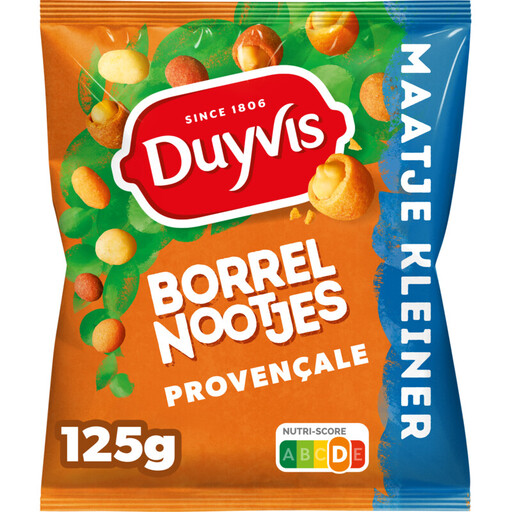 No image available
The listed nutrition and portion information can help you calculate the amount you’re packing separately.
527 kcal per 100 g; the product description gives a portion size of 30 g. Contains peanuts and wheat; may contain milk, nuts, soya and mustard.
 No image available
This product lists energy per 100 g, so you can compare it with other products on the same basis.
542 kcal and 15 g of protein per 100 g. Contains peanuts and wheat; may contain milk, nuts, soya and mustard.
No. According to the European Commission, solid food can carry a ‘low energy’ claim only if it contains no more than 40 kcal (170 kJ) per 100 g. A ‘reduced energy’ claim requires at least 30% less energy, along with details of the properties that account for the reduction. A smaller portion proves neither of these product claims.
Multiply the stated kcal per 100 g by the weight in grams you’re packing, then divide by 100. For Duyvis Provençal 275 g, 25 g at 542 kcal per 100 g works out at 135.5 kcal. This is a calculation example, not a recommended portion for every pupil.
No. The Netherlands Food and Consumer Product Safety Authority lists peanuts and tree nuts separately. Check for both if the pupil’s or school’s requirements call for it, and read the other ingredients and warnings on the pack you buy.
Follow the advice for the exact product. For AH Provençale, Albert Heijn advises storing it in a cool, dark and dry place and putting it in a sealed container once opened. This product advice isn’t a general shelf-life guarantee for all coated peanuts.
No, that isn’t the general advice from the Netherlands Nutrition Centre. Growing teenagers need a varied diet and enough energy; their needs depend on factors including growth and activity. If you’re concerned about weight or losing weight, speak to a youth health service rather than using this snack comparison to create a strict calorie plan.