
Quick packers
You want to put an individually wrapped packet straight into the lunchbox, without weighing one out every day. Check that these are genuine individual packets, rather than several serving sizes listed on the label for one larger pack.


Choose individually wrapped coated peanuts if you want to pack them without weighing them out; choose a larger pack if you want to decide how much to include. Before making your choice, check the school’s rules and the ingredients on the current label: a small packet does not change the allergens or safety requirements. The Netherlands Nutrition Centre advises filling lunchboxes mainly with foods from the Dutch Wheel of Five; treat coated peanuts as an extra, not a replacement for lunch.
You want to put an individually wrapped packet straight into the lunchbox, without weighing one out every day. Check that these are genuine individual packets, rather than several serving sizes listed on the label for one larger pack.
You want to decide how much to pack and don’t mind weighing and repacking it. A resealable larger pack could work well; the serving size on the label doesn’t have to match the amount you choose.
You check the school’s rules and the allergen information before considering convenience. An individual packet isn’t a suitable choice if its contents don’t meet the rules or requirements that apply to your child.
First check whether coated peanuts are allowed at school and meet its allergen requirements; then choose between individual packets and portioning them yourself.
Choose this if: you want to prepare several snacks in advance without weighing them out each time.
Bear in mind: the amount in each unopened packet is fixed, and the product may still contain ingredients that don’t meet the school’s rules.
Choose this if: you’re looking for a compact factory-sealed pack and the specific variety meets the requirements.
Bear in mind: 40 g is the pack size, not a recommended portion for a child.
Choose this if: you want to decide how much to pack and find a larger pack more practical.
Bear in mind: you’ll need to weigh and repack the snacks yourself, and store the opened pack according to the packaging instructions.
Choose this if: the school excludes peanuts or nuts, or an individual allergen requirement makes this snack unsuitable.
Bear in mind: you’ll need to leave this snack out and choose something that does meet the school’s rules.
| What to consider | What should you look for? | Who is this important for? |
|---|---|---|
| School rules and allergens | Ask about your child’s school rules and check the current label for peanuts, nuts and any other relevant allergens. | I want to know first whether the snack is allowed at school and whether its ingredients meet my child’s requirements. Around 29% of consumers prioritise school rules and allergens. |
| Genuinely individual packets | Check the number of physical packets and the weight of each one; a serving size on the label doesn’t automatically mean it’s individually wrapped. | When I want to put a lunch together quickly, I want to be able to pack a packet straight away. Around 29% of consumers mainly choose based on individual packaging and ease of packing. |
| How much to pack | Check the weight you actually want to pack and compare nutritional values on the same basis. | I want to decide how much of the snack to include and how it fits alongside the rest of the lunch. Around 24% of consumers put quantity and nutritional values first when choosing. |
| Storage and keeping the product fresh | Check whether the pack is resealable and follow the storage advice for the variety you choose. | With a larger pack, I want to know how to store the opened contents properly. Around 18% of consumers focus mainly on storage and the practical implications of the packaging. |
A smaller pack doesn’t change the ingredients. The Duyvis varieties checked contain peanuts, among other ingredients; ingredients and potential allergens vary by product.
Check the current label and ask about the school’s rules before choosing a pack format.
Albert Heijn lists AH Borrelnoten cocktail as a 250 g pack with ten 25 g servings. That doesn’t mean there are ten individual packets. Duyvis Borrelnootjes Provencale 20-pack, on the other hand, is listed as 20 x 45 g.
Check the number of physical packs separately from the number of servings shown on the label.
The packs checked show different serving sizes: 45 g for Duyvis Provencale 20-pack and 25 g for AH Borrelnoten cocktail. These product listings don’t determine how much your child needs.
Decide what role the snack will play in the lunchbox, then consider how much you want to pack.
Albert Heijn lists a Duyvis Provencale multipack with 20 packets of 45 g. The manufacturer also lists a 40 g variety of Patatje Joppie.
AH Borrelnoten cocktail comes in a resealable 250 g pack. Albert Heijn lists ten servings of 25 g and also sells the Duyvis multipack checked.
Jumbo Borrelnoten Cocktail is a 300 g multipack for storing at home; Jumbo says to keep the product in a cool, dry, dark place.
PLUS lists Borrelnoten Mild in a 300 g bag and describes the flavour as mild.
ALDI Netherlands lists TRADER JOE’S coated peanuts in a 300 g pack, with oriental, provençale or cocktail varieties.
The Dutch Lidl product page checked is for Duyvis Borrelnootjes in a 200 g pack.
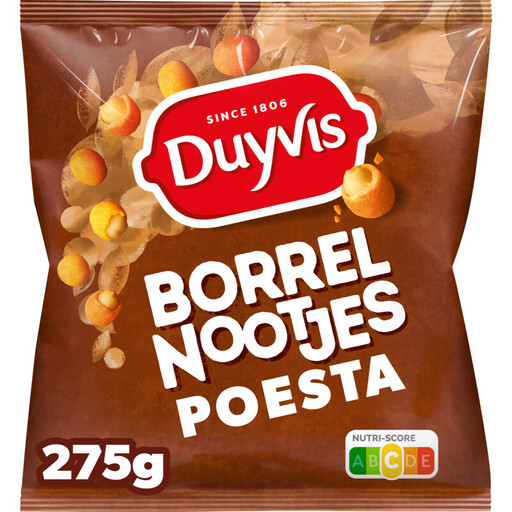
This Joybuy pick is aimed at anyone who wants to portion snacks from a larger pack.
 No image available
The 275 g pack lets you weigh out the amount you want for the lunchbox.
Contains peanuts, milk, wheat and celery; may contain traces of soya, mustard and other nuts. Check that it meets the school’s rules and any allergen requirements.
It depends on your child’s school rules. For example, OBS De Venen publishes a school-wide ban on eating peanuts and nuts; this is that school’s policy, not a nationwide ban. Check which rules apply at your child’s school.
The Netherlands Nutrition Centre advises against giving whole nuts or peanuts to children under 4 because of the risk of choking. Being 4 years old doesn’t in itself determine whether this is a suitable way for an individual child to eat them.
Check the product information for the number of physical packets and the weight of each one. For example, AH Borrelnoten cocktail is a single 250 g pack with ten listed servings; Duyvis Provencale 20-pack is listed as 20 individual packets of 45 g.
No. The serving size on the label describes that particular product and isn’t individual advice. The listings checked range from 25 g for AH Borrelnoten cocktail to 45 g for Duyvis Provencale 20-pack. The Netherlands Nutrition Centre advises filling lunchboxes mainly with foods from the Dutch Wheel of Five.
According to the Netherlands Food and Consumer Product Safety Authority, allergen information must appear on the label of prepacked foods; peanuts and nuts are separate allergen categories. Since 1 January 2026, the Netherlands has also had rules requiring substantiated warnings about unintended presence, using wording such as ‘May contain X’ and ‘Not suitable for people with an X allergy’. Labelling rules don’t mean a product is allowed at every school.