
Fat-conscious snackers
You want to keep eating coated peanuts, but first compare the grams of fat per 100 g, then calculate the amount for your own portion. The products checked call for mindful portion choices, not a low-fat label.


If you want to keep enjoying coated peanuts, choose based on the nutritional information for the exact variant and the portion you weigh out. A smaller portion reduces the amount of fat and energy you consume, but it doesn’t change the product’s composition. According to the European Commission, solid foods must contain no more than 3 g of fat per 100 g to carry a ‘low fat’ claim, and no more than 40 kcal per 100 g for a ‘low energy’ claim. The coated peanut variants reviewed are above these limits.
You want to keep eating coated peanuts, but first compare the grams of fat per 100 g, then calculate the amount for your own portion. The products checked call for mindful portion choices, not a low-fat label.
You want to know how much energy a weighed snack portion provides, without automatically assuming that a handful or small bag is low in calories.
You want to keep the seasoned, crunchy snack you enjoy and are looking for a suitable pack, a pre-set portion and a practical way to store the rest.
First compare the nutritional values per 100 g, then calculate them for the amount you actually want to eat.
| What to consider | What to look for | Who is this important for? |
|---|---|---|
| Total fat | Compare the grams of fat per 100 g and calculate the amount for the portion you weigh out. According to the European Commission, solid foods must contain no more than 3 g per 100 g to carry a ‘low fat’ claim. | When I choose coated peanuts, I want to know how much total fat my portion contains. Around 34% of consumers make total fat their top purchasing priority. |
| Energy per portion | Compare kcal per 100 g and calculate the amount for the same portion weight. For solid foods, the European Commission sets a limit of 40 kcal per 100 g for a ‘low energy’ claim. | I want to know how much energy my own snack moment contains, not just what’s listed per 100 g. Around 33% of consumers prioritise calories per snack occasion. |
| Portion and packaging | Check the net weight, portion information and storage instructions. A small pack isn’t automatically one portion. | I want packaging that’s easy to seal and an amount I can weigh out without any fuss. Around 20% of consumers prioritise portioning and packaging convenience. |
| Ingredients and allergens | Read the ingredients and allergen information for the exact flavour variant, including any warnings about possible presence. The Netherlands Food and Consumer Product Safety Authority (NVWA) states that allergen information for prepacked products must appear on the label. | If I have a relevant allergy, I check the ingredients for that exact flavour variant. Around 13% of consumers prioritise ingredients or allergens. |
Eating less reduces the amount of fat and energy in your snack, but product claims are assessed based on the composition per 100 g.
Calculate the label values for the amount you weigh out. Don’t treat a smaller portion as equivalent to a low-fat or low-calorie product.
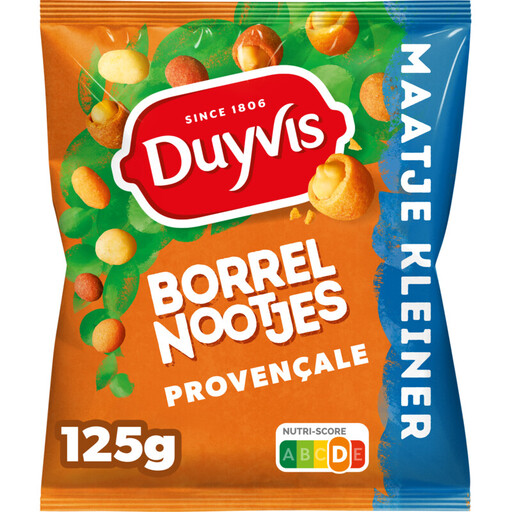
Pack weight and serving size are different things. Jumbo lists an average portion of 30 g for Duyvis Provencale 125 g.
Decide how much you want to eat beforehand and weigh it out; don’t use the net weight as a serving suggestion.
Products with the same flavour name in different pack sizes may have different nutritional values.
Use the nutrition table on the exact pack you’re buying. Don’t assume the composition is identical just because the brand and flavour match.
Duyvis describes Provencale as peanuts with a crunchy coating and onion and garlic flavour.
AH Borrelnoten cocktail is a supermarket own-brand variant in a 250 g pack.
Jumbo Borrelnoten Cocktail 300 g is described as peanuts with a crunchy dough coating.
Lidl lists coated peanuts as a supermarket option.
ALDI lists TRADER JOE’S coated peanuts in bacon and cheese, Puszta and paprika flavours, in 300 g bags.
PLUS Borrelnoten Mild is listed as an own-brand variant in a 300 g bag.
These product picks include Duyvis coated peanuts and unsalted peanuts as an alternative type of snack. Compare the nutritional values on the exact pack and weigh out your own portion.
 No image available
For anyone who wants to enjoy the Provencale flavour and weigh out their own portion.
Pack size: 125 g. The product information gives a 30 g portion; weigh out the amount that’s right for you.
 No image available
An alternative type of snack to consider if you’re looking for unsalted peanuts as well as coated peanuts.
Product: unsalted peanuts. Pack size: 250 g.
 No image available
For anyone who wants to keep the crunchy coating and Provencale flavour, while choosing how much to eat.
Pack size: 275 g. Use the nutritional values on the exact pack you buy for your calculations.
No. A small portion doesn’t support a product claim like that. According to the European Commission, solid foods must contain no more than 40 kcal per 100 g for a ‘low energy’ claim and no more than 3 g of fat per 100 g for a ‘low fat’ claim. The variants reviewed are above these limits.
Multiply the value per 100 g by the number of grams you weigh out, then divide by 100. Based on Jumbo’s product information, 20 g of Jumbo Borrelnoten Cocktail, which contains 527 kcal and 32.7 g of fat per 100 g, works out at 105.4 kcal and 6.54 g of fat. This is a calculation example, not a recommended diet portion.
Follow the instructions on the exact pack. Albert Heijn advises storing AH Borrelnoten cocktail in a cool, dark and dry place and closing the bag securely. For Duyvis Provencale 125 g, Jumbo recommends transferring the contents to a light- and airtight container after opening.
Check the up-to-date ingredients and allergen information for your flavour variant, including statements about possible presence. The Netherlands Food and Consumer Product Safety Authority (NVWA) states that allergen information for prepacked products must appear on the label. The variants reviewed list peanuts and wheat; some also mention milk or the possible presence of other allergens.
No. The Netherlands Nutrition Centre includes unsalted nuts in the Wheel of Five, but that doesn’t mean they’re low in fat. Keep nutrition advice separate from your personal goal for total fat.