Who is this guide for?

People who check allergens first

You want to make sure a lower-calorie claim doesn’t distract you from the ingredients and cross-contamination warnings. The Netherlands Nutrition Centre notes that even a small amount of an allergen can cause symptoms.

People who want to weigh their portions

You want to choose a familiar savoury snack and manage how much energy you consume by controlling the portion size. The general nutritional value is a starting point, not an exact figure for every variant.

People who compare labels

You compare flavours and own-label products using information for the specific variant, rather than relying on a brand name or preparation method as a guarantee. This also lets you check product information before buying online.

What should you look for when choosing?

If you want less energy per snacking occasion and need to take a food allergy into account, check the allergens first, then compare energy content and portion size.

What to consider What should you check? Who should give this more weight?
Allergens Read the ingredients and cross-contamination warnings on the label of the exact variant. I want to know first whether the ingredients and warnings are suitable for my allergy; calories come second. Around 36% of consumers prioritise avoiding allergens.
Energy per quantity Compare the energy per 100 g on current labels; a claim about fat is not a comparison of energy content. If I want to get less energy from my snack, I compare variants for the same quantity. Around 29% of consumers give lower energy for the same quantity top priority.
Portion size Weigh the portion you eat and use the nutritional information for your variant. My main priority is being able to weigh out the amount of a suitable snack I want, without necessarily choosing a different variant. This is the most important consideration for around 21% of consumers.
Product information Before buying, check that the information relates to the right flavour and pack. I want to be able to check the label for the right variant as part of my usual way of shopping. Around 14% of consumers prioritise clear, checkable information and ease of purchase.

The Netherlands Nutrition Centre gives 133 kcal per 25 grams as a general nutritional value for coated peanuts; values can vary between brands. When comparing products, use the information for the exact variant and the same weight basis. Since 1 January 2026, the Netherlands Food and Consumer Product Safety Authority has been checking during inspections whether prepacked products carry the correct warnings about allergen cross-contamination. This alone does not tell you whether an individual product is suitable for your allergy.

Common pitfalls

  • Checking calories before checking allergens

    A favourable energy figure doesn’t make an ingredient you need to avoid suitable for you. The Netherlands Nutrition Centre warns that even a small amount of an allergen can cause symptoms.

    First check the ingredients and warnings on the current pack; only then compare the energy content.

  • Assuming less fat means just as many fewer calories

    A historical product listing from Albert Heijn for Duyvis Oven Roasted Onion & Herbs stated 30% less fat than a described average reference of plain peanuts in a crispy coating. The page also said that the product was no longer stocked. The fat claim does not prove a corresponding reduction in energy.

    Check which nutrient a claim refers to and compare energy separately for the same quantity. Don’t use this historical listing as a current product recommendation.

  • Treating a handful, a labelled serving and a whole bag as the same quantity

    The Netherlands Nutrition Centre uses 25 grams as a general serving for calculations, while some of the packs mentioned weigh 300 grams. The contents of a bag are not automatically the amount you eat in one snacking occasion.

    Weigh your own portion and use the nutritional information for the variant you bought.

  • Taking a vegetarian label as allergen information

    PLUS states that its Ham and Cheese Coated Peanuts variant is vegetarian. This does not tell you whether the ingredients or warnings are suitable for your allergy.

    Read the allergen information separately from vegetarian or other dietary labels.

Brands to compare

Duyvis

Duyvis describes its Oriental Coated Peanuts as peanuts in a crispy coating with a curry flavour; the manufacturer lists a 275 g pack.

  • The Oriental variant gives you a specific flavour to check on the label.
  • The flavour description is not proof of lower energy or suitability for someone with an allergy.

Albert Heijn

Albert Heijn has listed AH Cocktail Coated Peanuts as an own-label variant.

  • A specific own-label variant gives you information to compare with other labels.
  • Albert Heijn recommends checking the pack, as ingredients, nutritional values and allergen information can change.

Jumbo

Jumbo describes its 300 g Cocktail Coated Peanuts as peanuts with a crispy batter coating.

  • The product description makes clear that peanuts are the base ingredient in this variant.
  • This variant is not suitable if you need to avoid peanuts; the description does not prove an energy advantage over other brands.

PLUS

PLUS lists Ham and Cheese Coated Peanuts in a 300 g pack.

  • The product page states that it is vegetarian and has a Nutri-Score of C.
  • Vegetarian does not mean allergen-safe; check the allergen information separately.

ALDI

ALDI lists coated peanuts under the Trader Joe’s product name, in bacon and cheese, poesta or paprika flavours, in 300 g bags.

  • The listed flavours give you specific variants to check individually on the label.
  • The choice of flavour does not show that a variant contains less energy or is suitable for a particular allergy.

Lidl

Lidl lists coated peanuts in several variants, in 250 g packs; the product page says they are available in store.

  • This gives you the option of buying in person and checking the pack.
  • The product information does not identify a specific variant as lower in energy or suitable for a particular allergy.

Coated peanuts at Joybuy

This selection includes coated peanuts for which you can weigh out your own portion. Always check that the ingredients and allergen information are suitable for your circumstances.
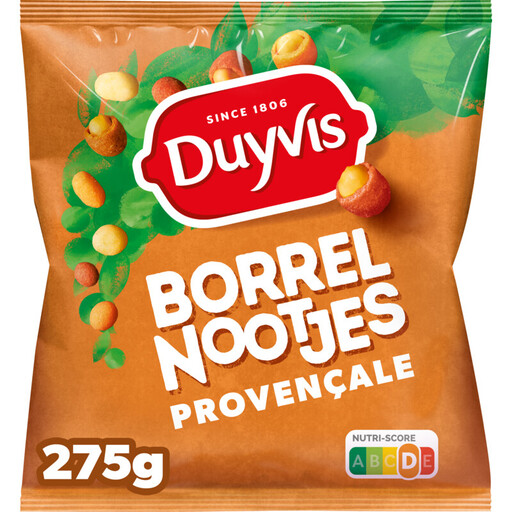
Duyvis Coated Peanuts Provençal, 275 g

Duyvis Coated Peanuts Provençal, 275 g

This variant is only an option if the ingredients and allergen warnings are suitable for your allergy requirements.

Energy: 542 kcal per 100 g. Contains peanuts and wheat/gluten; may contain traces of milk, nuts, soya and mustard.

View at Joybuy

Frequently asked questions

How do you work out the calories in your own portion of coated peanuts?

Use the energy per 100 grams shown on the current label and multiply it by your portion weight divided by 100. The Netherlands Nutrition Centre gives 133 kcal per 25 grams as a general example and notes that values can vary between brands.

If you avoid peanuts, can you still have a small portion of peanut-coated snacks?

No. A product that contains peanuts as an ingredient is not suitable if you need to avoid peanuts; a smaller portion does not change the ingredient. The Netherlands Nutrition Centre notes that even a small amount of an allergen can cause symptoms.

How should you store opened coated peanuts?

Follow the storage instructions for your variant. Jumbo recommends storing its Cocktail Coated Peanuts in a cool, dry, dark place; HANOS recommends keeping the Duyvis Cocktail variant described there in a light-proof, airtight container once opened.

What change to allergen labelling has applied since 2026?

Since 1 January 2026, the Netherlands Food and Consumer Product Safety Authority has been checking during inspections whether prepacked products carry the correct warnings about allergen cross-contamination. This does not confirm that every individual product is suitable for your allergy.

Does product information also need to be available online when shopping for groceries?

According to Business.gov.nl, label information must be available in Dutch and online. For prepacked foods, government information includes ingredients, allergens and nutritional values, among other details.
