What should you look for in a radio for marine weather?
Direct marine VHF
Choose this if: you specifically want to receive the spoken Coastguard broadcast on channel 23 or 83, and the exact receiver model supports these channels.
Trade-off: indoor reception isn’t guaranteed. A transmitting marine radio is also subject to separate requirements for using marine radio equipment.
Medium wave (MF)
Choose this if: you want to try the Coastguard broadcast on 1890 kHz or 3673 kHz with a receiver that supports the required frequency range and reception method.
Trade-off: a label such as AM or medium wave alone doesn’t confirm that both frequencies can be received. Reception in your loft will also depend on local conditions.
Internet radio
Choose this if: you’ve confirmed that the broadcast you want is available via an audio stream and you have Wi-Fi where you plan to listen.
Trade-off: internet radio doesn’t provide direct marine VHF or MF reception. A general internet radio feature doesn’t prove that the broadcast you want is available as a stream.
The Netherlands Coastguard lists VHF channels 23 and 83, and MF frequencies 1890 kHz and 3673 kHz for its Dutch broadcasts. Check the exact model and audio source before choosing a reception method.
| Concern |
What should you check? |
Who should consider this? |
| Direct VHF reception |
Check that the exact model supports marine channels 23 and 83; assess reception where you plan to listen. |
I want to receive the spoken Coastguard broadcast directly, so I’ll check for the right channels first. Around 40% of consumers prioritise direct reception. |
| Broadcast via the internet |
Confirm that the broadcast you want is available as an audio source and that Wi-Fi works where you plan to listen. |
I mainly want to play a confirmed audio source over Wi-Fi. Around 30% of consumers prioritise internet audio. |
| Tuning MF frequencies |
Check that the stated frequency range includes 1890 kHz and 3673 kHz, and that the required reception method is available. |
I want to try the specified MF broadcast, so I’ll check both the frequency range and reception method. Around 20% of consumers prioritise MF reception. |
| Moving the radio around |
Check the power type and whether batteries or an optional battery pack are included with the version you’ve chosen. |
I want to take the radio between listening spots, so I’ll check that its power supply suits my needs. Around 10% of consumers prioritise portability. |
Joybuy products for listening on the move
This product section features a portable AM/FM radio for moving between listening spots. Its stated AM range doesn’t include the MF frequencies used for the Netherlands Coastguard broadcast.
 No image available
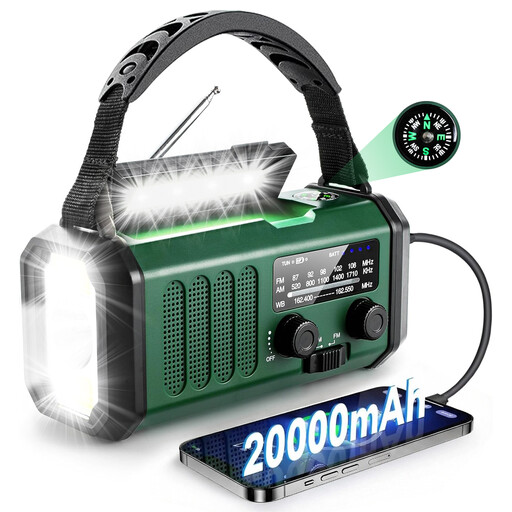
Solar Emergency Radio AM/FM, 20,000mAh
This portable model may suit you if you want to move your radio between listening spots or use it without a mains socket.
The description lists solar, hand-crank and USB-C charging, plus a 20,000 mAh power bank.
Its stated AM range is 520–1710 kHz, so it doesn’t include the MF frequencies 1890 kHz and 3673 kHz specified by the Netherlands Coastguard. This model isn’t suitable for direct reception via MF.
Joybuy
Frequently asked questions
Is a standard DAB+ radio enough to receive the Coastguard broadcast directly?
No. DAB+ alone doesn’t confirm that the radio can receive it. The Netherlands Coastguard specifies marine VHF channels 23 and 83, and MF frequencies 1890 kHz and 3673 kHz. Check that the exact radio supports the reception method you need.
When does the Netherlands Coastguard say it broadcasts weather reports?
The Netherlands Coastguard lists 08:05, 13:05, 19:05 and 23:05 local Dutch time for VHF, and 09:40 and 21:40 UTC for MF. Check the Coastguard’s information again before you plan to listen to a broadcast.
What can you do if radio reception is poor in your loft?
Try the receiver in different places and, for DAB+, run a fresh station scan first, as Digital Radio NL recommends. For direct Coastguard broadcasts, only use an alternative audio source that you’ve actually confirmed is available.
Do you need to buy or register a transmitting marine radio to listen at home?
A transmitting marine radio is different from a radio receiver. The Dutch Authority for Digital Infrastructure outlines registration and an operator’s certificate for using marine radio equipment on board, and lists a separate licensing route for a handheld radio used without a vessel. This information doesn’t establish which rules apply to a scanner used solely for reception at home.
What should you check about the power supply before buying?
Check the power type and what’s included with the exact version. Pure lists an optional battery pack for the Evoke Play; Sangean specifies four D batteries for the WFR-28BT.


