
Chairing and speaking yourself
You lead the meeting from your desk and want to be able to mute the microphone quickly without interrupting the flow of the discussion.


If you’re the only person leading the meeting, choose a headset based on its microphone controls, connection and the freedom of movement you need at your sit-stand desk. A wired USB headset keeps things simple; a wireless headset makes it easier to step away from your desk during the meeting, but you’ll need to charge it and maintain a working connection. If other club members in the room also need to be heard by remote participants, consider a separate room audio solution too: a personal headset’s microphone doesn’t guarantee this.
You lead the meeting from your desk and want to be able to mute the microphone quickly without interrupting the flow of the discussion.
You move between your standing desk and other parts of the room. Freedom of movement and a wireless connection may therefore be important.
You need to decide whether remote participants should also be able to hear people in the room. This may require a separate room audio solution alongside a personal headset.
Choose this if: you’ll mainly stay at your desk and want to connect the microphone directly to your computer.
The trade-off: you won’t need to charge a battery, but the cable limits how far you can move. Logitech lists a 1.9 m cable for the H390; check that it’s long enough when your desk is at its highest setting.
Choose this if: you regularly step away from your desk while chairing the meeting.
The trade-off: you won’t be tethered by a headset cable, but you’ll need to keep it charged and connected to your computer.
Choose this if: club members in the room also need to speak to remote participants.
The trade-off: you’ll need to set up extra equipment and test the audio from where people will be speaking. The features Logitech describes for MeetUp won’t necessarily apply to another room or setup.
| Buying concern | What to look for | Who it’s for |
|---|---|---|
| Your voice and muting | Check whether the microphone is adjustable and whether you can easily use the mute function during a meeting. | When I’m leading the meeting myself, I want to be able to speak and mute the microphone quickly. Around 28% of consumers say their own voice and easy controls are their main buying concern. |
| Freedom of movement | For a wired headset, measure the cable route with the desk at its highest setting; for a wireless headset, check the connection and battery life of the specific version. | When I step away from my desk, I don’t want a cable pulling on me. Around 22% of consumers say freedom of movement is their main buying concern. |
| Voices in the room | Decide who will be speaking and test whether remote participants can hear people in the room from their seats. | If club members in the room will also be speaking, I want to know whether remote participants can hear them clearly. Around 17% of consumers say room audio is their main buying concern. |
| Wearing comfort and awareness of the room | Compare mono and stereo versions, and check the fit and ear cushions of the specific model. For example, HP distinguishes between the mono Blackwire 5210 and the stereo Blackwire 5220. | For a long meeting, I want a headset that fits me well and lets me stay aware of what’s happening in the room. Around 17% of consumers say wearing comfort and awareness of the room are their main buying concern. |
| Connection and app | Check that the connector on the version you choose is compatible with your computer, then test the microphone and speaker in your meeting app. | To get started without connection problems, I want a headset that works with my computer and meeting app. Around 16% of consumers say connectivity and audio settings are their main buying concern. |
A personal microphone and a room audio setup are designed for different speaking positions. A headset worn by the chair doesn’t show that other people in the room will be picked up clearly.
Before buying, work out who will be speaking and test the sound from every relevant position.
The H390 is an example of a wired USB headset for speaking from a computer.
The Blackwire 5200 series includes wired headsets for calls in mono and stereo versions.
The Evolve2 40 SE is designed for desk use, while the Evolve2 65 is a wireless alternative.
The IMPACT SC 60 USB ML is a wired, dual-ear headset for a computer or softphone.
The UH34 series includes wired USB headsets in mono and dual-ear versions.
These picks include wireless and wired personal headsets for someone chairing a meeting from a computer; separate room audio may be needed to pick up other people in the room.
 No image available
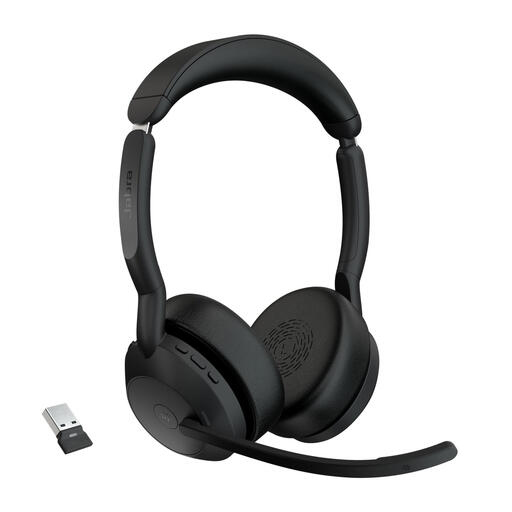
A wireless personal headset that lets you step away from your desk while chairing a meeting.
The product description lists Bluetooth 5.2, connection to two devices and a range of 30 m. Talk time is listed as 10 hours with ANC on and 16 hours with ANC off.
 No image available
A wireless headset for meeting chairs who want to move away from their desk during calls.
The product description lists Bluetooth, connection to two devices and a range of 30 m. It also mentions eight beamforming microphones and battery life of up to 36 hours.
 No image available
The flip-up microphone may suit you if you want to mute it quickly while chairing a meeting.
The product description lists a 3.5 mm connection and a USB audio adapter. The headset is wired, so check that the cable route gives you enough freedom to move.
 No image available
A wired headset for someone chairing a meeting from their desk and wanting to mute the microphone quickly.
The product description lists two microphones, an in-line mute control and USB-A. It also mentions compatibility with Windows and Mac.
 No image available
A wired USB headset for speaking from your computer, with an in-line mute control.
The product description lists an adjustable microphone boom and volume and mute controls. Check that the cable route works with your sit-stand desk.
Don’t assume so: a personal headset is designed for the person wearing it. If other people also need to speak, test how clearly they can be heard separately and consider room audio if necessary. Logitech describes MeetUp as a room device with several built-in microphones, but this doesn’t guarantee the same results in your room.
Check the connection and select the headset as your microphone and speaker in your meeting app. Test speaking and muting with the desk both sitting and standing, with the cable following its actual route. If you have a wireless model, test the connection when you step away too.
For a purchase made by a consumer in the Netherlands, the statutory guarantee applies alongside any manufacturer’s warranty. According to the Netherlands Authority for Consumers and Markets (ACM), there is no fixed term for the statutory guarantee. If the product breaks during normal use sooner than you could reasonably expect, contact the retailer to find an appropriate solution.
Wireless radio equipment placed on the EU market is covered by the European Radio Equipment Directive, which sets requirements including safety and electromagnetic compatibility. For products subject to the relevant CE rules, the CE marking is a declaration made by the manufacturer; it isn’t an independent quality or microphone test and doesn’t, on its own, confirm that a specific listing is compliant.
According to the ACM, online consumer purchases often come with a statutory cooling-off period of up to 14 days after delivery, although exceptions apply. Before opening the packaging, check the returns policy and the exceptions described by the ACM, particularly if the product is sold as a hygiene item.