
Chairing a meeting with remote participants
You lead the discussion on a laptop and want your voice to come through clearly. An adjustable microphone boom and easy-to-reach mute control may be important; Logitech lists these features for the H390.


Choose a personal headset if you mainly need your voice to reach remote participants through your laptop. Choose a room microphone or speakerphone when several people at the table will be speaking, or a suitable headset microphone with a transmitter and sound system when you need to amplify your voice in the room. Compare the controls, connection and freedom of movement, but address backlighting separately by adjusting the camera setup or lighting: a headset’s noise cancellation does not guarantee that you’ll be clearly heard in your room.
You lead the discussion on a laptop and want your voice to come through clearly. An adjustable microphone boom and easy-to-reach mute control may be important; Logitech lists these features for the H390.
You regularly invite people around the table to speak and want remote participants to hear them too. Zoom’s audio guidelines highlight factors such as microphone quality and distance from the sound source, so consider a solution designed for the room.
You speak to people in the room through a sound system and want to move around freely. Shure says the MX153 can connect to compatible bodypack transmitters; check that the complete setup is suitable for your system.
First decide who needs to be heard and through which system: the chair, several people around the table or a speaker using the room’s sound system. Then choose between a wired or wireless headset, and assess backlighting separately for the video.
Suitable if: you’ll mainly be speaking yourself, will usually stay by your laptop and want the mute button within easy reach.
Bear in mind: the cable limits your freedom of movement, and the microphone is directed towards the wearer, not the whole table.
Suitable if: you move around during online meetings but mainly need to transmit your own voice.
Bear in mind: you’ll need to check the battery and connection; a personal headset won’t automatically pick up the voices of the whole group.
Suitable if: several people in the room speak around the table and remote participants need to hear them.
Bear in mind: room acoustics and microphone placement still matter; test the sound from different seats.
Suitable if: your voice needs to be amplified through the sound system for people in the room, including when you’re moving around.
Bear in mind: the connector, transmitter, receiver and sound system must all be compatible; wireless use may also depend on the frequency in use.
| Factor to consider | What should you check? | Who is this important for? |
|---|---|---|
| How clearly your own voice comes through | Check the position of the microphone boom and whether you can mute the microphone directly. Test it with the room’s background noise. | If you’re chairing and will mainly speak through your laptop, you’ll want your voice to come through without having to search for the mute button mid-conversation. Around 28% of consumers prioritise how clearly their own voice is heard. |
| Hearing several people in the room | Decide who will be speaking and test the recording from the furthest relevant seat. Compare a personal headset with equipment designed for a room. | When the conversation passes around the group, you won’t want only the chair to be clearly audible. Around 22% of consumers give group conversations top priority. |
| Moving around or amplifying your voice in the room | Decide whether the sound needs to go to a meeting app or the room’s sound system. For wireless equipment used in the room, check the complete audio chain and the applicable frequency requirements. | If you want to move around while chairing or speak to the room through its sound system, the equipment needs to suit that audio path. Around 22% of consumers prioritise freedom of movement or sound amplification in the room. |
| Connection and awareness of the room | Check your laptop’s connection and whether the headset is mono or stereo. Also consider whether you want to keep one ear free during the conversation. | If you’re connecting the headset to a specific computer while also wanting to hear people in the room, check the ports and headset type in advance. Around 17% of consumers prioritise connection and awareness of the room. |
| Being visible beside the window | Check the camera image at the time of the meeting and decide whether you need to block daylight or add lighting to brighten faces. | If you’re chairing a video meeting beside a bright window, you’ll want participants to be able to see you clearly. Around 11% of consumers give visibility on video top priority. |
The microphone sits close to the wearer, so that doesn’t necessarily mean voices from elsewhere in the room will come through clearly too.
Test the conversation from the relevant seats. If several people speak regularly, compare equipment designed for group conversations.
Microphone noise cancellation and passive noise isolation from the ear cups are different features. A product claim won’t tell you how the headset will sound in your meeting room.
Check which part of the sound the claim relates to, and make a test recording with the actual background noise.
A matching connector doesn’t confirm that the transmitter, receiver and sound system will work together. The Dutch Authority for Digital Infrastructure links licence-exempt use of wireless microphones to specific frequencies and conditions.
Before choosing, check the complete audio chain and the requirements for the exact wireless version.
A headset won’t change the lighting. Zoom notes that daylight can affect what the camera captures.
Test the picture at the planned time and, if necessary, adjust the setup, window covering or lighting before choosing additional audio equipment.
These brands offer product ranges for different audio needs. Check that each model’s version is suitable for your laptop, meeting app or room sound system.
The H390 is a personal USB headset for a chair who mainly speaks at their computer; the Zone Wired is a separate wired range to compare.
The Evolve2 65 is worth considering if an individual speaker wants to move around wirelessly during online meetings; the Evolve2 40 SE is a separate wired range.
The Blackwire 3300 series offers personal wired mono and stereo options. The Sync 40 is a separate room solution.
The MX153 is a headset microphone for presentations and live sound reinforcement, not necessarily a replacement for a USB meeting headset.
These product options range from a speakerphone for group conversations to personal wired and wireless headsets for the chair.
 Image unavailable
This speakerphone is suitable for a hybrid meeting where several people around the table will be speaking.
The description lists Bluetooth, a touchscreen, a built-in 12-hour battery and 32 GB of storage.
It also mentions eight microphones, several recording patterns and a quoted voice recording range of up to 16.4 ft. You can pair up to three devices.
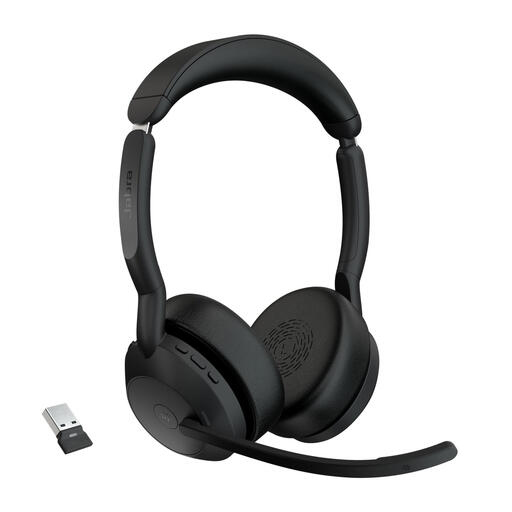 Image unavailable
This wireless stereo headset is suitable for a chair who speaks online and wants to move around during the meeting.
The description lists Bluetooth 5.2, a USB adapter for your laptop, a connection to two devices at once and a quoted range of 30 m.
This version is for Microsoft Teams; you’ll need to charge it for wireless use.
 Image unavailable
This mono headset may be suitable if you mainly need the chair’s voice to come through online and want to keep one ear free.
The description lists Bluetooth 5.0 and a USB-A Bluetooth adapter for connecting to a computer.
Talk time is quoted at up to 35 hours; you’ll need to charge it for wireless use.
 Image unavailable
This wired stereo headset is suitable for a chair who speaks from a computer and stays in one place.
The description lists a 3.5 mm connection and a USB controller for the computer.
The cable is listed as 0.95 m long, so bear in mind how far away your computer is.
 Image unavailable
These wired USB headphones with a microphone are suitable for a chair who mainly speaks through a computer.
The description lists an adjustable microphone boom with 270° rotation and a 1.8 m USB cable.
Windows, Mac and Chromebook are listed as compatible systems.
Select the connected microphone and speaker in the meeting app, then test both before the meeting. Zoom describes how to test the microphone and speaker; for a hybrid meeting, also ask people to speak from different places in the room.
No, a headset won’t change the lighting. Check the camera image at the planned time and decide whether you need to block daylight or add lighting to brighten faces; Zoom lists daylight and reflective windows as factors to consider for the camera image.
Don’t assume you can. The Logitech H390 is described as a USB headset for connecting to a computer, while Shure’s MX153 is designed for a suitable wireless bodypack transmitter. First check which input the sound system has and what equipment you’ll need in between.
No, it depends on the frequency in use and the requirements that apply to it. The Dutch Authority for Digital Infrastructure publishes frequency bands that can be used for wireless microphones without a licence, and notes that a licence is required for some other bands. The fact that Bluetooth generally uses licence-exempt frequencies doesn’t mean that every UHF system can be used without a licence.
There’s no fixed statutory warranty period in the Netherlands; according to the Dutch government, what matters is what you could reasonably expect from the product under normal use. For online consumer purchases, ACM ConsuWijzer says the cooling-off period generally ends 14 days after delivery. Check whether any exceptions apply.