
Drying in a small space
If you dry clothes in a flat or small utility room, compare the airer’s footprint when in use with its folded size. DOMO and InnovaGoods list different placement and size options for each model.


First, measure the available space with the airer fully open. Choose a compact heated airer if floor space is limited and you only dry small loads; a heated winged airer if you have room to spread garments out; or an unheated airer if you don’t need extra heat. Heating doesn’t replace ventilation: follow care labels and ventilate while drying clothes indoors.
If you dry clothes in a flat or small utility room, compare the airer’s footprint when in use with its folded size. DOMO and InnovaGoods list different placement and size options for each model.
If you often dry workwear indoors, weigh up the spreading space and electricity use against your ability to ventilate. Milieu Centraal stresses the importance of ventilation when drying clothes indoors.
If garments need to be dried hanging or flat, choose an airer that lets you follow the drying instructions on the care label. GINETEX distinguishes between line drying and flat drying, among other methods.
Choose this if: you have limited floor space and dry a small amount of workwear at a time.
Bear in mind: there’s less room to spread out several large garments; product specifications aren’t measured drying results.
Choose this if: you want to spread out several garments and have enough clear floor space.
Bear in mind: its dimensions when open are larger than when folded; 230 W alone doesn’t tell you how long drying will take.
Choose this if: you can dry clothes without extra heat and need an airer that fits your floor layout.
Bear in mind: it doesn’t have heated bars; you’ll still need to remove moist air when drying clothes indoors.
| What to consider | What to check before buying | Who is this important for? |
|---|---|---|
| Space and storage | Compare the airer’s width, depth and height when open with the space available, and check its folded size too. DOMO lists the DO7117DR as 52,5 × 36,5 × 90 cm; InnovaGoods gives the Warmmat’s dimensions when open as approximately 148 × 112 × 54 cm. | If you want to put the airer away after use, the space it takes up when open matters just as much as its drying length. Around 26% of consumers are most concerned about space. |
| How your clothes need to dry | Read the care labels and check whether the airer offers enough flat space or hanging space. | If some workwear needs to dry flat while other garments can be hung up, you’ll want to follow the instructions for each item. Around 21% of consumers put fabric care first. |
| Moisture and ventilation | Check whether you can ventilate while drying clothes indoors and leave space around the garments. Milieu Centraal highlights the need for ventilation when drying indoors. | When you dry clothes indoors, you need to be able to remove moist air; a heated airer won’t do this for you. Around 21% of consumers put moisture and ventilation first. |
| Electricity use | Compare the wattage, timer and expected running time. DOMO lists 150 W for the DO7117DR and InnovaGoods lists 230 W for the Warmmat; running continuously, these work out at 0,15 and 0,23 kWh per hour respectively. | If you want to weigh the extra electricity use against drying clothes on an unheated airer, the wattage and running time are relevant. Around 16% of consumers are most concerned about running costs. |
| Electrical safety and placement | For the specific model, check the CE marking and instructions, and whether the manufacturer allows it to be used where you intend to place it. Ondernemersplein outlines the applicable European product safety requirements; RVO explains that CE is not an independent quality mark. | If you want to use a heated airer in a particular place, you’ll want to know whether its design and placement are suitable. Around 16% of consumers put electrical safety first. |
A winged airer takes up more room while you’re drying clothes. InnovaGoods lists the Warmmat’s dimensions when open as approximately 148 × 112 × 54 cm.
Measure the space with the airer fully open and allow room to walk past the hanging clothes.
Drying laundry indoors adds moisture to the air. Heating doesn’t remove that moisture from your home.
Choose a spot where you can ventilate and don’t hang clothes too close together. Milieu Centraal recommends ventilation when drying clothes indoors.
The stated wattage doesn’t tell you how many hours your workwear will take to dry.
Compare the wattage and timer with the expected running time. Consider an unheated airer if you don’t need extra heat.
Garments that need to dry flat may not be suitable for an airer that only provides hanging space. A washable garment isn’t automatically suitable for every drying method.
Check the drying symbols on each garment before choosing the type of airer. GINETEX describes line drying and flat drying, among other methods.
DOMO describes the DO7117DR as a heated airer that can be used freestanding or wall-mounted. For this model, the manufacturer lists a power rating of 150 W and dimensions of 52,5 × 36,5 × 90 cm.
For the Warmmat, InnovaGoods lists 20 heated bars, adjustable temperature, a timer, 230 W and dimensions of approximately 148 × 112 × 54 cm when open.
Brabantia describes clothes airers, including a drying tower with platforms where delicate laundry can be dried flat.
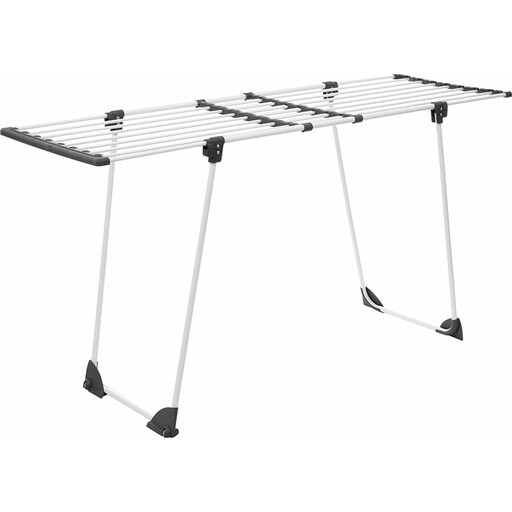
Tomado describes the Vento 30 as a foldable, unheated clothes airer with adjustable wings and space for flat drying.
This product is for anyone who wants to dry washable workwear on a clothes airer and put it away after use.
 No image available
Suitable for anyone who wants to dry workwear on a clothes airer and fold it away after use.
The product description lists 17 m of drying space, a frame and hanging bars made from steel and polypropylene, wheels and a foldable design.
No. Don’t assume it can just because a garment is washable. Check the care label on each item: GINETEX distinguishes between line drying and flat drying, among other methods. Then check that your chosen airer allows you to dry it as instructed.
Yes. A heated airer doesn’t remove moisture from your home. Milieu Centraal recommends ventilation when drying clothes indoors and highlights its importance in helping to prevent moisture problems.
Multiply the power rating in kilowatts by the number of hours it’s used. If it runs continuously at the stated power, 150 W uses 0,15 kWh per hour and 230 W uses 0,23 kWh per hour; a timer or control setting can affect actual usage. Multiply the electricity used by your own rate per kWh to work out the cost.
No. Ondernemersplein outlines the applicable European product safety requirements for electrical appliances on the Dutch market. RVO explains that CE is a manufacturer’s declaration of conformity, not an independent safety mark. Also check the markings and instructions for the specific model.
In the Netherlands, the seller is responsible for the statutory guarantee if a product is faulty. The Autoriteit Consument & Markt lists free repair or replacement as possible solutions; a separate manufacturer’s guarantee doesn’t replace your statutory rights.