
People who dry small loads and have little storage space
They mainly need somewhere to dry socks and want to put the airer away after use, or avoid taking up floor space.


For a few pairs of cotton socks, a compact, unheated airer is often a good choice if you want to avoid using electricity. A heated airer is worth considering if you regularly want to use extra heat and have room for the model. Compare the space it takes up when open with the room you have for storage, and make sure you can ventilate the room when drying clothes indoors. For an electric model, check the markings and instructions for the specific product too.
They mainly need somewhere to dry socks and want to put the airer away after use, or avoid taking up floor space.
They are considering targeted electric heat for socks and other small items, as long as the airer and ventilation options suit their home.
They want to dry socks without electric heating and can opt for an unheated airer.
Suitable for: people who regularly dry small items of washing and have room for a freestanding model or can mount one securely on the wall.
Bear in mind: electricity use and the fact that this model cannot be folded away like a winged airer; the manufacturer lists the DOMO DO7117DR as measuring 52,5 × 36,5 × 90 cm and using 150 W.
Suitable for: people who want to hang larger loads as well as socks and have room for the wings when extended.
Bear in mind: foldable does not mean it takes up little space when in use; InnovaGoods lists 20 heated bars, temperature settings and a timer for the Warmmat.
Suitable for: people who mainly hang small loads and do not need electric heating; a hanging model may work if you have a suitable door or ledge.
Bear in mind: a freestanding airer needs floor space, while a hanging airer must fit the place where you plan to hang it.
Suitable for: people who want to keep the floor clear and have suitable fixings and a power connection.
Bear in mind: its installation and size make it a different solution from a small airer for a few pairs of socks; Foxydry describes the Pro as offering ventilation at room temperature and with warm air.
| What to consider | What to look for | Who is this important for? |
|---|---|---|
| Space for use and storage | Compare the airer's dimensions when open and folded with the space available; for a hanging airer, measure the ledge it will hang from too. | If I have little storage space, I want to know whether I can put the airer away after use. Around 36% of consumers prioritise storage space. |
| Room for a small load of socks | Think about how many pairs you want to hang up at once and check that they can be spaced far enough apart. | If I only dry a few pairs, I do not want to choose an airer based on capacity I rarely need. Around 29% of consumers prioritise having a suitable place for small loads. |
| Heating or avoiding electricity use | Check the stated power rating and think about how long you will use the airer; an unheated airer does not use electricity for heating. | If I want to avoid or limit extra electricity use, it will affect my choice between a heated and unheated airer. Around 21% of consumers prioritise energy use. |
| Ventilation and electrical use | Check whether you can ventilate the drying area and, for an electric model, follow the product and placement instructions. | When drying clothes indoors, I want to be able to clear away moisture and position an electric airer according to the instructions. Around 14% of consumers prioritise ventilation and safe positioning. |
Wings take up extra space when extended for drying. An open airer could get in the way.
Measure both the drying area and the storage space, then compare them with the dimensions of the exact model.
Drying washing indoors adds moisture to the air; heating does not automatically remove that moist air.
Choose a spot where you can ventilate appropriately, even when using a heated airer. Milieu Centraal describes ventilation as bringing air in and sending it out.
DOMO lists IPX4 for the DO7117DR. This model specification does not mean that every electric airer can be used anywhere in a bathroom.
Before using an airer in a damp room, check the protection rating and placement instructions for the specific product.
The DO7117DR is a heated airer for people with a suitable permanent drying spot; DOMO says it can be used freestanding or wall-mounted.
The Warmmat is a folding heated winged airer for people who want to hang other washing as well as socks.
The Pro is a ceiling- or wall-mounted airer with ventilation at room temperature or with warm air.
The 4,5 m hanging clothes airer is an unheated alternative if you do not want to set up a freestanding frame.
The Classic 100 Easy is a folding, unheated freestanding airer for situations where there is no suitable place to hang one.
This selection mainly features folding or wall-mounted clothes airers, including one electrically heated model. Focus on how much space the airer takes up when in use and whether you need heating.
 No image available
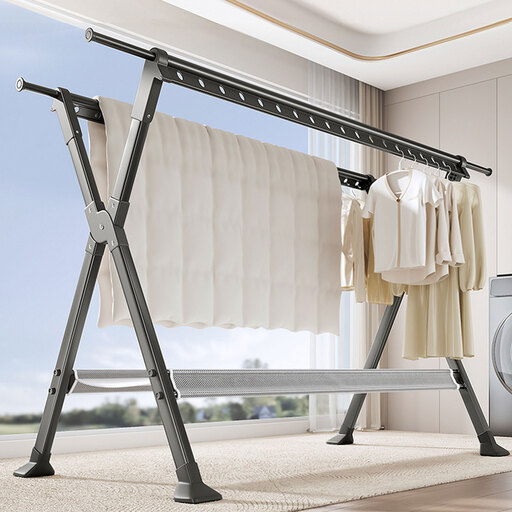
The foldable design and drying mesh for small items may suit anyone who wants to store the airer more compactly after use.
The adjustable length is 136–230 cm; the airer has 42 holes described in the product listing as windproof.
 No image available
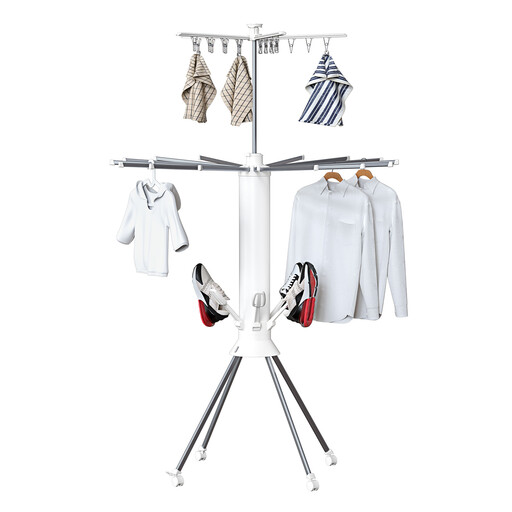
The sock clips offer a way to hang small items; check that the folded dimensions will fit your storage space.
The description lists 16 arms, 6 shoe racks, 20 clips and a folded width of 49,5 cm.
 No image available
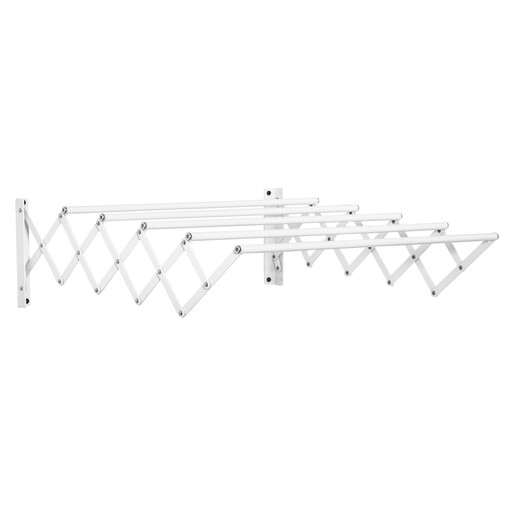
A wall-mounted model may suit you if you do not want to store a freestanding airer; bear in mind that it needs to be installed.
The stated dimensions are 63,5 × 60 × 20 cm and the maximum total load is 10 kg.
 No image available
This model may suit you if you are looking for a heated drying option and have room for the airer when it is open.
The stated power rating is 230 W and the dimensions are 144 × 53 × 91 cm. The description says to use it indoors on a stable, level surface, with adequate ventilation and at least 31 cm of clearance from walls. Before buying, check the applicable CE marking and the instructions for the specific product.
 No image available
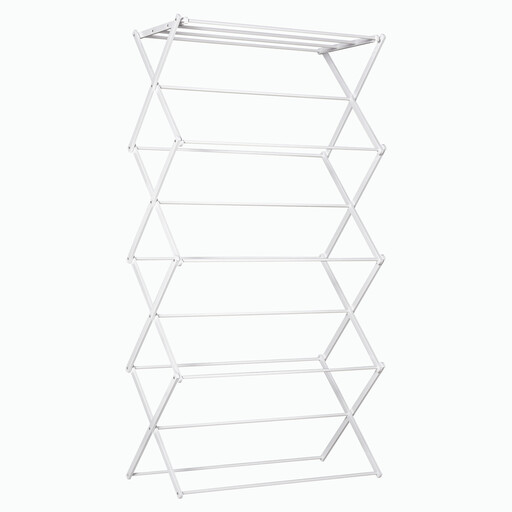
The folded dimensions can help you work out whether the airer will fit in a cupboard or corner; compare them with the space it takes up when open too.
The description lists 10 hanging rails, 8 arms and a maximum load of 18 kg. Folded, the airer measures 74 × 51,5 × 10 cm; open, it measures 74 × 35 × 144 cm.
No, heating does not automatically remove moist air. Milieu Centraal recommends ventilating when drying washing indoors so that the moist air can be cleared.
Measure the space the airer takes up when in use. For a hanging airer, check that the door or ledge is suitable; for an electric wall- or ceiling-mounted model, follow the installation and connection instructions for that exact model.
Multiply the stated power rating in kilowatts by the number of hours you use it. At 150 W, that is 0,15 kWh per hour when used continuously at that power; this is a calculation, not a measurement of actual electricity use or drying time.
Electrical equipment covered by the Low Voltage Directive, including equipment for a rated AC voltage between 50 and 1.000 V, must have a CE marking when placed on the EU market. The European Union explains these requirements through Your Europe and the Publications Office of the European Union; check the marking and product instructions for the model you choose. A CE marking is not an independent test certificate.
According to the Dutch government, you are entitled to a product that works properly and should contact the seller if it is faulty. There is no fixed statutory guarantee period for all products; a manufacturer's guarantee is in addition to your statutory rights.