
Frequent small washes
You want to hang a few freshly washed flannels separately each time and are considering extra heat to help them dry. Compare the usable rails and the space around your laundry, rather than looking at the stated wattage alone.


Start by choosing an airer that lets you hang your flannels separately and fits where you plan to use it. A compact heated airer could work if you regularly want extra warmth; an unheated airer uses no electricity, while an electric towel rail provides a dedicated place to hang a few items. You’ll still need ventilation when drying clothes indoors. For an electric model, check the instructions and applicable conformity information for that exact version.
You want to hang a few freshly washed flannels separately each time and are considering extra heat to help them dry. Compare the usable rails and the space around your laundry, rather than looking at the stated wattage alone.
You’re looking for an airer that fits while in use and can be folded away afterwards, or a fixed spot on the wall for a few cloths.
You’re weighing up the extra electricity use against drying without heat, and can check how to ventilate the room while drying laundry indoors.
A good fit if: you often do small washes, can space out your flannels and have room to set up and store the airer.
Bear in mind: electricity use and the space it takes up when open; heating doesn’t replace ventilation.
A good fit if: you mainly want a dedicated place to hang a few flannels or towels.
Bear in mind: the fitting and placement instructions for the exact model.
A good fit if: you don’t need extra heat to help your laundry dry and can hang your flannels in a well-ventilated room.
Bear in mind: this airer doesn’t have a heating function; check that it has enough hanging space for your laundry.
| What matters when buying | What to look for | Who should consider this? |
|---|---|---|
| Space for frequent use | Check how many usable rails there are and whether you can hang the flannels without them overlapping. | If I need my flannels again soon, I want to hang them separately; around 33% of consumers say frequent small washes are their main concern when buying. |
| Using and storing the airer | Check the dimensions against the space you have in mind, and whether the airer can be folded away or wall-mounted. | With limited floor or storage space, I want an airer that keeps walkways clear and can be put away after use; around 27% of consumers prioritise the space it takes up during use and storage. |
| Electricity use | Estimate consumption using watts ÷ 1000 × hours switched on; controls or a thermostat can affect actual consumption. | If the airer will be on often, I want to factor in how long it’s used, rather than looking at wattage alone; around 20% of consumers put electricity use first. |
| Damp and positioning | Check that damp air can be extracted, and read the manual and permitted placement instructions for an electric model. | When drying laundry indoors, I want to be able to remove damp air and know whether the chosen spot is permitted for the exact electric model; around 20% of consumers put ventilation and safe positioning first when buying. |
Wattage alone won’t tell you how long flannels take to dry or how much electricity each session uses. The time it’s switched on and any controls also make a difference.
Estimate consumption using the wattage and the number of hours you’ll have it switched on. Compare the result with an unheated airer, which uses no electricity itself.
If you use it frequently, the hours it’s switched on add up. So consider how long you’ll actually need the airer for.
Damp air still needs to be removed from the room when you use a heated airer. Milieu Centraal and GGD Leefomgeving recommend paying attention to ventilation when drying laundry indoors.
Choose a spot where damp air can be extracted, whether or not the airer is heated.
Permitted placement can vary between models, especially near a bath, shower or washbasin.
Before fitting or using it, read the manual for the exact model and check that your chosen spot is permitted.
Silvergear offers heated flat clothes airers and tower models. Its Premium airer is one to consider if you regularly hang out small washes.
The MEQ-EL8980/002 is an electric towel rail to compare if a dedicated place to hang a few items matters more to you than a larger clothes airer.
Brabantia offers a range that includes hanging clothes airers and drying towers without electric heating.
The range includes electric winged clothes airers and electric towel rails to suit different placement needs.
This selection includes an electric towel rail and heated clothes airers, as well as foldable and wall-mounted airers for anyone who doesn’t need heating. Before buying any electric model, check the applicable marking, documentation and placement instructions for the exact version.
 No image available
A wall-mounted place to hang laundry could work if you want a dedicated spot for a few flannels.
The product information lists dimensions of 58,5 × 55 cm, a digital temperature display, touch controls and a top shelf. Wall mounting is required; check the placement instructions and applicable product documentation for this exact electric model.
 No image available
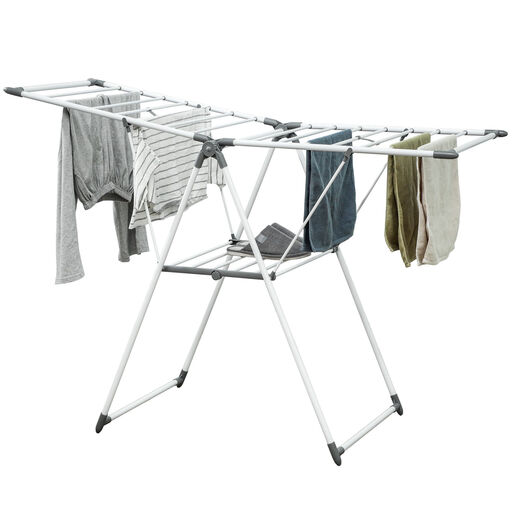
A foldable clothes airer could work if you want to be able to put it away after use.
It measures 156,5 × 61,5 × 97 cm. The product information lists a load capacity of up to 15 kg and a folded depth of 8 cm.
 No image available
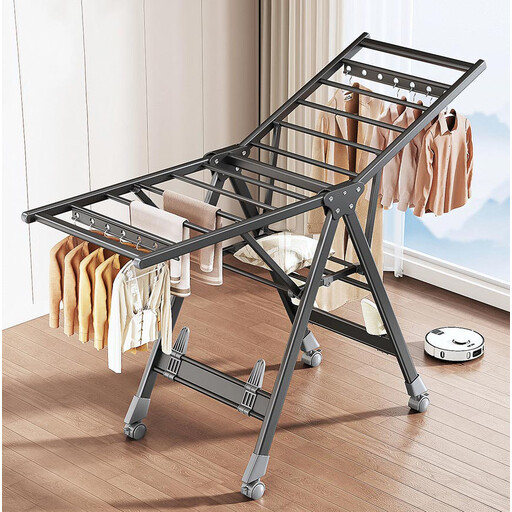
This model could work if you want an airer you can move and fold away after use.
The product information lists adjustable side wings from 108 to 160 cm, two levels and castors with brakes.
 No image available
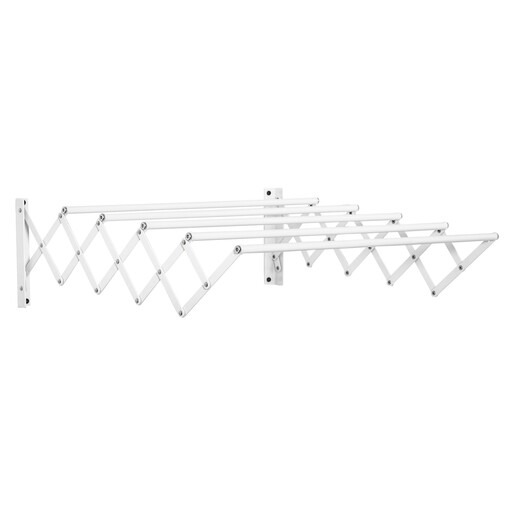
A wall-mounted airer could work if you want to keep floor space clear and have a suitable place to fit it.
It measures 63,5 × 60 × 20 cm. The product information lists a maximum load of 2 kg per rail and a total load capacity of 10 kg. Wall mounting is required.
 No image available
This airer could work if you regularly want extra heat and have room for a model that folds out.
It measures 144 × 53 × 91 cm; the product information lists a temperature range of 45–55 °C and two fold-out side wings. Use it indoors on a stable, level surface, with ventilation and at least 31 cm of clearance from walls. Before buying, check the applicable marking and documentation for this exact electric model.
No, an unheated airer may be enough if you don’t need extra heat to help your laundry dry. It uses no electricity itself; either way, make sure the room is ventilated when drying laundry indoors.
Divide the wattage by 1000, then multiply it by the number of hours the airer is switched on to estimate consumption in kWh. Multiply that estimate by your own rate per kWh. If the airer has controls or a thermostat, actual consumption may differ from continuous use at its rated wattage.
Make sure damp air is extracted. GGD Leefomgeving recommends continuous ventilation; Milieu Centraal advises increasing the setting on mechanical ventilation when drying laundry indoors, if you have it. Heated bars don’t replace ventilation.
You can’t determine this from the product category alone. For the Dirt Devil MEQ-EL8980/002, the product information specifies a minimum distance of 60 cm from the bath, shower and washbasin. Check the manual and permitted placement for your exact model; this distance isn’t a general rule for all airers.
Electrical products covered by the applicable regulations must carry a CE marking. The Netherlands Food and Consumer Product Safety Authority states that the Low Voltage Directive covers a range of 50–1000 V AC. Check the marking and documentation for the exact model; a CE marking is the manufacturer’s declaration of conformity, not proof of an independent test.