
Shirt wearer in a small home
You want to hang wet cotton shirts indoors without permanently filling a wide walkway or room with an airer. Silvergear and DOMO’s different designs show why floor space, height and how the airer is mounted all matter.


If floor space is limited, a heated tower airer or wall-mounted airer can free up room, but check that there’s enough space to hang cotton shirts without them touching. A heated winged airer takes up more floor space when in use; an unheated airer is worth considering if you don’t need the extra warmth and can ventilate the drying area properly. Measure the space with the airer set up, and check the placement instructions and applicable conformity information for any electric model.
You want to hang wet cotton shirts indoors without permanently filling a wide walkway or room with an airer. Silvergear and DOMO’s different designs show why floor space, height and how the airer is mounted all matter.
You need enough separate hanging spaces and clearance above them; the total length of the drying rails alone won’t tell you how many shirts can hang freely. Silvergear and Tomado models illustrate different hanging layouts.
You’re weighing up the heat and electricity it uses against drying without extra warmth. Milieu Centraal highlights ventilation as something to consider when drying laundry indoors.
First compare the space needed while drying and the hanging room your shirts require. Then consider whether heating suits the way you use the airer and your drying space.
| What to consider | What should you look for? | Who will find this important? |
|---|---|---|
| Floor space when in use | Measure the airer’s length and width when fully open, and allow room to get around it and for the recommended placement. | If I have little free floor space, I want to avoid the airer blocking a walkway. Around 33% of consumers put floor space first. |
| Clearance for hanging shirts | Check the clearance between tiers, the hanger points and the care label on each shirt. | I want to hang cotton shirts without them resting on a lower tier. Around 27% of consumers prioritise enough hanging room for shirts. |
| Moisture when drying indoors | Check whether the drying area can be ventilated, and follow the placement instructions for your chosen airer. | If I dry laundry indoors, I want to be able to remove humid air. Around 20% of consumers put moisture control first. |
| Energy use versus drying time | Compare the power rating in watts with a realistic period of use; calculate kWh by multiplying the power in kW by the number of hours. | I want to know what heating means for my usage and compare it with drying without heat. Around 20% of consumers prioritise running costs. |
An airer may fold flat for storage but still take up a lot of room when set up for drying.
Measure the space with the airer fully open, and allow room to get around it and follow the placement instructions.
A long rail doesn’t tell you how many full shirts can hang with enough space between them. GINETEX distinguishes between different natural drying methods in its care symbols.
Check the hanging clearance and follow the drying instructions on each shirt.
The stated power rating alone doesn’t tell you how much electricity a drying session will use; the length of time it’s switched on matters too.
Compare energy use over a suitable period of use and for the same type of load. Consider an unheated airer if you don’t need extra warmth.
A heated airer won’t automatically remove the moisture released into your home when drying laundry indoors. Milieu Centraal highlights laundry drying as something to consider for indoor air quality.
Choose a spot where you can ventilate the room, and follow the placement instructions for the specific airer.
Silvergear offers heated winged airers and a heated tower airer. These different designs may be worth considering if you’re weighing up floor space against height.
According to DOMO, the heated DO7117DR can be freestanding or mounted using the supplied fittings.
The unheated Concerto 14 tower airer is an option to compare if electric heating isn’t essential.
For models in the Pegasus range, Leifheit lists rails shaped to hold clothes hangers, which may be useful if you want to dry shirts on hangers.
This Joybuy selection includes airers for hanging laundry: a wall-mounted airer, a freestanding airer and a heated winged airer. Compare the dimensions when in use with the space you have available.
 No image available
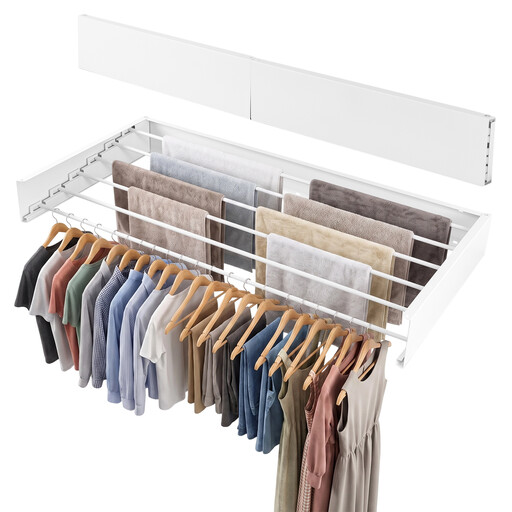
A wall-mounted airer may suit you if you want to keep the drying area off the floor and hang shirts on rails.
The product description lists six drying rails and shirts as suitable laundry. The dimensions when in use are 100 × 50 cm; when folded, the airer is 3 cm deep. Wall mounting requires drilling; the listed suitable wall materials are concrete, brick and wood.
 No image available
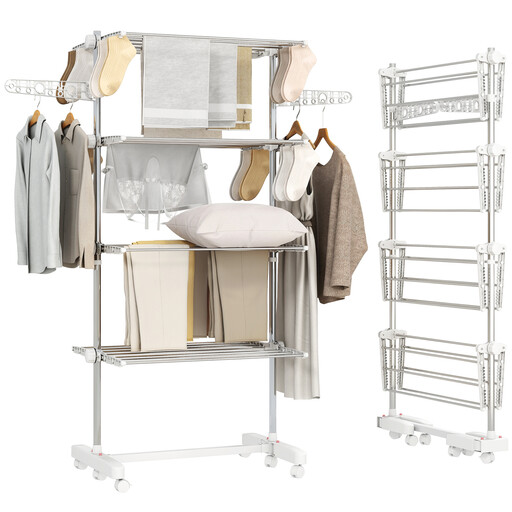
The side arms with hanger slots provide somewhere to hang shirts, if you have enough floor space.
The dimensions when in use are 172 × 142 × 55 cm, and the folded dimensions are 172 × 80 × 13 cm. The description lists wheels and brakes; bear in mind that this airer needs plenty of space when in use.
 No image available
This heated winged airer may suit you if you want extra warmth and have enough room for it and its required placement.
The dimensions when in use are 144 × 53 × 91 cm; the description lists 230 W and a temperature range of 45–55 °C. For indoor use, it specifies a stable, level surface, ventilation and a minimum distance of 31 cm from walls. For an electric model within scope, check the model-specific EU Declaration of Conformity and CE marking.
Electrical equipment within the scope of the EU rules for low-voltage equipment is subject to conformity assessment requirements, an EU Declaration of Conformity and CE marking. EUR-Lex describes this scope as equipment designed for 50–1.000 V AC; check the information for the specific model.
Follow the drying instructions for the specific shirt and the airer’s instructions. GINETEX distinguishes between natural drying methods, including line drying and flat drying.
Choose a spot where the air can circulate and humid air can be removed. Milieu Centraal highlights laundry drying as something to consider for indoor air quality; also follow the placement instructions for your chosen appliance.
Divide the stated power rating in watts by 1,000, then multiply it by the number of hours the airer is switched on for a simple estimate in kWh. Multiply that figure by your own electricity tariff; actual energy use and drying time may vary.
No, you can’t assume that just because the airer is heated. DOMO lists IPX4 for the DO7117DR, but check the manual and intended placement for each specific model; this specification applies only to that model, not to other airers.