Who is this relevant to?

Parent with a narrow laundry area

Wants to hang school clothes indoors without blocking the way through. Compare the airer’s dimensions when in use with the available space, then check separately how it can be stored. DOMO and Adler publish the in-use and storage dimensions for the models mentioned.

Parent with a quick clothing turnaround

Regularly needs certain items of clothing again and wants to know whether there’s enough room to spread them out. A heating function or stated power rating alone won’t tell you how long a school uniform will take to dry.

Anyone drying clothes indoors and keeping an eye on damp and energy costs

Wants to dry laundry indoors without overlooking ventilation or estimating energy costs from the wattage alone. Kenniscentrum Duurzaam Leven points out that damp indoor air makes ventilation important.

What should you look for when choosing?

Compact heated airer

Suitable if: you mainly want to dry a few items and have a narrow space on the floor or a suitable wall. DOMO says the DO7117DR can be freestanding or wall-mounted.

Bear in mind: there’s less room to hang items apart; 150 W doesn’t indicate a measured drying time.

Heated winged airer

Suitable if: you want to hang several items at once and have more floor space available while they dry. Adler says the AD 7821 has heated rails.

Bear in mind: the manufacturer gives a length of 148 cm when the airer is unfolded; claims of reduced drying time aren’t based on independently measured drying performance.

Standard clothes airer

Suitable if: you don’t need the clothes again quickly and can find a shape and hanging capacity to suit your laundry area.

Bear in mind: the airer doesn’t actively heat clothes; whichever option you choose, moist air needs to be able to escape the room.

What to consider What to check before buying Who is this important to?
Space while in use Compare the length, width and height of the unfolded airer with the available space; check its storage dimensions separately. If I have a narrow laundry area, I want to avoid the airer blocking the way through. Around 36% of consumers prioritise the space needed for an airer.
Clothes dry in time Check how many items fit with space between them and whether the model has heated rails; a wattage isn’t a drying time. If I need certain school clothes again soon, I want to know how much usable hanging space there is without making assumptions about drying time. Around 29% of consumers prioritise having clothes ready in time.
Damp indoor air Check what ventilation is available in the laundry area and whether air can still flow in and out. If I dry clothes indoors, I want to be able to clear damp air; Kenniscentrum Duurzaam Leven warns that excess moisture can encourage mould. Around 21% of consumers prioritise moisture control.
Energy costs Estimate kWh by multiplying the rated power in kW by the hours of use; multiply the result by your own tariff. If I use the airer regularly, I want to take the length of time it’s in use into account rather than looking at the wattage alone. Around 14% of consumers prioritise energy costs.

Common mistakes

  • Comparing only the folded dimensions

    An airer may fold down to a slim size yet take up a lot of floor space while clothes are drying. For the Adler AD 7821, the manufacturer gives a folded depth of 8 cm and an unfolded length of 148 cm.

    Measure the space with the airer unfolded and clothes hanging on it. Also measure separately where you can store it.

  • Assuming a lower wattage means cheaper drying

    The rated power doesn’t tell you how many hours the same clothes will take to dry. The stated 150 W for the DOMO DO7117DR and 220 W for the Adler AD 7821 aren’t measurements of drying time or energy used per drying session.

    For a simple estimate, multiply the power in kW by the hours of use to get kWh, then multiply that figure by your own electricity tariff. Don’t compare drying results unless the conditions and length of use are the same.

  • Assuming heating will solve damp problems

    Drying clothes indoors, even on a heated airer, adds moisture to the air. Kenniscentrum Duurzaam Leven explains that excess moisture can encourage mould.

    Check in advance how damp air can escape from your laundry area; heating doesn’t replace ventilation.

Brands to consider

DOMO

According to DOMO, the DO7117DR is a compact heated model that can be used freestanding or wall-mounted.

  • DOMO lists 150 W, a timer, IPX4 and dimensions of 52,5 × 36,5 × 90 cm.
  • The product information doesn’t give a measured drying time for a school uniform. Before wall-mounting, check the space and the instructions for the exact model.

Adler

According to Adler, the AD 7821 is a foldable heated winged airer for anyone who can make more space available while it’s in use.

  • Adler lists 220 W, 18 heated rails and a folded depth of 8 cm.
  • When unfolded, the airer is 148 cm long according to the manufacturer. Claims of shorter drying times aren’t based on an independently verified comparison.

Leifheit

Leifheit offers unheated clothes airers as an alternative when active heating isn’t needed.

  • Leifheit Nederland lists 18 m of drying length for Family models.
  • This range information doesn’t confirm that the airers are heated. Check the dimensions of your chosen model separately.

Brabantia

The HangOn airer mentioned is an unheated alternative for anyone who likes to hang clothes on hangers.

  • For this version, Brabantia lists 25 m of drying space, eight hooks and a hanging rail.
  • Check the full unfolded dimensions; a description of compact storage doesn’t tell you how much space the airer takes up in use.

Clothes airers at Joybuy

These product picks are clothes airers for hanging laundry, including school clothes, indoors.
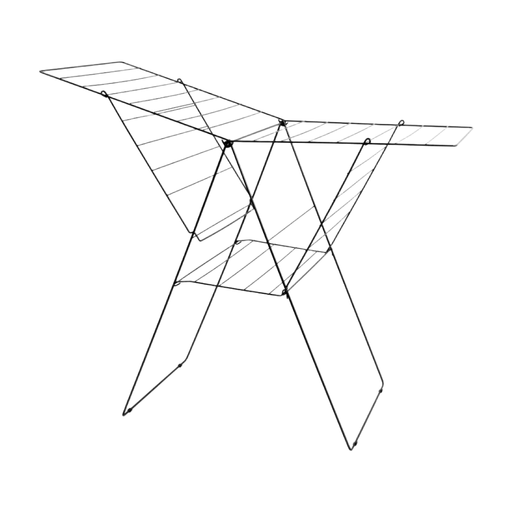
Practo Jeanne clothes airer with 20 m of drying space

Practo Jeanne clothes airer – 20 m of drying space

The stated drying length may suit you if you want to hang several items of school clothing; measure the space it will take up in use beforehand.

Dimensions in use: 95 × 128,5 × 59 cm. Folded: 101 × 59 × 4,5 cm. Maximum load: 10 kg.

View at Joybuy
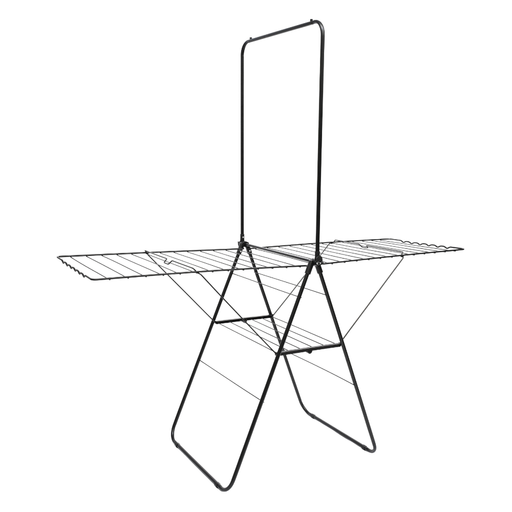
Practo Suzanne clothes airer with rail and 26 m of drying space

Practo Suzanne clothes airer with rail – 26 m of drying space

The rail with hooks provides space to hang clothes on hangers; check that the unfolded airer will fit in your laundry area.

Drying length: 26 m. The description lists 12 hooks and a maximum load of 15 kg; distribute the laundry evenly.

View at Joybuy
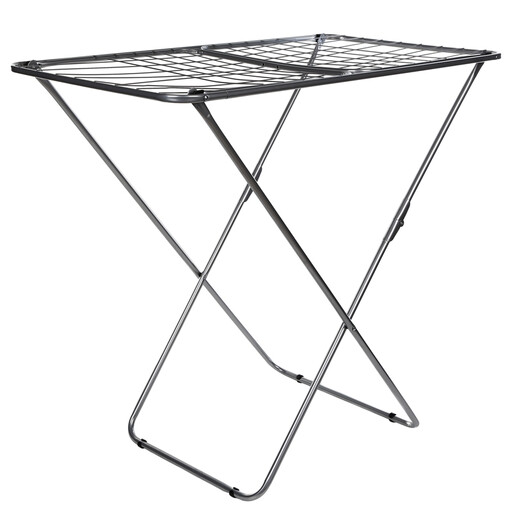
5five clothes airer with 18 m of drying space

5five clothes airer – 18 m of drying space

An option for drying laundry indoors if you want an airer you can set up without tools.

The description lists 18 m of drying space and metal and plastic components.

View at Joybuy

Frequently asked questions

Does an electric clothes airer need a CE marking?

Electrical equipment covered by the relevant European rules must meet safety requirements and carry a CE marking. Check the details for the exact model; the CE marking is the manufacturer’s declaration, not approval by a central EU body.

Can I keep the laundry area closed while clothes are drying?

Make sure damp air can escape and fresh air can get in. Kenniscentrum Duurzaam Leven points out that excess moisture can cause mould; a heated airer doesn’t remove the need for ventilation.

Can I use a heated clothes airer in the bathroom?

Don’t rely on the product category alone. DOMO lists IPX4 for the DO7117DR and says it can be used in a bathroom; the suitable location depends on the instructions for that model and where the socket is. Don’t assume the same applies to other airers.

How can I estimate the energy use of a heated airer?

For a simple estimate, multiply the rated power in kW by the number of hours it’s used; this gives you kWh. At four hours, the 150 W listed by DOMO comes to 0,60 kWh, before applying your own tariff. This is a calculation, not a measurement of an actual drying session.

What if a heated airer breaks quickly during normal use?

For a consumer purchase in the Netherlands, the seller is responsible for the statutory guarantee if the product doesn’t provide what you could reasonably expect during normal use. ACM ConsuWijzer explains that any manufacturer’s guarantee doesn’t automatically limit this statutory right.
