A heated winged airer can hold several uniform items at once, provided you have enough room to open it out. A small heated airer takes up less floor space but offers less room to spread clothes out. If an unheated airer dries your school washing in time, you don’t need heating. Whichever type you choose, drying clothes indoors calls for ventilation, and the care label should always guide your drying method.
Which airer is right for you?
Parent with limited floor and storage space
You’re looking for an airer that fits while clothes are drying and can be folded away or moved afterwards. Compare its dimensions when open with the space you have available. DOMO, InnovaGoods and Leifheit list model dimensions or foldable designs.
Parent with regular school washing
You want to hang uniform items separately and need to weigh up the drying space available against the space the airer takes up. Compare the layout of the bars or the stated drying length with the clothes you usually dry at the same time.
Renter with a damp drying area
You need a place indoors where damp air can be removed. Milieu Centraal explains that ventilation brings in fresh air and removes stale air; a heated airer doesn’t replace air circulation.
What should you look for when choosing?
Heated winged airer
Best for: spreading out several uniform items at once, if you have room for its full width when open.
Consider: it takes up more floor space while in use, and heating uses electricity.
Small heated standing airer
Best for: drying a few items at a time when there isn’t room for a wider airer.
Consider: its more compact design offers less room to hang items separately.
Unheated folding airer
Best for: school clothes that dry in time without extra heat, and for anyone who wants to put the airer away after use.
Consider: it has no heating function; drying clothes indoors may still call for extra ventilation.
First, measure the space available while clothes are drying and once the airer is put away. The percentages below indicate how many consumers put each consideration first.
| What to consider |
What to look for when buying |
Who is this important to? |
| Space and storage |
Measure the available floor space and clearance; compare the model’s dimensions when open and folded. |
If I have limited floor and storage space, I want to know whether the airer will fit while clothes are drying and can be moved out of the way afterwards. Around 30% of consumers put space first. |
| Amount of school washing |
Compare the layout of the bars or the drying length with the uniform items you want to hang up at the same time. |
With regular school washing, I want to be able to hang several uniform items separately. Around 30% of consumers prioritise the amount of washing. |
| Damp and ventilation |
Check that the chosen spot can be ventilated and follow the model’s placement instructions. |
If I dry clothes indoors in a damp room, I want the air to be refreshed; heating doesn’t remove moisture by itself. Around 20% of consumers put moisture control first. |
| Heating and running costs |
Compare the stated power rating and control features; work out electricity costs using a suitable running time and your own tariff. |
If I want to limit extra electricity use, I want to know whether an unheated airer will fit my schedule. Around 20% of consumers put running costs first. |
Common buying mistakes
-
Only checking the airer’s folded dimensions
A winged airer takes up more space when opened out. If a model blocks a passageway while in use, you may need to find another place to dry clothes or choose a different size.
Measure the space with the airer open and clothes on it, then compare it with the model’s dimensions.
If the airer blocks a passageway, you may need to find another place to dry clothes.
-
Assuming heating removes moisture
A heated airer also releases moisture from clothes into the air indoors. Milieu Centraal describes ventilation as bringing in fresh air and removing stale air.
Choose a spot with working ventilation. If damp or mould problems keep coming back, you may need to speak to your landlord.
-
Confusing wattage with the cost of each drying session
A stated power rating, such as 150 W or 230 W, doesn’t measure the electricity used to dry a full load of school washing, nor does it tell you how long drying will take.
Compare models using the same running time and electricity tariff. Also consider whether an unheated airer will work for your schedule.
Electricity costs depend in part on how long the airer is switched on and on your own tariff.
-
Assuming a similar-looking Joybuy airer is the same model
A folding airer with side wings may look like another model, but that doesn’t confirm that the brand and model are the same.
Check the brand name, full model name and specifications of the product you want to compare.
Brands to compare
DOMO
The DO7117DR is a small, freestanding heated airer for anyone who wants to hang a few items at a time.
- DOMO states that the DO7117DR has a power rating of 150 W, a built-in timer, IPX4 and freestanding dimensions of 52,5 × 36,5 × 90 cm.
- The manufacturer also mentions wall-mounted use. Consider any installation separately if you’re renting; the product specifications don’t confirm drying times or child safety.
InnovaGoods
The Warmmat is a folding, heated winged airer for anyone who wants to spread out several items and has the space to open it fully.
- InnovaGoods specifies 20 heated bars, 230 W, six temperature settings from 35–60 °C and a timer of up to 12 hours.
- These product specifications aren’t an independent test of how long school uniforms take to dry.
Leifheit
The Pegasus 150 Solid Slim is an unheated alternative for anyone looking for a folding, freestanding airer.
- Leifheit lists a width of 55 cm and a drying length of 15 m for this model.
- The airer has no heating function. Its stated drying length doesn’t guarantee that a particular load of school washing will dry in time.
Innotic
A heated winged airer to compare with models offering more room to spread clothes out.
- Product information lists 230 W and 20 heated bars.
- Check the exact version and dimensions before buying: the available product information doesn’t consistently list the same measurements. The stated features aren’t an independent performance test.
Clothes airers at Joybuy
This selection includes unheated folding airers and a heated winged airer. Compare the space required, drying method and any installation requirements with your own situation.
 No image available
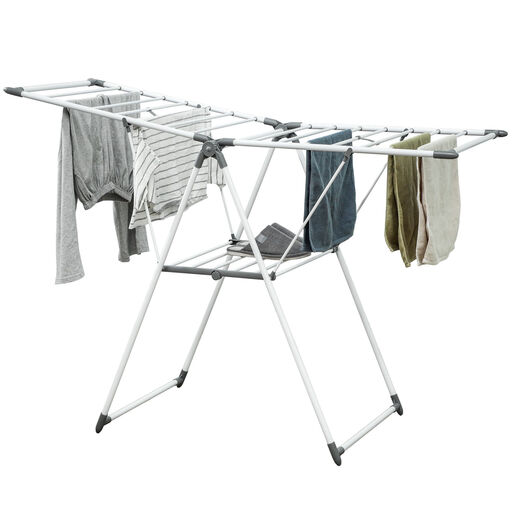
Folding clothes airer with two adjustable levels
An unheated indoor airer with two hanging levels; according to the description, it folds down to a depth of 8 cm.
Dimensions: 156,5 × 61,5 × 97 cm. Colour: white.
View at Joybuy
 No image available
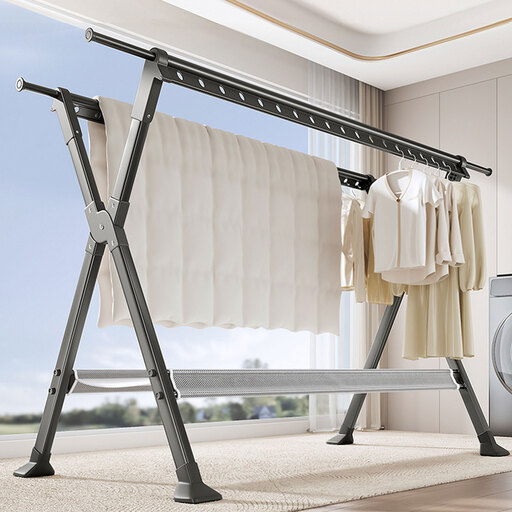
JOYBOS metal folding, extendable clothes airer
An unheated airer with an adjustable length, for anyone who wants to adapt the drying space to the room available.
According to the product description, the length adjusts from 136 to 230 cm; the airer has 42 hanging holes and folds flat for storage.
View at Joybuy
 No image available
Electric heated clothes airer with two side wings
The two side wings provide room to spread clothes out; the airer is designed for indoor use.
Power: 230 W. Dimensions: 144 × 53 × 91 cm. Recommended maximum load: 10 kg.
The product description calls for a stable, level surface, adequate ventilation and a clearance of at least 31 cm from walls. Check the full instructions for use.
View at Joybuy
 No image available
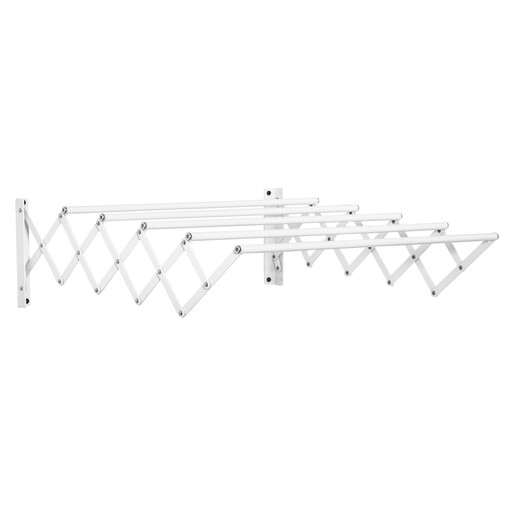
Folding wall-mounted airer with five rails
An unheated airer with five rails that folds flat against the wall when not in use.
Dimensions: 63,5 × 60 × 20 cm. Wall mounting is required, so bear this in mind if you’re renting.
View at Joybuy
Frequently asked questions
Can I put a heated clothes airer in the bathroom?
It depends on the exact model and where it can be used. DOMO lists IPX4 for the DO7117DR; check the manual for guidance on positioning it in relation to water and sockets. That rating doesn’t automatically make every spot in a bathroom suitable.
Do I need permission to install a wall-mounted airer in a rented home?
According to the Dutch Government, permission isn’t needed for a minor change that can be reversed without too much expense, such as filling in small holes. Consider whether your particular installation falls into this category; permission is required for renovation work. A freestanding airer avoids the need for installation.
How should I dry a uniform that isn’t suitable for tumble drying?
Follow all the drying symbols on the care label. GINETEX distinguishes between a ban on tumble drying and natural drying, such as drying flat or on a line. A ban on tumble drying doesn’t automatically mean the garment can be placed directly on a heated bar; check the airer’s instructions too.
What should I do with an electric clothes airer after use?
Follow the instructions for switching it off, letting it cool down and cleaning it. Brandweer Nederland advises switching electrical appliances off completely and making sure heat can escape.
Does a CE mark prove that a clothes airer dries well?
No. According to Dutch government information, CE is not a quality mark or proof of drying performance. Check the product information and the specifications for the specific electric airer.


