
If you have limited storage space
You dry T-shirts indoors and need to put the airer away somewhere narrow after use. So measure both the space available when the airer is open and the place where you plan to store it.


Start by checking how much space the airer takes up both when open and when stored away. Choose an unheated airer if you can dry your clothes without extra heat, and consider a heated model only if you want to use that feature in your situation. Milieu Centraal advises drying washing on a line whenever possible. Whichever type you choose, ventilate the room and, for an electric model, check its dimensions, instructions and applicable product marking.
You dry T-shirts indoors and need to put the airer away somewhere narrow after use. So measure both the space available when the airer is open and the place where you plan to store it.
If you often hang several cotton T-shirts at once, consider how you can space them out on the airer and how well the room is ventilated. Milieu Centraal points out that drying washing indoors adds moisture to the air.
You can hang your washing up without electric heating and weigh up whether heat would make a difference in your situation. Milieu Centraal advises drying washing on a line whenever possible, preferably outdoors or in an unheated room.
Start with the space available while the airer is in use. Then compare heated and unheated options based on what you need to dry and store your T-shirts.
Choose this if: you want to dry clothes indoors and be able to switch the heating on, provided the airer fits when open.
Consider: the airer uses electricity. Allow for ventilation and check the storage dimensions of the exact model.
Choose this if: a tower shape suits your available space better and you want a cover and adjustable controls.
Consider: Silvergear lists temperature and timer settings for the Premium model; check the specific version and its dimensions. Claims that it dries clothes faster are manufacturer claims, not the result of an independent test.
Choose this if: storing and drying your washing without electric heat are your priorities.
Consider: Tomado lists a folded size of 68 × 55 × 3 cm for the Den Haag 9; this size does not automatically apply to other models.
| What to consider | What should you check? | Who is this important for? |
|---|---|---|
| Space and storage | Measure the available storage space and the area the airer takes up when open; remember to allow room to walk past it too. | I want to put the airer away somewhere narrow after use, but I also need room to walk past it; around 33% of consumers prioritise finding a suitable fit and storage. |
| Spacing out T-shirts | Check the layout of the rails or shelves and the maximum load for the exact model. | If I dry several cotton T-shirts at once, I want to hang them with space between them; around 27% of consumers prioritise having enough usable space to spread out their washing. |
| Heating and electricity use | Compare the power rating of the exact model with how long you expect to use it; a wattage figure alone does not measure drying time. | I only want to use extra heat if it makes a difference to my drying routine; around 20% of consumers weigh electricity use against the benefits of heating. |
| Ventilation and electrical use | Check the ventilation options and follow the instructions and product marking for the specific electrical model. | When drying clothes indoors, I want to be able to remove moisture from the air and follow the safety instructions for my model; around 20% of consumers prioritise indoor air quality and safe use. |
An airer may fit in your storage space when folded but take up too much room when open, or leave too little space for the T-shirts you want to hang.
Measure both the storage space and the area needed when the airer is open with clothes hanging on it.
The power rating alone does not tell you how much energy a full drying session will use; the actual time you use the airer matters too.
Compare the power rating of the exact model with how long you expect to use the airer. Don’t treat wattage as a measured drying performance.
A cover does not automatically remove moisture from your home. Ventilating the room is still important when drying clothes with heat.
Choose a suitable, well-ventilated spot and use the airer and any cover according to the model’s instructions.
The features below apply to the product ranges and models mentioned; they do not describe a brand’s entire range.
Offers folding heated clothes airers in sizes including 12 m and 21 m models.
Offers an electric tower airer with a heat cover, as well as a Premium model with adjustable controls.
Offers unheated hanging and tower airers for anyone who doesn’t need electric heat.
Offers unheated, folding HangOn airers, with options for drying clothes on hangers.
This selection for drying clothes indoors includes one heated airer and several unheated models. Check the dimensions, assembly requirements and conditions of use for each model.
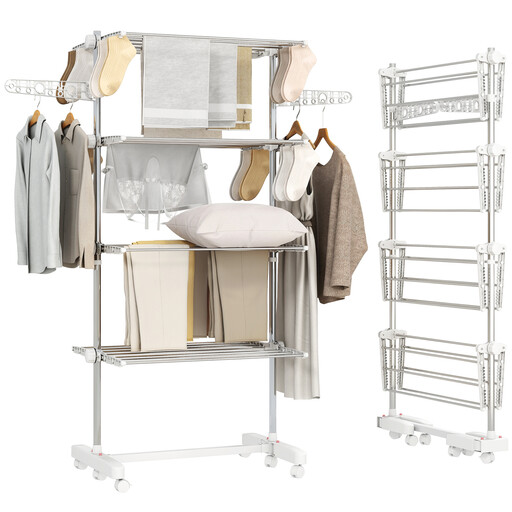 Image unavailable
An airer with several drying levels to spread your clothes across; check that it fits in your room when open.
Four main shelves and two side wings. Open: 172 × 142 × 55 cm; folded: 172 × 80 × 13 cm.
Maximum load of 6 kg per shelf. The airer has six wheels, two of which have brakes.
 Image unavailable
A heated model with side wings for anyone who wants the option of using extra heat indoors.
Listed dimensions: 144 × 53 × 91 cm. Recommended maximum load: 10 kg.
Use indoors on a stable, level surface, with ventilation and at least 31 cm clearance from walls. Follow the instructions and check the product marking for this electric model.
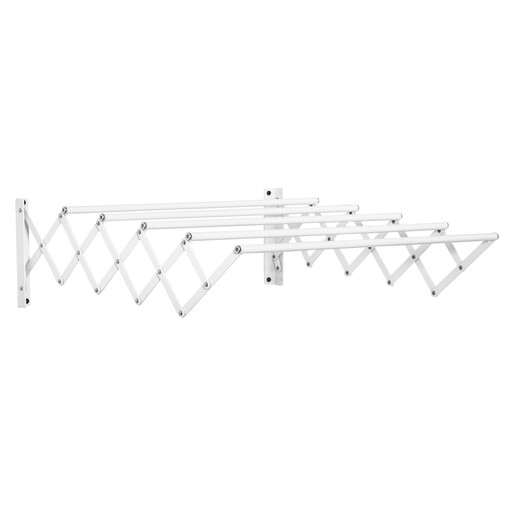 Image unavailable
A wall-mounted model that makes use of drying space without taking up floor space with a freestanding airer.
Listed dimensions: 63.5 × 60 × 20 cm. The description gives a maximum load of 2 kg per rail and 10 kg in total.
This airer needs to be mounted on a wall; check that the size and fixing location are suitable.
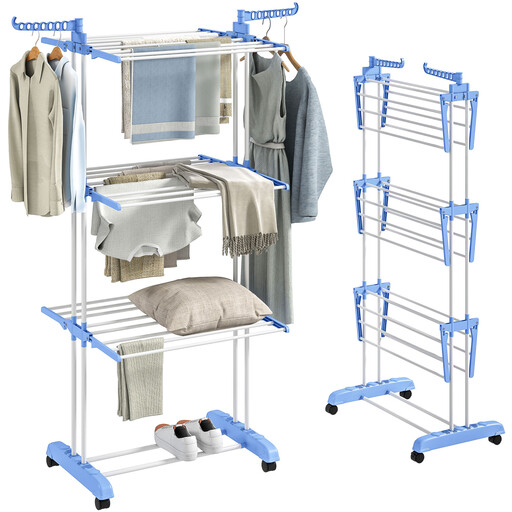 Image unavailable
A tower-style model with several drying levels, so you can spread your clothes across different racks.
Three adjustable drying racks, two side wings and four wheels, two of which lock.
The drying racks fold down and can be removed. Some assembly is required; check that you have enough space before buying.
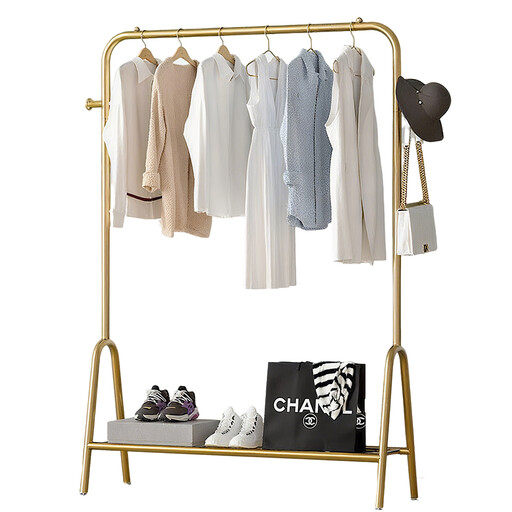 Image unavailable
A freestanding airer with a single rail for hanging clothes to dry.
The title gives a width of 100 cm.
Check that this width suits your available space and the clothes you want to hang.
Choose an unheated airer if you can dry your clothes without extra heat; it won’t use electricity to dry your washing. Consider a heated model if you want to use that feature in your situation, and compare the dimensions, power rating and instructions for the exact version.
Make sure the room is ventilated even when using a heated airer, as drying washing indoors adds moisture to the air. Milieu Centraal advises ventilating your home. Also follow the instructions for your specific model. The product description for the Joybuy model mentioned here requires ventilation and at least 31 cm clearance from walls, but that clearance does not automatically apply to other models.
Follow the instructions for the exact model. The product description for the Joybuy model mentioned here says to switch off the airer, unplug it before cleaning, let it cool down and never immerse it in water. Don’t apply these instructions to another model without checking first.
For a simple estimate, multiply the power rating in kilowatts by the number of hours of use. This won’t give you a guaranteed figure for each drying session. If a purchase breaks during normal use sooner than you could reasonably expect, ACM ConsuWijzer says the seller must offer an appropriate free solution under the statutory guarantee.
CE marking is compulsory for electrical products where the relevant European rules require it. According to the Netherlands Food and Consumer Product Safety Authority, a CE mark on its own is not proof of an independent assessment. For a standard online consumer purchase in the Netherlands, there is generally a statutory 14-day cooling-off period after delivery, subject to legal exceptions. ACM ConsuWijzer explains this cooling-off period.