What should you look for?
First compare the airer’s shape and the space available; then consider heat, ventilation and electricity use.
| What to consider |
What should you look for? |
Who is this important for? |
| Space and storage |
Measure the width, depth and height when the airer is fully open, and allow for doors, walkways and storage space. DreamGoods lists approximate dimensions of 147 × 73 × 70 cm for the 21m version. |
If I want to keep the walkway clear and put the airer away after use, I’ll check its fully opened dimensions. Around 36% of consumers prioritise space and storage. |
| Hanging space and drying time |
Check whether you can hang shorts separately and compare the number of usable rails, heat settings and any timer. A stated temperature doesn’t tell you how long your laundry will take to dry. |
If I want to wear my cotton shorts again soon, I’ll want to hang them without the fabric being packed tightly together. Around 29% of consumers rank drying time above other buying concerns. |
| Moisture and ventilation |
Check that air can flow into the room and moist air can escape. A heated airer is no substitute for ventilation; Milieu Centraal stresses the importance of airing the room. |
In a shared indoor space, I want to consider moisture levels for myself and others. Around 21% of consumers give moisture control top priority. |
| Electricity use |
Compare the stated power with the actual time you use the airer. Power in kW × hours of use gives an estimate in kWh; the rating plate doesn’t measure the electricity used for your drying session. |
If I plan to use the airer regularly, I’ll want to know how long the heating is on and how much electricity it uses. An estimated 14% of consumers consider electricity use first. |
Products at Joybuy
These product picks are for hanging and drying laundry in a shared room, with space and storage in mind.
 No image available
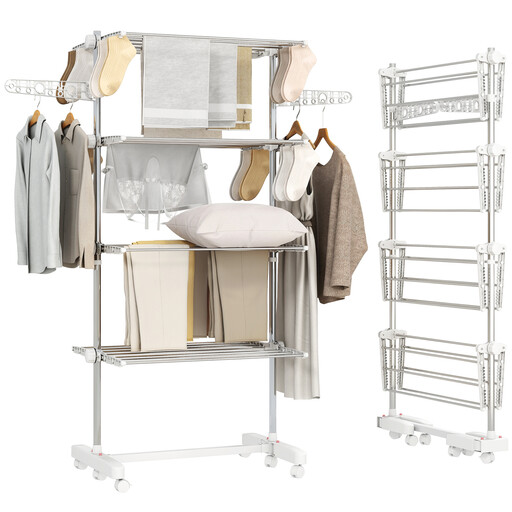
Folding clothes airer with four shelves, side arms and wheels
An option if you want to hang laundry across several levels and fold the airer away after use.
Four shelves, side arms with hanger slots and wheels with brakes. The stated folded dimensions are 172H × 80L × 13W cm. Distribute the laundry evenly, load each shelf with no more than 6 kg and lock the wheels during use.
View at Joybuy
 No image available
Folding electric clothes airer with 2 side wings, 230 W, 144 × 53 × 91 cm, silver
A heated winged airer to consider if you want to hang shorts separately and fold the airer away after use.
The stated dimensions when open are 144 × 53 × 91 cm and the power is 230 W. The product description gives a temperature of 45–55 °C. Use it indoors on a stable, level surface, with adequate ventilation and at least 31 cm of clearance from walls. Plug it into an earthed socket that matches the appliance’s mains voltage.
View at Joybuy
Frequently asked questions
How do you position a heated clothes airer safely in a shared laundry room?
Place the airer somewhere stable and follow the instructions for the exact version, including guidance on connecting it, clearance and switching it off. The Fire Service advises placing electrical appliances where heat can escape; also check that the room can be ventilated properly.
How do you maintain a heated clothes airer?
Follow the cleaning and maintenance instructions for your exact model. This helps you avoid accidentally applying guidance for a different version to your airer.
Is a heated clothes airer cheaper to run per drying session than a tumble dryer?
You can’t tell from the wattage alone: you need the energy use and running time of both appliances, compared on the same basis. An unheated airer uses no electricity itself; when drying indoors, remember to ventilate, as Milieu Centraal advises.
What are your rights when buying online in the Netherlands?
For an online consumer purchase, you generally have 14 days from delivery to change your mind, according to ACM ConsuWijzer. Separately, the seller is responsible for the statutory guarantee if the product doesn’t meet what you can reasonably expect from it under normal use, as the Netherlands Authority for Consumers and Markets explains.
Does an electric clothes airer need a CE marking?
Electrical equipment covered by applicable harmonised EU rules must have a CE marking. The Low Voltage Directive applies to equipment designed for, among other things, 50–1,000 V AC. Check the rated voltage and information for the exact model; according to the European Union, the CE marking is the manufacturer’s declaration of conformity, not an independent quality mark for drying performance.


