
Swimmer with delicate swimwear
You want to dry your swimwear with care while also making room for everyday laundry. The care label will tell you whether heat is unsuitable.


Use the care label on your swimwear as your guide. If it says to dry the garment away from heat, choose an unheated spot. A heated winged or tower airer may suit the rest of your weekly laundry, provided its drying capacity, load limit and footprint meet your needs. When drying clothes indoors, remember to ventilate the room, and check the product information for the UK version if you’re considering an electric model.
You want to dry your swimwear with care while also making room for everyday laundry. The care label will tell you whether heat is unsuitable.
You dry different garments at the same time and need to balance drying space and load capacity against the floor space available.
You’re looking for an airer that fits when open and can be stored away afterwards. If you dry clothes indoors, you’ll also need to consider moisture and ventilation.
| Buying concern | What should you look for? | Who is this important to? |
|---|---|---|
| Drying swimwear without unwanted heat | Follow the care label and check whether you have a suitable unheated place to dry it. | If the label rules out heat, I want to dry my swimwear separately, away from heated rails. Around 33% of consumers prioritise caring for swimwear. |
| Space for the rest of the weekly wash | Compare the drying length, load capacity, rail layout and access to the different levels. | For a mixed weekly wash, I want enough room to hang garments with space between them. Around 27% of consumers give capacity for everyday laundry top priority. |
| Space to set up and store away | Measure the available width and height, and check the dimensions of the model. | In a small home, I want to know whether the airer will fit in the drying area and can be stored away afterwards. Around 20% of consumers focus mainly on the space available. |
| Energy use and moisture | For a heated model, compare the stated power rating and running time; ventilate the room when drying clothes indoors. | When I dry washing indoors, I want to take both energy use and moisture in the home into account. Around 20% of consumers prioritise these points. |
Even a low heat setting doesn’t automatically mean a garment can be dried on heated rails. For the Arena swimming trunks model examined, the care instructions say to dry away from heat.
Follow the care label on your own swimwear and use a separate, unheated place to dry it if needed.
The load capacity doesn’t tell you how much space will be left between garments or how long they’ll take to dry.
Compare the rail layout and drying length, and leave enough space between everyday garments when you hang them up.
A model that looks like a clothes airer we’ve reviewed isn’t necessarily the same version or suitable for the UK market.
Before buying, check the full model name, version and electrical product information.
Heated winged airers; the Warmmat model is designed for those looking for adjustable heat and a timer.
The range includes compact and multi-tier heated airers, worth considering if you need to hang your everyday laundry across several levels.
Unheated clothes airers are an option when the care label says laundry should be dried away from heat.
Unheated compact and larger airers are worth considering when weighing up your available setup space against the room needed for a weekly wash.
These clothes airers are intended for mixed weekly laundry. Dry swimwear separately if its care label says to keep it away from heat.
 No image available
The heated side wings are intended for everyday laundry that the care label says can be dried with heat.
Stated power: 230 W. The model has two side wings and measures 144 × 53 × 91 cm.
For an electric model, check that the version is suitable for the UK and has the required CE marking.
 No image available
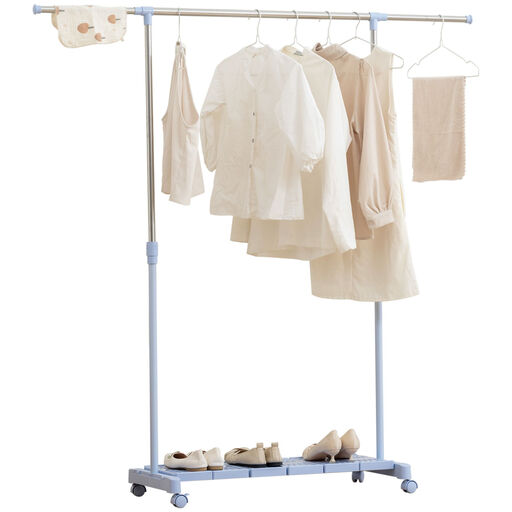
The adjustable width and height give you several options for setting up the airer in a suitable spot.
Width: 94–159 cm; height: 93–168 cm. Stated maximum load: 15 kg. The airer has four castors, two with brakes, and a lower shoe shelf.
 No image available
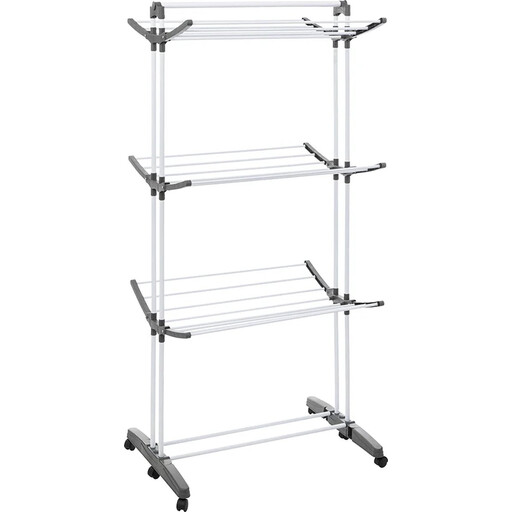
The stated drying length can help you decide whether this model has room for a larger mixed load.
Drying length: 24 m; maximum load: 40 kg. The airer folds away and measures 125 × 62 × 172 cm.
This model requires self-assembly.
 No image available
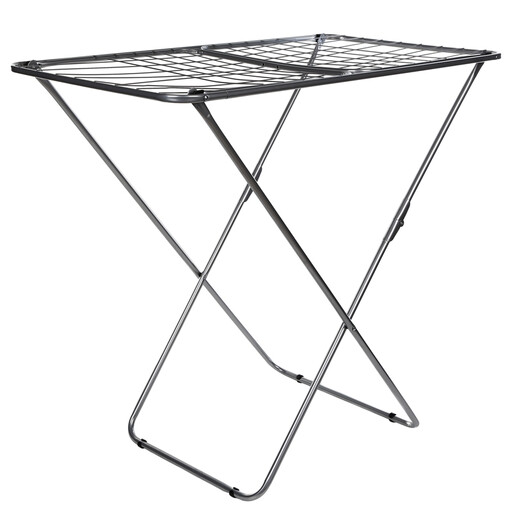
The stated drying length makes this model worth comparing with the amount of washing you usually hang out.
Drying length: 18 m. The product description says it can be set up without tools and stored away to save space.
 No image available
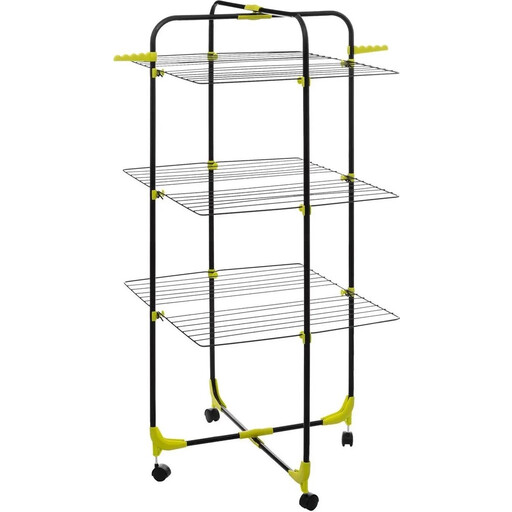
The three drying levels give you several places to hang different laundry items.
Drying length: 30 m; maximum load: 15 kg. The tower folds away and measures 65 × 70 × 137 cm.
This model requires self-assembly.
Not if the care label says to dry the swimwear away from heat. Arena gives this advice for the swimming trunks model examined. Follow the care label on your own garment, rather than assuming a low setting on an airer is safe.
Choose a stable spot that follows the instructions for the specific model. Ventilate the room when drying clothes indoors: the moisture from your washing doesn’t disappear just because the rails are warm. Milieu Centraal explains why good ventilation matters for the air in your home.
Multiply the stated power in kilowatts by the number of hours the airer is switched on to calculate energy use at a constant rated power. At the 230 W stated by InnovaGoods, four hours would use 0.230 × 4 = 0.92 kWh; actual energy use may differ if the controls adjust the power.
The relevant CE marking applies to electrical products with a rated AC voltage between 50 and 1,000 V. The Netherlands Food and Consumer Product Safety Authority explains these low-voltage rules; check the marking and product information for the specific version. CE marking alone doesn’t mean that every consumer product has been independently tested.
Report a fault to the seller. According to ACM ConsuWijzer, in the Netherlands, alongside any manufacturer’s or seller’s guarantee, you have a legal right to a product that, under normal use, meets what you could reasonably expect from it.