Choose an airer based on how many aprons need to hang at once, how much time there is between stays and how much space you have. A compact heated airer may suit a few aprons; for more washing, consider a larger model, while an unheated airer is an option if there’s enough time for clothes to dry. If you dry clothes indoors, make sure the room is ventilated and check the electrical specifications and required CE marking before you buy.
Which clothes airer is right for you?
Property manager with a short changeover time
If you need to hang aprons out to dry between stays, first check how many can be spread out on the airer at once. Manufacturers list different dimensions and drying capacities, but these figures alone don’t tell you how long aprons will take to dry.
Holiday-let owner with limited drying space
You’ll need space for the airer both while it’s in use and when it’s stored away. A small freestanding or wall-mounted model and a larger folding model each need a different amount of space.
Holiday-let owner who dries clothes indoors
If you hang aprons indoors, bear ventilation and the instructions for electrical appliances in mind. Milieu Centraal recommends extra ventilation when drying washing indoors.
What should you look for?
Small heated airer
Choose this if: you dry a few aprons at a time and have limited floor space, or a suitable spot for wall mounting.
Bear in mind: there may be less space to hang several aprons separately. The dimensions and wattage don’t prove how long drying will take.
Larger heated airer with several tiers
Choose this if: you regularly need to dry more aprons or other washing at once and have room to spread it out.
Bear in mind: a larger airer takes up more space both in use and when stored away. Beldray lists three tiers and 20 m of drying space for model EH3786; these are manufacturer specifications, not the result of an apron drying test.
Unheated clothes airer
Choose this if: there’s enough time between stays and a heated airer isn’t essential. Milieu Centraal suggests line drying as an alternative.
Bear in mind: extra ventilation is still needed when drying clothes indoors, and this doesn’t guarantee how long aprons will take to dry at your holiday home.
| What to consider |
What should you check? |
Who should give this more weight? |
| Drying space when changeover time is short |
Count the aprons needed for each changeover and compare this with the hanging space and dimensions of the exact model. |
If there’s little time between stays, I want to know whether all the aprons can be spread out to dry. Around 36% of consumers say the number of hanging spaces is their main requirement. |
| Where to put it and where to store it |
Check the space available for use and the storage space needed; check the dimensions for assembly and storage separately. |
If the drying area is needed for other things too, I want to know in advance where the airer will go and where it will fit after use. For around 29% of consumers, placement and storage are the main considerations. |
| Moisture when drying clothes indoors |
Work out how moist air can be removed from the drying area. |
If I dry aprons indoors, I want to know whether the chosen spot can be ventilated. Around 21% of consumers prioritise a suitable drying space and ventilation. |
| Electricity use and running costs |
Compare the wattage, actual running time and the same electricity tariff; wattage alone doesn’t tell you the cost per drying session. |
If the airer is used often, I want to be able to estimate the running costs and consider an unheated airer too. Around 14% of consumers say electricity use is their main consideration. |
Common buying mistakes
-
Assuming drying length proves how long drying takes
A stated drying length or wattage doesn’t tell you when your aprons will be dry.
Choose an airer with enough hanging space for the number of aprons you have. Treat any expected drying time as uncertain unless it’s been verified for your specific use.
-
Choosing a heated airer without a ventilated place to dry clothes
Drying clothes indoors releases moisture. Milieu Centraal recommends extra ventilation when drying washing indoors.
Before choosing an airer, decide where it will go and how the room will be ventilated.
-
Assuming a product listing confirms the model’s specifications
A product page or the fact that a product comes from another country doesn’t confirm that the version on offer meets Dutch requirements. According to the NVWA, CE marking is compulsory for electrical consumer products.
Before buying, check the CE marking, plug and instructions for the exact version on offer.
Brands to consider
DOMO
An example to consider if you’re looking for a compact heated airer that can be used freestanding or wall-mounted.
- For model DO7117DR, DOMO lists 150 W, a timer, IPX4 and dimensions of 52,5 × 36,5 × 90 cm. These are manufacturer specifications, not the results of an independent drying test.
- Check that the chosen location and any mounting are suitable, and that there’s enough room to hang your aprons.
Beldray
An example of a larger heated airer with several tiers.
- For EH3786, Beldray lists 36 heated bars, 20 m of drying space, 300 W and a folding design.
- These manufacturer specifications don’t confirm how long drying takes or whether the version on offer is suitable for the Netherlands. Check the specifications and marking before buying.
Dry:Soon
According to the brand’s website, its range includes airers with three tiers and a drying pod, offering different styles and capacities to compare.
- For the Deluxe version, Dry:Soon lists a maximum load of 15 kg of washing and 21 m of drying space.
- These figures apply to that version and don’t confirm that there’s a Dutch model variant or indicate how well it will dry aprons.
Leifheit
An unheated alternative to consider if a heated airer isn’t essential and there’s enough time for clothes to dry.
- For the Pegasus RockSolid, Leifheit lists 21 m of drying length.
- This isn’t a heated model, so don’t compare it with a heated airer based on electrical power or an unproven drying time.
Products for drying clothes indoors
These Joybuy products include a wall-mounted model, a folding heated airer and a portable dryer. For each electrical product, check that the version on offer carries the required CE marking. Only choose a model if it’s suitable for the intended use and the space available.
 No image available
Electric heated towel rail with touch controls, digital temperature display and top shelf
This wall-mounted model may suit you if you want to keep the floor clear. Check whether the intended mounting location and use with aprons are suitable.
The product name specifies touch controls, a digital temperature display and a top shelf. Wall mounting is required.
View at Joybuy
 No image available
Folding electric heated clothes airer, 230 W, 144 × 53 × 91 cm
This airer may suit you if you want to spread out several items of clothing and store it between stays. Check that its dimensions are suitable for your drying and storage space.
The product name specifies two side wings, a power rating of 230 W and dimensions of 144 × 53 × 91 cm. Follow the instructions on positioning and ventilation.
View at Joybuy
 No image available
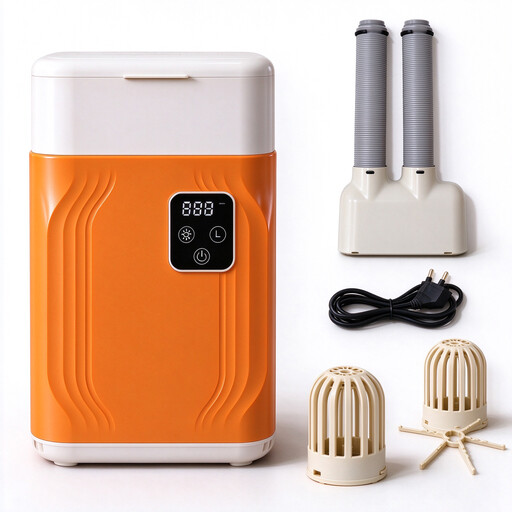
HB-222 portable multifunctional clothes and shoe dryer with timer
This portable dryer is different from an open clothes airer. Consider it only if this type of appliance suits the amount and shape of your aprons.
The product name specifies a 3-in-1 design, heating and a timer. The product information warns that the air outlet gets hot and that the appliance must be at least 50 cm away from flammable materials.
View at Joybuy
Frequently asked questions
How do I know whether a clothes airer is big enough for my aprons?
Count how many aprons need to dry at once and compare this with the hanging space and dimensions of the exact model. A stated drying length doesn’t guarantee that your aprons will fit without overlapping or be dry before the next guests arrive.
Can I dry aprons indoors without extra ventilation?
Milieu Centraal recommends extra ventilation when drying washing indoors. Check that the chosen spot can be ventilated; a heated airer doesn’t remove the need to do this.
Is CE marking required for an electric clothes airer in the Netherlands?
According to the NVWA, CE marking is compulsory for electrical consumer products; the same source says individual testing isn’t generally required. Check the marking on the version on offer.
How much does it cost to dry one load on a heated airer?
You can’t work this out from the wattage alone. Calculate electricity use in kWh by multiplying the power in kW by the actual running time in hours, then multiply this by your electricity tariff. For a fair comparison, use the same running time and tariff; the time needed to dry aprons hasn’t been established.
What should I consider when positioning and using an electric airer?
Follow the instructions for the exact model when positioning and cleaning it, and check the cord and connection before use. The Fire Service advises allowing electrical appliances to release their heat. This doesn’t confirm that a specific model can be used anywhere or left unattended.


