
Speaker in a fixed position
You record spoken audio at a table and can position the microphone close to your mouth. Clear speech and a straightforward computer setup are important.


Choose a setup that keeps the microphone close to the speaker. As Shure explains, a microphone cannot improve the acoustics of a classroom. For a stationary speaker, you can connect a USB microphone directly to a compatible computer. If you’ll be moving around, a wireless clip-on microphone is a good fit; for two speakers, you’ll need two transmitters or enough microphone inputs. Check the connections and what’s included in the set, then make a test recording in the intended location.
You record spoken audio at a table and can position the microphone close to your mouth. Clear speech and a straightforward computer setup are important.
You speak while moving around the classroom and need a microphone that moves with you.
You record a narrator and a second speaker at the same time. Choose the number of microphones and recording inputs to suit your setup.
For this type of recording, your choice should focus on clear speech, easy connectivity, freedom to move and the ability to record two people at once.
| What to consider | What to look for when buying | Who is this important for? |
|---|---|---|
| Clear speech in an echoey room | Keep the microphone close to the speaker and assess the sound with a test recording in the intended location. | If I’m recording in an echoey room, I want my voice to remain clear, so I test the recording position. For around 36% of consumers, clear speech despite echo is the main reason to buy. |
| Easy connectivity | Check that USB works with your computer. An XLR microphone also needs an audio interface for computer recording. | If I want to record one speaker on a compatible computer, an easy connection is a major factor. Around 29% of consumers say easy setup is their main reason to buy. |
| Freedom to move | Check that the transmitter and receiver you choose connect to your camera or phone and are suitable for the recording you want to make. | When my speaker walks around the room, I want the microphone to move with them. For around 21% of consumers, freedom to move is the main reason to buy. |
| Two voices at once | Check how many transmitters or microphones are included and how many inputs your recording equipment has. | If I’m recording two people at once, I want a separate microphone for each person or enough inputs. For around 14% of consumers, recording two speakers is the main reason to buy. |
A microphone cannot improve the acoustics of a room. A voice-processing feature doesn’t guarantee that echo will disappear.
Make a test recording where you’ll be speaking and listen back before recording the full voice-over.
If the recording is unusable, you may have to record the voice-over again or spend more time editing it.
According to DJI, the 1 TX + 1 RX set includes one transmitter, while the 2 TX + 1 RX set includes two transmitters and a charging case.
Compare the full bundle name and contents with the number of people speaking at the same time.
For two speakers, you may need an extra transmitter or a different set.
These connections require different recording setups: for XLR recording on a computer, you’ll also need an audio interface.
Compare complete setups that work with your computer, not just the microphones.
An XLR computer setup also requires an audio interface and an XLR cable.
The MV7+ is a dynamic microphone for speech, with USB-C and XLR connections, designed for a speaker in a fixed position.
The PodMic USB is a dynamic microphone with USB-C and XLR connections; the NT-USB+ is a separate USB condenser microphone.
The Mic 3 is designed for speakers on the move and is available in sets with different numbers of transmitters.
The Wave:3 MK.2 is a USB condenser microphone for a fixed computer setup.
The H1essential is a portable recorder with built-in X/Y microphones for recording without a fixed computer setup.
These product choices are suited to wireless clip-on recording, a fixed USB setup and standalone speech recording.
 Image unavailable
This set is suitable for a speaker who moves around or for two people recording at the same time.
The title lists two transmitters and one receiver. The product description mentions clip or magnetic attachment and connection to cameras, smartphones and PCs.
 Image unavailable
This wireless lavalier microphone system is a good fit for a speaker who moves around while recording.
The product information lists 48 kHz/24-bit audio, a 9 g transmitter and up to 10 hours of use from the transmitter; the charging case can provide additional use.
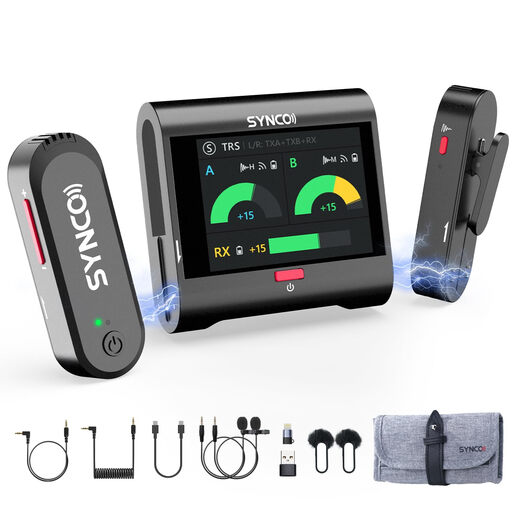 Image unavailable
This system with two microphones is suitable for a recording with two speakers.
The product information lists gain control, a headphone socket and TRS/TRRS and USB-C outputs for cameras and smartphones. Check that the connections are compatible with your recording device.
 Image unavailable
This microphone is suited to a fixed computer setup where you want to monitor the recording as you work.
The product information lists a USB connection, cardioid pickup pattern, headphone monitoring and an included scissor-arm stand.
 Image unavailable
This device is an option for recording spoken audio without a separate setup.
The product information lists 64 GB of storage, plus transcription and summaries in 118 languages.
Don’t assume it will: according to Shure, a microphone cannot improve the acoustics of a room. Position it closer to the speaker and assess a test recording made in the intended location.
For the computer setup described, you’ll also need an audio interface and an XLR cable for an XLR microphone. A USB microphone can connect directly to a compatible computer. Also check the requirements of the model you choose.
Check how many transmitters or microphones are included and how many recording inputs are available. According to DJI, the Mic 3 set with 1 TX + 1 RX includes one transmitter, while the set with 2 TX + 1 RX comes with two transmitters.
An XLR microphone connected to a computer needs an audio interface and an XLR cable. If you’re using a recorder, also check what storage medium and power supply it needs.
First, check the privacy rules that apply to the specific recording. The Dutch Data Protection Authority considers identifiable audio recordings to be personal data; processing them requires an applicable legal basis under the GDPR, and schools have a duty to provide information. The situation depends on the recording and how it is used.