
Organising a hybrid recital
You want online listeners to be able to follow the performance while pupils are in the classroom. Your setup needs to handle both picture and sound for both groups.


The right camera depends mainly on how the pupils will perform and how clearly their voices will come across online. A webcam may be enough for one stationary speaker, while a group or speakers who move around will need a wider view. A tracking camera can follow a moving performer; a PTZ camera gives you more control over the picture, but needs a separate audio setup. Specifications alone cannot guarantee that a quiet voice will be audible throughout the classroom.
You want online listeners to be able to follow the performance while pupils are in the classroom. Your setup needs to handle both picture and sound for both groups.
Pupils take turns performing or move to a speaking position. You need a camera setup that won’t require constant manual adjustments.
The performance takes place in one spot and you want a simple USB setup. You don’t need the whole class to be in view at all times.
Choose this when: one performer stays in the same place and a compact frame is all you need.
Trade-off: a fixed field of view is less suitable for showing the whole class or several speaking positions at once.
Choose this when: several performers are standing close together and you want camera and audio in one setup.
Trade-off: a wide group shot shows more of the surroundings, but makes each individual speaker appear smaller.
Choose this when: the performer moves around within a defined area of the classroom.
Trade-off: tracking follows the action, but doesn’t prove that the speaker’s voice will be picked up clearly from a distance.
Choose this when: you want to frame different speaking positions precisely and can set up or operate the camera yourself.
Trade-off: plan and test the audio separately; camera features don’t provide a complete audio setup.
Choose this when: performers are standing side by side across a wide area, such as at the front of a shallow classroom.
Trade-off: a panoramic view isn’t the same as a close-up, nor does it guarantee that pupils at the back of the class can hear clearly.
| What to consider | What to look for when buying | Relevant to these consumers |
|---|---|---|
| Clarity of speech | Check what audio is included and test a quiet performance from the furthest speaking position with an online listener. | If I speak quietly, I want to know whether online listeners can hear me from the furthest speaking position. Around 36% of consumers put clear speech first. |
| Changing speaking positions | Decide where pupils will stand and practise switching between two performers in advance. | When pupils take turns moving between positions, I want to know whether the camera will keep them in view. Around 29% of consumers give changing performers their highest priority. |
| Group shot | Mark the speaking positions and decide whether you need a group view or a close-up. | If several pupils perform at the same time, I want to be able to show them together. Around 21% of consumers choose with the group shot in mind. |
| Ease of use | Check the connections, power supply, mounting and compatibility with your chosen video-calling software; test the whole setup in advance. | I want to support the performance without having to operate equipment constantly. Around 14% of consumers prioritise easy connection and operation. |
Being able to see someone’s face doesn’t guarantee that a quiet performance will be easy to hear online. SURF describes making presenters audible without feedback as a challenge in hybrid classrooms.
Design and test the audio chain from the actual speaking positions before treating the camera as a complete solution.
A separate audio chain may require extra equipment and preparation.
A webcam with a fixed, narrower field of view may cover less than a wide-angle video bar. Logitech lists a diagonal field of view of 78° for the C920e; according to Logitech, the MeetUp has a 120° field of view.
First decide who needs to be in the picture at the same time. Then compare the field of view and camera position in the classroom.
Making a recording, showing identifiable pupils and sharing the video are separate decisions. The Dutch Data Protection Authority and the Dutch Government treat privacy and copyright as separate considerations.
Before sharing, consider separately who will be identifiable in the video and what rights apply to the text being performed.
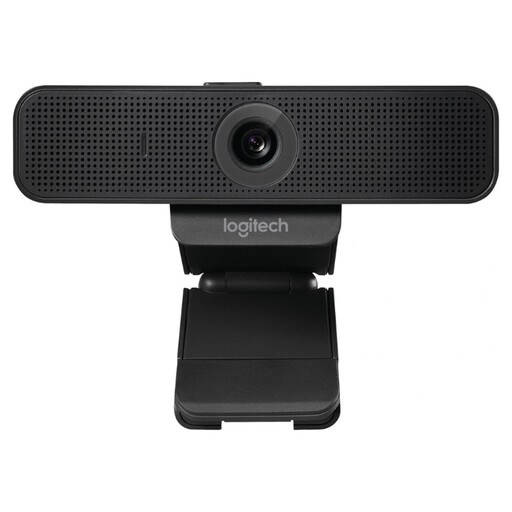
The C920e is designed for one stationary speaker; the MeetUp is a USB video bar for small groups.
Studio R30 is a USB video bar for a small room when you want a group view and integrated audio.
Tiny 2 Lite is a tracking webcam for a performer who moves within a set area.
CAM520 Pro3 is a controllable PTZ conference camera for pre-selected speaking positions.
PanaCast 50 is a panoramic video bar for a wide group close to the camera.
This Joybuy selection includes webcams for computer-based performances, from a single stationary speaker to a wider shot with more than one person. Check that the field of view and microphone suit the speaking position in your classroom.
 No image available
Suitable for a performer in a fixed position when you want to connect the camera to a computer or tripod via USB.
The stated field of view is 80°. The webcam has autofocus and manual focus, USB 2.0 and a built-in omnidirectional stereo microphone. The product title lists 1440p/1080p at 60 fps.
 No image available
Could suit a computer-based performance where you need a table tripod and a choice of USB connections.
The title lists PDAF autofocus, dual microphones and USB-A/USB-C. The product specifications state a 75° field of view.
 No image available
The wider field of view may be useful if you need to include more than just the performer in the frame. Check the image from the camera’s actual position.
The title lists 4K, a 99° field of view, a built-in noise-cancelling microphone and a privacy cover.
 No image available
The fixed field of view is designed for a compact frame around one or two people; check that it suits the speaking position.
The product specifications list a 78° field of view, Full HD 1080p at 30 fps, a built-in microphone and an adjustable clip.
 No image available
This webcam is designed for individual use and can be attached to a laptop or external monitor.
The product specifications list a fixed 78° field of view, autofocus, automatic light correction, a privacy shutter and a USB connection.
No. Live video calling and saving a recording are two separate choices. The Dutch Data Protection Authority advises educational institutions to consider whether pupils need to appear on screen; for a lesson recording, pupils should in principle not be shown. Agree in advance when recording will start and who will be seen or heard.
Not automatically. The Dutch Data Protection Authority states that consent is needed for identifiable images of pupils: from the pupil themselves from the age of 16, and from parents for younger pupils. Internal video calls and publication are different types of use; also consider the purpose, the applicable GDPR lawful basis and arrangements for storage and retention.
It depends on the model. Logitech describes MeetUp as an all-in-one camera that connects via USB; HP states that the Poly Studio R30 needs a mains power supply as well as USB. Check the connections and make a test call before the performance.
No. The Dutch Government states that permission may be needed to use and make copyright-protected texts public. Check the rights and any arrangements for the specific poem and intended broadcast separately; buying a camera does not take care of this.
The Dutch Government states that consumers who buy from a business at a distance generally have a 14-day cooling-off period, with some exceptions. If you’re buying on behalf of a school, don’t assume that consumer rights apply; check which terms and conditions apply to that order.