Start with the classroom’s sound system: a separate wired headset microphone will only work with a compatible input, amplifier and speaker. A complete wireless system gives you more freedom to move, but also requires a transmitter, receiver and suitable frequency. If there’s no suitable sound system, a portable amplifier could be the answer; just check whether the set you choose includes the microphone you need.
Who is a headset microphone suitable for?
Presenters who want to be heard at the back of the room
You want everyone in the classroom to be able to follow your reading. The Secondary Education Working Conditions Catalogue lists voice amplification as an option for speakers addressing a large group. The right set-up will also depend on the classroom.
Presenters who move around the classroom
You want to keep your hands free and move around while you read. As well as a compatible connection, a wireless set needs a frequency version that can be used at your location. The Dutch Authority for Digital Infrastructure (RDI) explains that availability can vary by location.
Schools with existing audio equipment
You want to connect a microphone to equipment you already have. Shure, Audio-Technica and RØDE describe different connections and power requirements for their models, so check the exact version and the system’s input.
What should you consider when choosing one?
For a poetry reading, you need to be heard clearly at the back of the classroom, and the microphone must work with the equipment available. Shure describes feedback as sound from a speaker being picked up again by an open microphone.
Wired headset microphone with an existing sound system
Suitable if: you’ll mostly stay in one place and the sound system has a compatible microphone input.
Bear in mind: you’ll also need an amplifier and speaker, and the cable will limit where you can move.
Complete wireless system
Suitable if: you want to move around the classroom and can connect a receiver to the sound system.
Bear in mind: check the transmitter, receiver, power supply and frequency suitable for your location. The RDI warns that frequency availability varies by location.
Portable amplifier with microphone
Suitable if: the classroom doesn’t have a usable sound system and you also need a speaker.
Bear in mind: check which microphone and, if applicable, transmitter are included in the set you choose. A headset microphone isn’t necessarily included.
Separate headset microphone for existing equipment
Suitable if: you already have a compatible input or transmitter, such as an input with the plug-in power required for the RØDE HS2.
Bear in mind: having the right plug doesn’t mean the microphone will work without the right power supply or equipment.
| What to consider |
What to look for when buying |
Who is this important for? |
| Clarity |
Check the entire signal path from the microphone to the amplifier and speaker. Test it with someone at the back of the classroom. |
I want pupils at the back to follow the reading, and I want to avoid feedback. Around 33% of consumers prioritise clarity. |
| Connection and what’s included |
Compare the exact connection and power requirements with your sound system, and check which components are included in the set. |
I want to use existing equipment and avoid finding that a required input, receiver or power supply is missing. Around 27% of consumers prioritise a compatible, complete set-up. |
| Freedom to move |
Decide where you want to move around. For a wireless system, check the complete set and the frequency version for your location. |
I want to move among pupils while reading without being restricted by a cable. Around 20% of consumers prioritise freedom to move. |
| Fit for shared use |
Check whether the microphone boom is adjustable and whether the microphone can be positioned comfortably for different presenters. |
I want several presenters to be able to adjust and wear the microphone comfortably. Around 20% of consumers prioritise a fit that works for shared use. |
Common purchasing mistakes
-
Assuming a separate headset microphone is a complete sound system
A separate microphone needs a compatible input and an amplifier with a speaker to make your reading audible to the audience.
Before you buy, map out the entire signal path from the microphone to the input, amplifier and speaker.
Depending on what you already have, you may also need a compatible amplifier, speaker or connection cable.
-
Confusing a compatible plug with full compatibility
Microphones can have different connections and power requirements. For example, the RØDE HS2 requires plug-in power when connected directly to a compatible 3.5 mm microphone input.
Compare the complete model code, connection and power requirements with your existing equipment.
-
Looking only at the stated frequency range for a wireless system
A particular frequency version can’t automatically be used everywhere. The RDI states that availability can vary by location.
Check the exact version and intended location against the latest RDI information.
-
Assuming that turning up the volume is the only way to improve clarity
Shure explains that placing the microphone and speaker poorly can cause feedback. The Secondary Education Working Conditions Catalogue also warns that excessive amplification can cause distortion.
Test the speaker position and a moderate volume with listeners in different parts of the classroom.
Brands to consider
Shure
Shure offers separate WH20 headset microphones with different connections, as well as the standalone wireless BLX14/PGA31 set.
- Shure describes the WH20 as having a cardioid pickup pattern. The WH20-XLR is a wired version.
- The BLX14/PGA31 includes a bodypack transmitter and receiver, but you’ll need to check that its frequency version is suitable for your location.
Audio-Technica
Audio-Technica describes the PRO8HEx as a wired headset microphone for use with a compatible XLR input.
- The manufacturer specifies an adjustable boom and a fixed 2.2 m cable with a 3-pin XLRM connector for the PRO8HEx.
- Check the complete model code: other PRO8HE versions have different connections.
RØDE
The HS2 is a separate headset microphone for use with a compatible input or transmitter.
- RØDE specifies an adjustable boom and a 3.5 mm TRS output.
- Direct connection requires a microphone input with plug-in power. The HS2 doesn’t include a receiver or speaker.
MIPRO
The MA-101B is a portable speaker and amplifier to consider if your classroom doesn’t have a suitable sound system.
- MIPRO says the MA-101B supports wired and wireless microphones.
- Check which microphone and, if applicable, transmitter are included in the specific set. The product information doesn’t confirm that a headset microphone is included.
Sennheiser
The XS Wireless 1 Headmic Set is a complete wireless headset microphone system for connecting to audio equipment.
- For the BC version reviewed, Sennheiser lists a headset microphone, bodypack transmitter and stationary receiver.
- The stated tuning range is 670–694 MHz. This doesn’t mean every frequency is available everywhere in the Netherlands, so check your location.
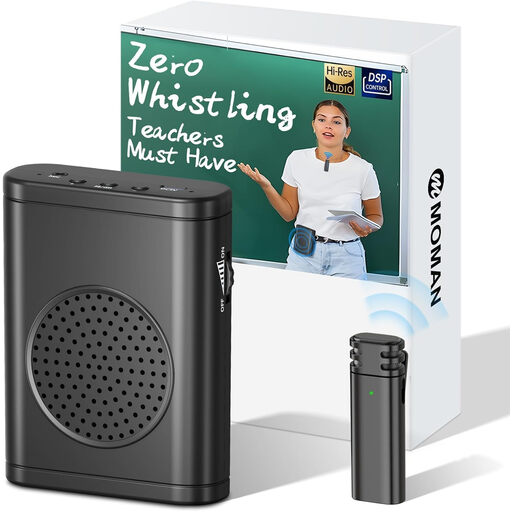
Joybuy product for voice amplification in the classroom
This product recommendation is for a reading in a classroom without a usable sound system. The microphone is a wireless lavalier microphone, not a headset microphone.
 No image available
Moman S57 voice amplifier with wireless lavalier microphone
The product description lists a portable voice amplifier with a speaker and wireless lavalier microphone, suitable for activities such as teaching and giving presentations. The microphone is not a headset microphone.
Joybuy
Frequently asked questions
Can you use a separate headset microphone to speak to the class?
Only if the rest of the set-up can connect the microphone and make the sound audible to the class through an amplifier and speaker. Check both the sound system’s input and the connection and power requirements of the exact microphone version.
What can you do if the speakers start feeding back?
Test the set-up before the reading and adjust the positioning or volume. Shure explains that feedback occurs when sound from a speaker is picked up again by the microphone, so check where the microphone and speaker are positioned.
What equipment should you check in addition to the microphone?
Check whether a speaker, amplifier, receiver, transmitter, power supply and suitable cables are available, or whether they’re needed for your chosen set-up. The Dutch government states that consumer purchases in the Netherlands are covered by a legal guarantee with no fixed time limit. If you’re buying on behalf of a school, it’s also worth checking the applicable contract and service terms.
Can you use a wireless headset microphone in the Netherlands without a licence?
That depends on the transmission frequency you choose and where you intend to use it. The RDI publishes information about frequencies that can be used without a licence, explains that not every UHF frequency is available everywhere and notes that some other bands require a licence. Before using the microphone, check the exact version and location against the RDI information.


