What should you consider when choosing?
Two wireless clip-on microphones
Choose this if: both the storyteller and interviewer can wear their own microphone and the receiver is compatible with your phone or camera.
Bear in mind: you’ll need two transmitters, a receiver and a power supply. Check what’s included in the package, as different versions may come with different receivers.
One wired lapel microphone
Choose this if: the focus is mainly on recording the storyteller and your device has a compatible microphone input.
Bear in mind: questions from further away won’t necessarily be recorded as clearly. The Shure MVL has a TRRS connection; the Audio-Technica ATR3350xiS has a dual-mono plug.
Standalone handheld recorder
Choose this if: you want to record without a phone and manage the recording file independently.
Bear in mind: placement matters if both speakers need to be clearly audible. You’ll also need suitable storage and power. Zoom lists built-in X/Y microphones and a 3.5mm microphone input for the H1essential.
For a classroom interview, the key question is whether you want the recording to capture just the storyteller or the questions clearly too. Then check the connection and make a test recording where the conversation will take place.
| Concern |
What to check |
Who is this important for? |
| Clear main speech |
Can you position the microphone close to the storyteller and listen back to a test recording? |
If my main aim is to capture the storyteller’s account clearly, I want to be able to check their voice during a test recording. Around 36% of consumers put clear main speech first. |
| Recording both voices |
Are two microphones or transmitters included, and can you listen back to both voices? |
If the questions are also part of the oral history interview, I don’t want only the answers to be clearly audible. Around 29% of consumers prioritise capturing both people in the conversation. |
| Connection to your device |
Check the input, plug or receiver, and whether the recording app uses the external microphone. |
If I want to use my own phone, camera or recorder, the connection needs to be compatible with that device. This is the main buying concern for around 21% of consumers. |
| Recording and storing independently |
Have you arranged power and storage, and can you transfer the original file securely? |
If you want to record without a phone and keep the source file, you’ll also need a plan for power, storage and transfer. Around 14% of consumers prioritise recording and storing independently. |
Microphones at Joybuy
These product picks focus on two wireless microphones for an interview where both people need to be heard. Check the exact receiver and connection for each model before choosing a recording setup.
 No image available
DJI Mic Mini 2S (2 TX + 1 RX + Charging Case)
The two transmitters suit a setup where both people in the conversation wear their own microphone.
The product name lists 2 TX, 1 RX and a Charging Case.
View product
 No image available
RØDE Wireless Micro Camera Kit
This version may be suitable when two speakers each wear a transmitter and your camera or USB-C smartphone works with one of the included receivers.
The package lists two transmitters, a camera receiver and a USB-C receiver. According to the product information, older iPhones with Lightning need a Wireless Micro Lightning configuration.
View product
 No image available
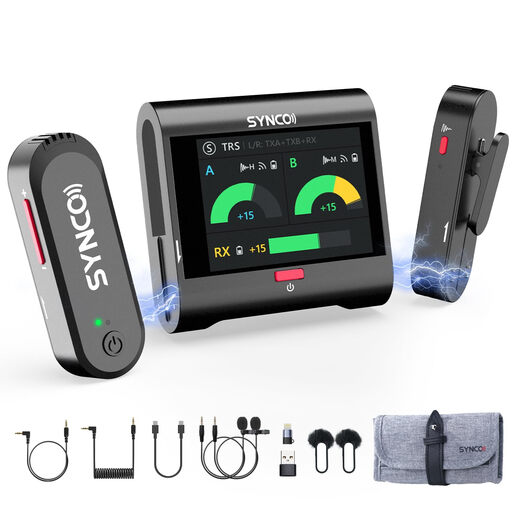
SYNCO G3PRO Wireless Lavalier Microphone System, 2.4GHz Dual Lapel Mics
The two transmitters are designed for a setup where both people in the conversation wear a microphone.
The product description lists TRS, TRRS and USB-C outputs on the receiver. Check which output is compatible with your recording device.
View product
 No image available
DJI Mic 3 (2 TX + 1 RX + Charging Case)
With two transmitters, each person in the conversation can wear their own microphone.
The product name lists 2 TX, 1 RX and a Charging Case. Check that the receiver is compatible with your camera or smartphone.
View product
 No image available
Verbex ST5 Dual-Mic Type-C
The dual lapel microphones may suit an interview where both speakers need a microphone.
The product name specifies a Type-C interface; check that it’s compatible with your recording device.
View product
Frequently asked questions
How do you check the setup before the interview?
Record a short clip with both people in the conversation, then listen back using headphones. If you’re using a phone, also check that the recording app is actually using the external microphone.
Can you simply keep or publish a classroom interview?
Not without considering the purpose and how the recording will be processed. According to the Dutch Data Protection Authority, a recognisable voice can be personal data; schools must inform pupils and parents about how pupil data is processed, and processing requires a valid legal basis under the GDPR. Sprekende geschiedenis also recommends agreeing with the interviewee in advance how the recording will be made, stored and accessed, and whether it may be made public. The agreements and legal basis required will depend on the specific project.
What should you do with the recording after the interview?
Keep the original file separate from any edited version prepared for a presentation. Before using it, decide who will have access and where and for how long the file will be stored, in line with your agreements with the interviewee and the privacy rules that apply to your school.
Who should you contact if a microphone breaks too soon during normal use?
Report the problem to the seller. According to ACM ConsuWijzer, if a consumer product is faulty, you may be entitled to a remedy under the statutory guarantee, such as a repair, replacement or refund. The appropriate remedy will depend on the circumstances; this doesn’t mean that every microphone has a fixed guarantee period.


