What should you look for?
Start with the seating arrangements and the level of privacy you need. Then consider the connection and whether you’ll need to move the speakerphone between classrooms.
Compact speakerphone for a small group
Choose this when: the mentor and participant are sitting close to the same device and speaking with someone remotely.
Trade-off: the stated microphone range doesn’t guarantee clear speech in a noisy or echoing classroom.
Speakerphone for people sitting further apart
Choose this when: several people need to contribute from different places; compare the stated coverage with each speaker’s position.
Trade-off: a larger stated coverage area won’t, by itself, solve problems with echo, background noise or privacy.
Personal audio or a separate room
Choose this when: others in the classroom must not hear a conversation containing sensitive information.
Trade-off: a headset makes it less easy for the mentor and participant to share audio; using a separate room requires planning.
| What to consider |
What should you check? |
Who is this most important for? |
| Clear speech from different seats |
Measure the distance from the device to each speaker and test from those positions. |
If you want someone joining remotely to hear contributions from seats further away, coverage is a priority. Around 29% of consumers prioritise this. |
| Conversation with classroom noise |
Check that the exact model supports full-duplex audio and any echo cancellation; try a call with normal classroom noise. |
If a conversation needs to flow smoothly despite classroom noise, it’s important to test the intended set-up. Around 23% of consumers prioritise this. |
| Connection to your device and calling app |
Check the USB port, supplied cable or dongle, and the audio settings on your device and in your calling app. |
If you want to join from your own laptop or phone, the connection and audio selection need to be suitable. Around 18% of consumers make compatibility their main concern. |
| Confidentiality |
Decide who can listen in, whether you need personal audio or a separate room, and what arrangements your educational institution has in place. |
If the conversation involves sensitive information, you’ll want to prevent others in the same classroom from hearing it. Around 18% of consumers prioritise confidentiality. |
| Moving between classrooms |
Check the connection, supplied accessories and stated talk time for the exact model. |
If you regularly take the set-up to another classroom, using it without a permanent installation matters. Around 12% of consumers prioritise portability. |
Joybuy products
This selection includes shared speakerphones for conversations with remote participants, as well as personal audio for situations where a shared speaker isn’t suitable.
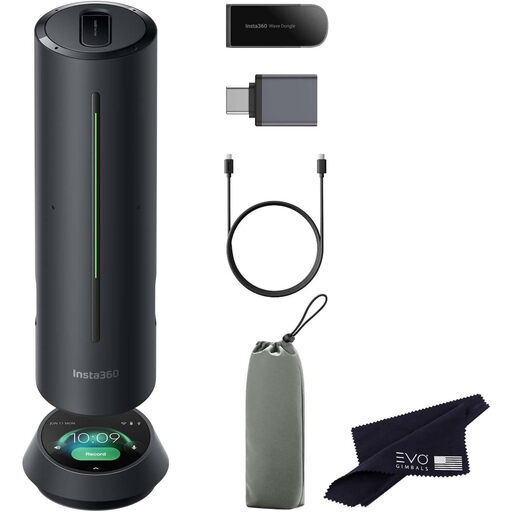 Image unavailable
Insta360 Wave AI Conference Speakerphone with Bluetooth, Black
An option to compare when several speakers aren’t sitting close to the device.
The product description lists eight microphones, a stated recording range of 16.4 feet, Bluetooth, a built-in battery and several recording patterns. It also mentions automatic echo and noise cancellation; these are product claims, not measurements taken in a classroom.
View at Joybuy
 Image unavailable
Jabra SPEAK 510 MS
A shared speakerphone to compare for conversations with someone remotely.
The product name lists USB-A (USB 2.0) and Bluetooth.
View at Joybuy
 Image unavailable
Jabra Evolve2 65 USB-A Black MS Mono
A personal audio option for conversations where a shared speaker isn’t suitable.
The product name identifies this as a mono headset with USB-A. A mono headset doesn’t provide a shared listening set-up for the mentor and others in the classroom.
View at Joybuy
Frequently asked questions
Where should I place the speakerphone during a mentoring conversation?
Position the device so that it’s close to the people who’ll be speaking, and test it from every seat. Yealink specifies different maximum distances for the CP700 and CP900; these don’t guarantee performance in your classroom.
Why is there echo when laptops in the classroom are also connected?
Several active audio devices in the same meeting can cause echo or feedback. Select the intended device as both the microphone and speaker, and make sure other devices in the room aren’t playing or recording meeting audio at the same time.
Can I use the speakerphone wirelessly with my laptop?
It depends on the model and version. For the Speak2 55, Jabra specifies USB-A or USB-C for a computer and Bluetooth for a smartphone or tablet; the AnkerWork S500 manual describes USB-C and the supplied Bluetooth dongle for computer use.
What extra costs or after-sales support should I check?
Check whether the dongle, adapter and charging option you need are included with your chosen model, and what warranty and support the seller offers. HP describes a charging stand for the Sync 40 as a separate purchase; Yealink reported that the CP900 went out of sale on 22 December 2025 and describes phased support after that date.
Can an educational institution record an online mentoring conversation without permission?
No. An institution can’t simply make recordings showing pupils or students. The Dutch Data Protection Authority asks schools to set clear arrangements for recordings, informing the people involved, storage and retention periods. Whether a particular recording can be made depends on how the data is processed and the institution’s policy; owning a speakerphone doesn’t give you permission.


