
Vandaag of morgen in huis

Kwaliteit gegarandeerd

Welkomstaanbiedingen ontgrendelen: GRATIS bezorging | Tot 80% korting | Gratis 30 dagen JoyPlus-proefperiode
Download de app
A citrus juicer may seem like a simple appliance, but the differences in ease of use can be significant. Do you want to juice oranges every day, make lemon juice occasionally or prepare several glasses at once? In that case, the juicing method, capacity and cleaning requirements are particularly important.
Many buyers look only at the wattage or a low price. This can lead to disappointment. For example, a powerful juicer is not automatically the most convenient choice for citrus fruit. And while a compact appliance may be easy to store, it may not have enough capacity for a family.
Higher power sounds appealing, but it does not tell you everything about how an appliance works. An electric citrus juicer rated at 20 to 40 watts may be suitable for oranges, lemons and limes. A 1,000-watt fruit juicer is more likely to be designed for different types of fruit and vegetables, often with a grater, sieve and pulp container.
So start by looking at the type of appliance. A traditional citrus juicer works with a rotating cone. A juicer processes ingredients through a wide feed chute and a rotating sieve. For pure orange juice, a citrus juicer is usually easier to use.
A citrus juicer with an anti-drip function can help reduce spills on your worktop, but check how the feature works. On some models, you close the spout manually; other appliances only have a raised edge or a spout that swivels above the glass.
Also consider the height and shape of the outlet. A long spout is useful for different-sized glasses, while a low outlet is better suited to a jug or reservoir.
Pulp and fruit flesh can quickly dry onto a sieve or juicing cone. An appliance with lots of separate parts can therefore become impractical, even if the purchase price is attractive.
Check whether the parts are removable and whether they are dishwasher-safe. With a dishwasher-safe citrus juicer, this generally applies only to the removable parts; the motor base should not be placed under the tap or in the dishwasher.
For oranges, grapefruits, lemons and limes, a juicing cone is sufficient. Models with two cones are practical if you want to juice both small limes and larger oranges.
A citrus juicer with a wide feed chute works differently. For example, the Philips Avance Collection Juicer HR1919/70 has a feed chute measuring 8 cm. The Bosch MES4000 specifies an opening of 84 mm. This reduces the need to cut larger pieces of fruit and makes these appliances more versatile, but they generally take up more space than a compact lemon juicer.
For one glass of fresh juice, a 500 ml reservoir is often enough. For several people, 700 ml to 1 litre is more practical. According to the product specifications, the Cuisinart CCJ210E has a 1-litre reservoir. The Aigostar Juicer has a capacity of 700 ml, while the Philips HR2738/00 uses a 500 ml jug.
A large capacity does not automatically mean you can use the appliance continuously without limits. Always follow the instructions and allow the motor to cool down when advised.
Not everyone wants the same type of juice. Some people prefer clear juice, while others like more pulp. A citrus juicer with adjustable pulp control offers an adjustable sieve or filter for this purpose.
The Bear CZJ-A04B1 is listed as having five pulp settings. The Braun MPZ9 Citrusquick 1 has an adjustable pulp sieve. On other models, such as a simple orange juicer with one juicing cone, the amount of pulp is less precise to control.
Bear in mind that terms such as ‘more juice’ or ‘efficient extraction’ may be product claims. According to a brand’s own research or communications, such results may depend on the type and ripeness of the fruit and the way it is juiced. When comparing products, focus mainly on verifiable features and dimensions.
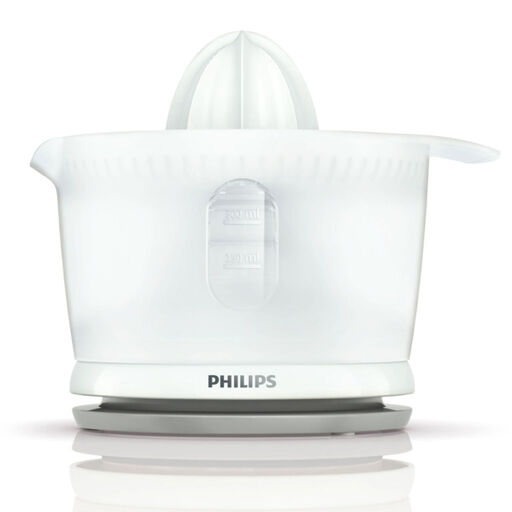
Why it suits this profile: This compact 25 W model has a 500 ml reservoir and is suitable for everyday use when making smaller quantities of juice.
The product information lists a drip-free spout, automatic start when pressure is applied and dishwasher-safe removable parts.
500 ml capacity, cord storage, non-slip feet and a compact size of 14,5 × 19,7 × 16,4 cm.
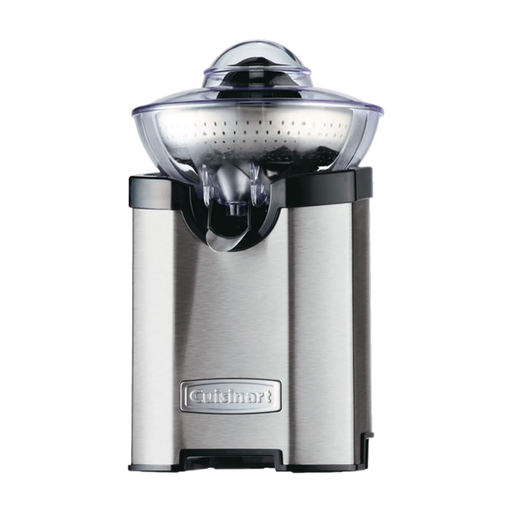
Why it suits this profile: The stainless-steel design, 100 W power and 1-litre capacity are well suited to users who regularly prepare several glasses.
The product specifications mention an anti-drip system, a wide outlet and dishwasher-safe removable parts.
1-litre reservoir, stainless-steel housing, weight of 1,9 kg and a three-year manufacturer’s warranty according to the product information.
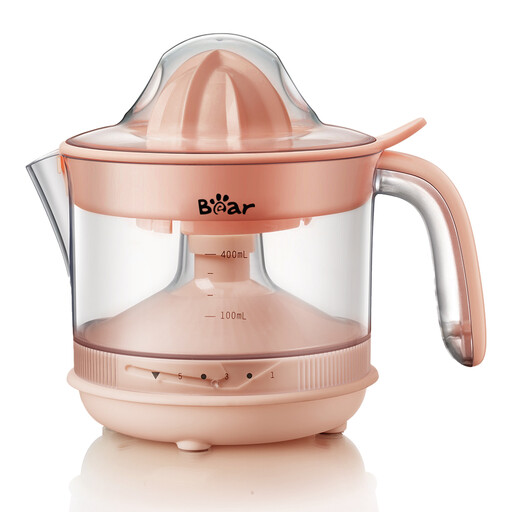
Why it suits this profile: This model is designed for users who process different citrus fruits and want precise control over the amount of pulp.
The extra-wide 110 mm feed opening and five pulp settings make the preparation process clearer than on models with just one filter setting.
One-button operation, separate pulp and juice collection, BPA-free food-contact materials, non-slip feet and a 24-month warranty according to the product information.
We have put together a complete, up-to-date list of products that fully meet these strict selection criteria and the applicable European safety regulations.
According to the product information, the appliances mentioned generally come with at least two years’ statutory warranty protection under European consumer regulations. An additional manufacturer’s warranty may vary by brand and model.
That depends on how you use it. An electric model uses power, but reduces the effort required and may be quicker when juicing several oranges or lemons at a time. For one glass, a manual lemon juicer may be sufficient. Focus mainly on the power rating, operating time and amount of juice you usually make.
Its lifespan depends on the materials, cleaning and frequency of use. Do not run the appliance for longer continuously than stated in the manual, and remove the pulp after use. A model with stainless-steel parts may feel different from an all-plastic version, but the construction, motor and correct operation remain decisive.
The electricity cost per juicing session is usually limited because the appliance is only used for a short time. The difference between 25 W, 40 W and 100 W is mainly noticeable with very frequent use. In practice, the purchase price, availability of replacement parts and ease of cleaning often matter more than a small difference in electricity consumption.
