
Detail inspector
You want to assess lettering, tracks or solder joints individually, so you’ll be looking at the field of view, magnification and working distance. Leica Microsystems describes microscopy as an application for PCB inspection.


Choose a mirrorless camera with a suitable macro lens if you want to take both wide shots and close-ups. A digital microscope is a good fit when viewing and documenting small areas, lettering or solder joints is your priority. Whichever you choose, check the working distance, depth of field and lighting. A dark background won’t prevent reflections, but diffused light and a stable set-up make your images easier to control.
You want to assess lettering, tracks or solder joints individually, so you’ll be looking at the field of view, magnification and working distance. Leica Microsystems describes microscopy as an application for PCB inspection.
You want to take wide shots and close-ups against the same dark background, consistently. A fixed camera set-up and controlled lighting help you keep framing and exposure consistent, as Canon Netherlands explains in its guidance on product photography.
You want to reduce distracting highlights on metal contacts and other reflective parts, so adjustable, diffused lighting is important. Edmund Optics discusses light diffusion and polarisation for reflective surfaces.
A good fit if: you want to switch between wide shots and close-ups, or use the camera for other types of photography too.
Bear in mind: macro magnification comes from the separate lens, not automatically from the camera body. Short shooting distances can also result in a shallow depth of field.
A good fit if: you mainly want to view and capture small areas, lettering or solder joints at a workbench.
Bear in mind: a microscope won’t necessarily show the whole circuit board at once, so check the field of view at your preferred setting. With an AmScope model, the magnification shown also depends in part on the monitor size.
| What to consider | What should you check? | Who is this important for? |
|---|---|---|
| Capturing small details clearly | For a macro lens, compare the magnification and working distance of the exact lens. For a microscope, check the field of view at your preferred setting. | If I want to examine small lettering or solder joints clearly, I’ll choose based on the area I need to capture. Around 33% of consumers prioritise the legibility of small details. |
| Controlling reflections | Check whether you can adjust the direction and intensity of the light. Try diffused lighting before choosing a polarisation set-up. | With shiny contacts, I want to reduce distracting highlights without losing sight of the details. Around 27% of consumers give controlling reflections top priority. |
| Getting consistently sharp results | Check that your set-up is stable and whether the exact camera-and-lens combination supports focus bracketing or focus stacking if you need several focal planes. | If components at different heights need to appear sharp, I want to choose a set-up and focusing method that can handle this. Around 20% of consumers prioritise consistently sharp photos. |
| Putting together a complete set-up | Check which lens, stand and lighting are included, and what equipment you’ll need to view and save your images. | I want to know in advance which components I’ll need to take and view my photos. Around 20% of consumers prioritise a complete, practical set-up. |
The quoted 1.4× for the Canon RF 100mm F2.8L Macro IS USM and 1:1 for the Nikon NIKKOR Z MC 50mm f/2.8 are specifications of individual lenses, not of every camera body or kit.
Check the exact kit contents, lens mount and lens before assuming your macro set-up is complete.
You may need to buy a separate compatible lens to get the macro magnification you want.
With the AmScope model reviewed, the field of view changes with the setting, and the magnification shown also depends on the monitor.
Compare the field of view at your preferred setting with the size of the area of the circuit board you want to photograph.
Shiny components respond to the direction and spread of light, even against a dark background.
Start with a test shot, adjusting the direction of the light and using diffused lighting. Then decide whether you need a suitable polarisation set-up.
OM Digital Solutions states that focus stacking on the OM-5 Mark II crops approximately 7% from the edge of the image.
Check that your exact lens is on the compatibility list, and leave some space around the circuit board in your shot.
Canon Netherlands describes the EOS R50 as a mirrorless camera with focus bracketing. The RF 100mm F2.8L Macro IS USM is a separate macro lens for close-ups.
The Nikon Z50II is a mirrorless camera; the NIKKOR Z MC 50mm f/2.8 is a separate macro lens for close-ups.
The OM-5 Mark II offers in-camera focus stacking. OM Digital Solutions lists the M.Zuiko Digital ED 60mm F2.8 Macro as a supported lens.
Sony lists the FE 90mm f/2.8 Macro G OSS as a macro lens for close-ups when used with a compatible camera body.
AmScope offers digital microscopes for electronics inspection, including models with a USB camera and adjustable polariser, as well as models with a boom arm for viewing via HDMI or computer.
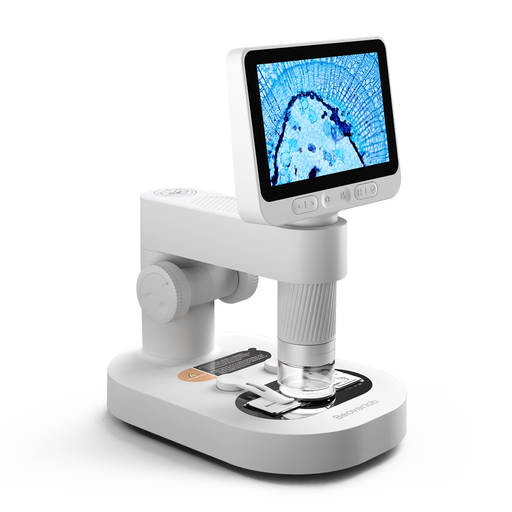
This product is a digital microscope for close-ups. For circuit board inspection, check that the field of view and working distance suit the components you want to capture.
 No image available
A digital microscope for viewing small details up close. Check that its field of view is suitable for your circuit board.
The built-in screen displays magnified details. The lighting features 8 adjustable LED lights.
The detachable design can be used on its stand or handheld, according to the product information.
No, the magnification you need depends on what you want to capture. For example, the 1:1 specification applies to the separate NIKKOR Z MC 50mm f/2.8 lens; you’ll need a wider field of view for an overview.
Make sure your camera is stable and check whether a single focal plane is enough. If the circuit board is stationary and your exact camera-and-lens combination supports it, you can combine shots taken at different focus points. Bear in mind that this may involve cropping.
First, adjust the direction and spread of the light. Diffused lighting can illuminate reflective components more evenly, while polarisation can reduce glare. Check in a test shot that the details you want to capture remain visible.
Before buying, check which lens, lighting, stand and image-viewing equipment are included. According to the Dutch government, online consumer purchases are often covered by a 14-day cooling-off period. There’s no fixed statutory guarantee period in the Netherlands. Whether these rules apply depends on the purchase and the circumstances, such as whether you’re buying as a business.