
Baker making large batches for a sale
You want to make plenty of cinnamon rolls and, above all, find out how much dough fits in one batch. Compare the weighed portion with the limit for the specific model and type of dough.


First, work out how much dough your recipe makes per batch and compare its weight with the stated limit for the exact model; bowl capacity alone isn’t enough. A compact mixer may suit you if you make smaller batches, while a model with a higher stated dough capacity could mean fewer batches. These capacities are figures supplied by the manufacturer, not independent tests using your cinnamon roll recipe.
You want to make plenty of cinnamon rolls and, above all, find out how much dough fits in one batch. Compare the weighed portion with the limit for the specific model and type of dough.
You can divide the dough and are looking for a machine that’s practical and easy to handle beyond the school fair, too. Think about how many extra batches would be manageable for you.
You prioritise an included dough hook and a practical process over making the largest possible batch. Also check how to clean the bowl and attachments after baking several batches.
First, weigh the dough in each batch and compare it with the limit for the exact model. Then check whether the number of batches required and the instructions fit your plans.
| What to consider | What to look for when buying | Who is this important for? |
|---|---|---|
| Dough capacity per batch | Weigh the entire batch of dough and compare it with the limit for the exact model and type of dough. | If I want to prepare lots of rolls at once, I need to know whether my weighed batch is within the model’s limit. Around 39% of consumers prioritise dough capacity per batch. |
| Ease of handling smaller batches | Check the stated capacity for yeast dough and the machine’s dimensions. | If I’d rather divide the recipe, I don’t want to choose a machine that’s larger than my batches require. Around 23% of consumers prioritise smaller batches and ease of handling. |
| Operation and cleaning | Check which attachments are included and follow the instructions for kneading and cleaning the exact model. | When baking several batches, I want to be able to organise the kneading steps and cleaning practically. Around 23% of consumers place particular importance on ease of repeated use. |
| Use after the school fair | Decide whether you’ll continue using the machine afterwards and check the included parts and the seller’s terms. | If I want to keep using the machine at home, its usefulness afterwards will factor into my decision. Around 15% of consumers focus mainly on using it after the event. |
Manufacturers sometimes specify separate limits for dough or yeast dough. Bowl capacity in litres alone therefore doesn’t tell you how many kilograms of dough you can knead.
Weigh your entire batch of dough and compare its weight with the limit for the exact model and type of dough.
For the Smeg SMF04CREU, Smeg specifies a maximum of 1,9 kg of bread or pizza dough in total, with a maximum of 1,2 kg of flour and at least 55% hydration. These conditions don’t prove that the same limit applies to every cinnamon roll recipe.
Check the instructions for the exact model and recipe; make smaller batches if your dough doesn’t meet the stated conditions.
ACM ConsuWijzer explains that your statutory guarantee applies even without a manufacturer’s warranty or an extended warranty you’ve purchased.
Check your statutory rights first and assess any additional cover separately.
Bosch offers models with different stated capacities for yeast dough.
The Chef XL KVL4110S is worth considering if you’re looking for a larger stated dough capacity.
The Assistent Original 6230 is worth considering if you’re looking at a high stated dough capacity and a different kneading method.
The SMF04CREU has a stated limit for bread or pizza dough, subject to specific recipe conditions.
The Artisan 5KSM125EER comes with a dough hook; check the dough capacity for the version you’re considering.
This selection includes stand mixers and a dough maker for kneading dough. Compare the stated capacity, included hook and any usage-time limits with your recipe and plans.
 No image available
The included dough hook makes this model suitable for kneading dough; check the limit for this version in the instructions.
The product title lists a 5.5L bowl, 1000W power and planetary mixing action.
The product description specifies that it’s for domestic use.
 No image available
The product description lists a dough hook; check the permitted dough quantity and instructions before planning for the school fair.
The product title lists a 6L bowl, six speeds and a 450W motor.
The instructions limit continuous use to a maximum of 6 minutes before a break.
 No image available
This model could suit you if you’re looking for a dough maker with automatic kneading; compare your recipe’s batch size with the stated capacity.
The product title lists a 5L capacity, a maximum of 2.5kg of dough, automatic kneading and a dough resting function.
 No image available
The product description lists a dough hook; check the capacity for this version before planning a large batch of dough.
The product description also lists a whisk and K-beater. The stated capacity of the Chef XL KVL4110S doesn’t automatically apply to this KVL4110 version.
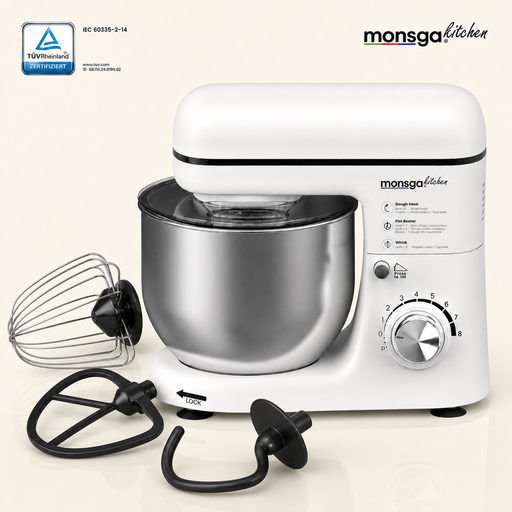 No image available
The product title lists a dough hook, making this model worth considering if you also want to compare the other included attachments.
The title lists a stainless steel bowl with a recommended capacity of 5.0L, eight speeds and 1000W peak power.
The product title specifies a Teflon-coated dough hook; check the instructions for the exact model.
Weigh the ingredients for one batch of dough and compare the resulting dough weight with the limit for the exact model and type of dough. Don’t compare bowl capacity in litres directly with dough in kilograms; for the Smeg SMF04CREU, also check the stated flour and hydration conditions.
KitchenAid recommends speed 2 for yeast dough. For bread dough, the brand advises kneading at that speed for no more than two minutes, and mixing and kneading for a total of four to six minutes. Also follow the instructions for your version.
According to ACM ConsuWijzer, when a product is used normally, the seller must provide one that meets the standard you could reasonably expect. A manufacturer’s warranty or an extended warranty you’ve purchased doesn’t replace this statutory right. The cooling-off period for online purchases is separate: ACM ConsuWijzer states that it’s generally 14 days from delivery, with some exceptions.
The NVWA says that individuals selling food at markets and events must prepare, store and sell it safely and hygienically. For unpackaged products, there are ways to provide allergen information, for example on a card or verbally. The NVWA links the requirement for a food safety plan to those who prepare and sell food several times a year; don’t assume this requirement applies based solely on one school fair.