
Someone who cooks small portions of meat
You mainly want to chop a small amount of cooked meat to use in another meal. Check the permitted quantity per batch: Philips specifies 100–150 g of meat per batch for the HR1393/00.


For small portions of cooked meat, a compact chopper may be suitable if the instructions allow you to chop meat and its capacity matches your portion size. A food processor makes more sense if you also regularly want to slice or grate other ingredients. A mincer attachment is only an option if you already have a compatible base machine and want to make minced meat.
You mainly want to chop a small amount of cooked meat to use in another meal. Check the permitted quantity per batch: Philips specifies 100–150 g of meat per batch for the HR1393/00.
Space in your kitchen is your main constraint, so you want to weigh up storage needs against extra features. The Consumers’ Association lists features and size as factors to consider when choosing.
You regularly want to chop, slice or mix other ingredients as well as meat. The Consumers’ Association describes a range of food processor tasks; check which features and accessories are included with each model.
Choose this if: you usually chop one small portion at a time and have limited storage space. Philips lists meat as a suitable ingredient for the HR1393/00.
The trade-off: the usable chopping capacity may be less than the bowl capacity, so you may need to split larger portions into batches.
Choose this if: you regularly want to slice, grate or mix ingredients as well as chop meat. Kenwood lists raw and cooked meat among the uses for the blade in its food processors.
The trade-off: extra features and parts won’t necessarily be useful for a single small portion. Check each model’s dimensions, minimum usable quantity and cleaning requirements.
Choose this if: you already have a suitable Bosch MUM Serie 2 and want to make minced meat. Bosch lists both raw and cooked meat as suitable for the MUZS2FWW attachment.
The trade-off: the attachment won’t work on its own. Check your machine’s E-Nr. and whether the extra parts suit your needs.
| What to consider | What should you check? | Who should give this more weight? |
|---|---|---|
| Suitability for meat and capacity | Check the instructions to see whether chopping meat is permitted and what quantity is allowed per batch. Bowl capacity and chopping capacity can differ. | If I mainly want to process small portions of cooked meat, I need to know whether the permitted quantity matches my portion size. Around 33% of consumers prioritise suitability for meat and portion size over other buying considerations. |
| Space and portion size | Compare the appliance’s external dimensions and storage space with the usable portion size, not just the bowl capacity. | With limited cupboard space, I want to know in advance whether I can store the appliance without its bowl being too small for my needs. Around 27% of consumers give limited kitchen and storage space top priority. |
| Cleaning and handling leftovers safely | Check which parts are removable and can be cleaned according to the manufacturer. Use clean equipment and keep raw and cooked food separate. | If I’m chopping cooked meat, I want to be able to clean the bowl and blade thoroughly after use and keep raw and cooked food separate. Around 20% of consumers prioritise cleaning and safe food handling. |
| Versatility and accessories | Check which slicing, grating and chopping functions are included. If you’re considering an attachment, verify the exact model of the base machine. | If I want to use the appliance for other food preparation too, I only want to choose extra features or accessories that I really need. Around 20% of consumers prioritise versatility and weighing up the associated costs. |
The Philips HR1393/00 has a bowl capacity of 0.7 l and a chopping capacity of 0.5 l; Philips specifies 100–150 g of meat per batch. A larger portion may therefore need to be chopped in several batches, with extra cleaning in between.
Compare the stated quantity per batch with your usual portion size, not just the bowl capacity.
The Bosch MUZS2FWW attachment is designed for a compatible Bosch MUM Serie 2 and won’t work without the required base machine.
Before you buy, check your appliance’s E-Nr. and which parts are included with the attachment.
A manufacturer’s statement that an appliance can chop or mince meat doesn’t guarantee that every appliance will produce the same texture with every type of cooked meat.
Follow the instructions for the exact model and choose a chopper or mincer to suit the result you want. Don’t assume a chopping blade will produce the same result as a mincer.
The Netherlands Nutrition Centre advises using clean equipment and keeping raw and cooked food separate. Cooked meat doesn’t keep indefinitely once it has been chopped.
Check that you can clean the bowl and blade properly according to the instructions, and follow advice on chilling and using leftovers.
The Daily Collection HR1393/00 is a compact chopper for small quantities. Philips lists meat as a suitable ingredient.
KitchenAid describes the 5KFC3516ECU as a mini chopper for small food-preparation tasks, with an 830 ml bowl, two speeds and a pulse setting.
Bosch offers standalone choppers, such as the MMR08R2, as well as the MUZS2FWW mincer attachment for a compatible MUM Serie 2.
Kenwood offers compact choppers and food processors. The right choice partly depends on the quantity you need to prepare and what else you’ll use the appliance for.
This selection focuses on compact electric meat choppers. If you’re chopping cooked meat, always check the instructions and the permitted quantity for the exact model.
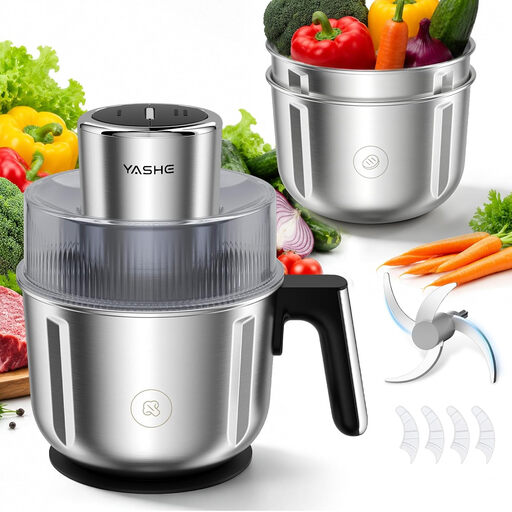 No image available
The product name lists meat as a suitable use. Check the instructions for cooked meat and the permitted quantity per batch.
The product name describes a set with three bowls.
 No image available
The product name lists mincing meat as a suitable use. Check the instructions before using it to process cooked meat.
The product name lists three nesting bowls of 2.5 l, 2.2 l and 1.8 l, plus two speeds. The product description specifies a maximum operating time of 30 seconds per cycle.
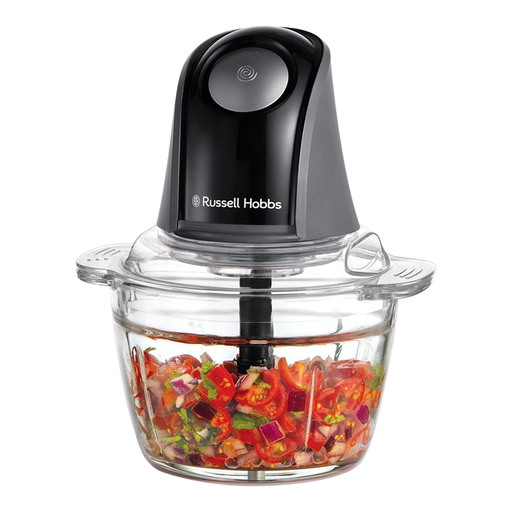 No image available
The product description lists meat as an ingredient. Check the instructions for this specific model to confirm whether it can be used for cooked meat and what quantity is permitted.
The product name specifies 200 W and dishwasher-safe parts.
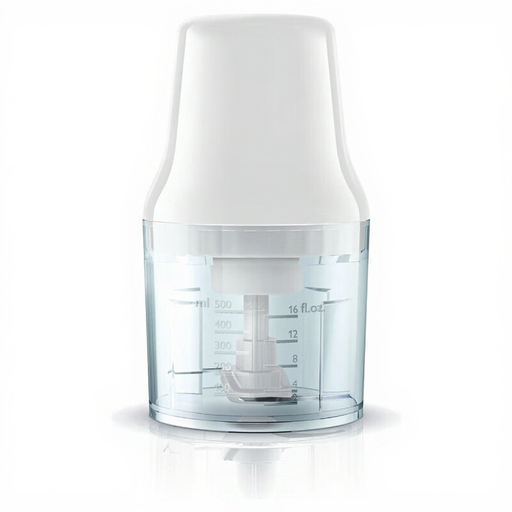 No image available
Philips lists meat as a suitable ingredient for this model. The manufacturer specifies 100–150 g of meat per batch; this isn’t a separate performance claim for cooked meat.
Philips specifies a bowl capacity of 0.7 l and a chopping capacity of 0.5 l.
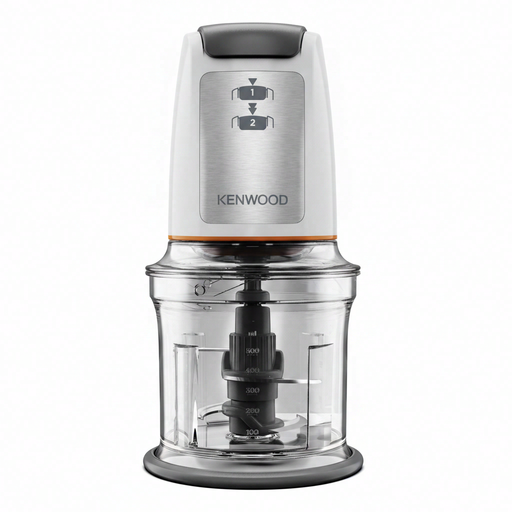 No image available
The product description lists meat as an ingredient. Check the instructions for this specific model before using it to chop cooked meat.
The product description specifies a maximum of 30 seconds’ continuous use, followed by 2 minutes to cool down.
It can, if you have a suitable model and chopping blade. Kenwood lists raw and cooked meat among the uses for the blade in its food processors, but advises checking the instructions for the specific model to find out how to use it and what quantity to process.
Use clean parts and keep raw and cooked food separate. The Netherlands Nutrition Centre advises storing leftovers at 4 °C and eating them within two days. When reheating, make sure they’re piping hot all the way through.
Not automatically. According to the Dutch Government, the seller must offer a solution if a product is faulty. Extra cover may only be worthwhile if its terms give you additional rights; in the Netherlands, there is no fixed statutory two-year guarantee period for all products.
The applicable European requirements depend on the appliance. For equipment covered by the Low Voltage Directive — 50–1.000 V alternating current or 75–1.500 V direct current — requirements include CE marking and an EU Declaration of Conformity. Ondernemersplein and EUR-Lex describe these requirements; check which rules apply to the specific appliance.