
Fan of chunky salsa
You want to control how chunky your tomato, onion and herbs stay, and you’re looking for a chopper that’s easy to use for a quick job.


For a small portion of salsa after an evening class, a compact chopper is the obvious choice. A food processor is a better fit if you also regularly want to slice or grate vegetables. Kenwood and KitchenAid describe pulse control as a way to control the chopping texture, but this isn’t an independent comparison of the models mentioned. So compare the bowl capacity with your usual portion, and check which parts you’ll need to clean and store.
You want to control how chunky your tomato, onion and herbs stay, and you’re looking for a chopper that’s easy to use for a quick job.
You make a small portion after class and want to keep washing up and putting away loose parts to a minimum.
You want to use the appliance for slicing or grating vegetables too, and have room for extra accessories.
A good fit for: anyone who mainly wants to make a small portion of salsa and doesn’t need slicing or grating discs. KitchenAid lists an 830 ml bowl and pulse control for the 5KFC3516EER; Kenwood lists a 600 ml glass bowl for the CHP62.400SI.
The trade-off: a chopping blade isn’t the same as the slicing and grating discs on a food processor.
A good fit for: anyone who regularly wants to slice or grate vegetables as well as make salsa. Bosch lists a 2.3 l bowl and included slicing and grating discs for the MCM3501M.
The trade-off: Bosch states that the MCM3501M measures 375 × 220 × 260 mm, so allow room for the appliance and its accessories.
| What to consider | What should you check? | Who is this most important to? |
|---|---|---|
| Control over texture | Check whether the exact model has pulse control and a suitable chopping blade. | If I want chunky salsa, I want to be able to stop part-way through and check the pieces. Around 33% of consumers say control over texture is their top priority. |
| Less washing up | See which parts you’ll use for salsa and check the dishwasher instructions for each one. | After a late class, I don’t want to be left with lots of loose parts, so I check what can go in the dishwasher. Around 25% of consumers prioritise less washing up. |
| Portion size and storage space | Compare your usual quantity with the bowl capacity and measure where you plan to store the appliance. | If I usually make a small portion and have limited cupboard space, I want the bowl and appliance to suit those needs. Around 25% of consumers prioritise portion size and storage. |
| Extra slicing functions | Check which blades and discs are included with the exact version. | If I regularly want to slice or grate vegetables as well as make salsa, I look for those functions in the same version. Around 17% of consumers say extra slicing functions are their top priority. |
A larger capacity doesn’t automatically tell you how well an appliance will handle a small portion of salsa. Bosch lists a 2.3 l bowl for the MCM3501M; compare this capacity with the amount you usually make.
Measure the space in your cupboard or on your worktop too, before choosing extra capacity.
Dishwasher instructions can vary by part and model. For the CHP62.400SI, Kenwood specifically lists the bowl, blade and lid; Bosch describes the MCM3501M accessories as generally dishwasher-safe.
Check the instructions for every part of the exact version.
A chopper with a chopping blade doesn’t automatically offer the slicing and grating functions of a food processor. Bosch lists slicing and grating discs as included with the MCM3501M.
First decide whether you’ll actually use those extra functions, then check which parts come with the model.
The Easy Chop+ CHP62.400SI is a compact chopper; according to Kenwood, the MultiPro Compact FDP31.170GY has a chopping blade and a slicing and grating disc.
The 5KFC3516EER mini chopper is designed for smaller chopping jobs. KitchenAid lists salsa as one of the ways to use this model.
The MultiTalent 3 MCM3501M is worth considering if you want to slice or grate as well as make salsa.
This selection focuses on choppers for salsa ingredients, from manual models for small quantities to electric versions with larger bowls.
 Image unavailable
The two bowl sizes give you a choice for different quantities of ingredients.
The product information lists two speeds and pulse control. The bowls and lids are not heat-resistant and must not be used in a microwave.
 Image unavailable
The product information describes this model as suitable for chopping vegetables and making salsa.
It lists two speeds, pulse control and 304 stainless steel blades. Use short pulses and don’t run the motor continuously for more than 30 seconds; cut large ingredients into pieces of around 2 cm first. Clean the motor unit with a damp cloth only; the blades are sharp.
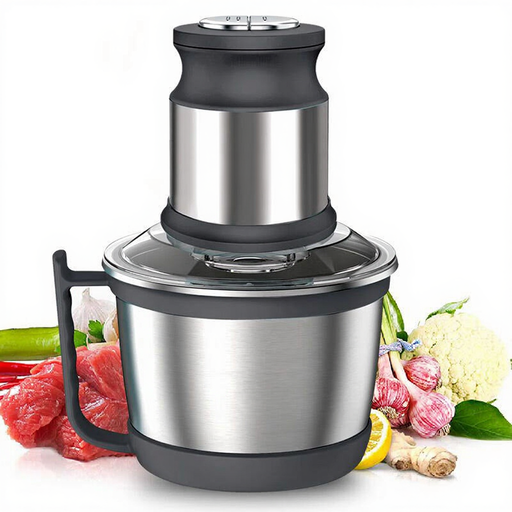 Image unavailable
The product description lists chopping vegetables and preparing larger meals among its uses.
The stated capacity is 3 l and the stated motor power is 800 W.
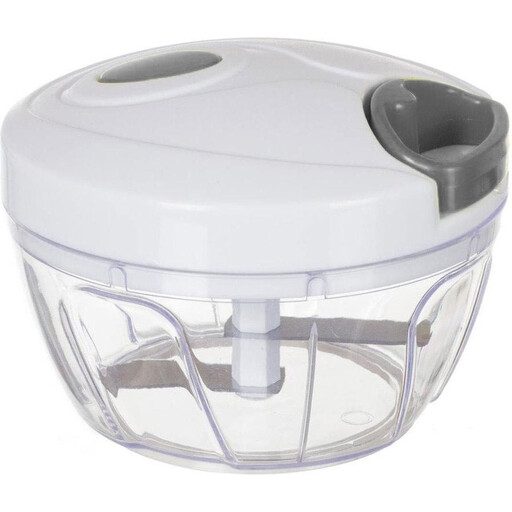 Image unavailable
This manual model is described as suitable for small quantities of vegetables and herbs, and for making sauces.
It has a 400 ml capacity and is operated with a pull cord. The product information lists a stainless steel chopping blade; clean the appliance with a damp cloth. This model isn’t electrically powered.
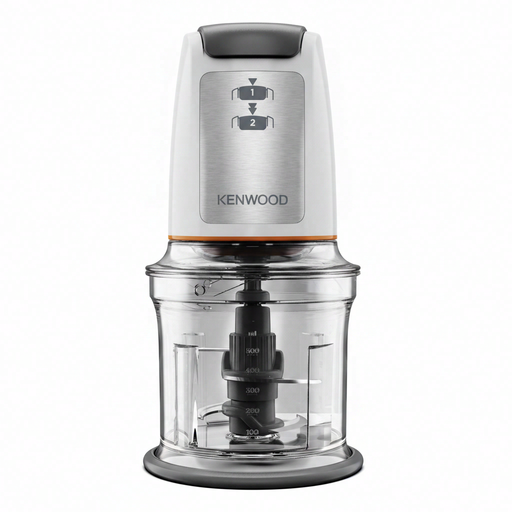 Image unavailable
This compact model is described as suitable for chopping vegetables and herbs, and making dips.
The stated bowl capacity is 500 ml; the product information lists two speeds and four stainless steel blades. After using the chopper for up to 30 seconds, let it cool for 2 minutes before using it again.
If your model has pulse control, use short pulses and check the texture as you go. Kenwood describes the pulse function as keeping the machine running while you hold down the button; KitchenAid says pulsing can give you a result ranging from chunky to fine.
Don’t assume so: for the CHP62.400SI, Kenwood specifically lists the bowl, blade and lid as dishwasher-safe. Check the instructions for the exact model for all other parts.
The Netherlands Nutrition Centre advises storing freshly cut vegetables in a well-sealed container in the fridge. For opened pre-cut vegetables, it recommends keeping them in the fridge for two days; don’t treat this automatically as a shelf-life guarantee for every prepared salsa.
According to the Government of the Netherlands, if a product is faulty, the seller must provide a solution. There’s no fixed statutory guarantee period in the Netherlands; what you can expect from a product depends, among other things, on the product itself and the information you were given.
For many online orders placed with a business, the Government of the Netherlands says you have a 14-day cooling-off period. Check the applicable terms; the government’s guidance, for example, distinguishes between buying from a business and buying from a private individual.