
Livraison le jour même et le lendemain

Qualité garantie

Débloquez vos offres de bienvenue: Livraison GRATUITE | Jusqu'à -80 % | 30 jours d'essai gratuits à JoyPlus
Téléchargez l'application
A ratchet seems simple: fit the socket, set the direction and turn. Yet many DIY enthusiasts and mechanics buy a model that is not suited to their work. The wrong drive size, an excessive return angle or a missing torque scale can lead to frustration, damaged bolts and extra costs.
As a Joybuy Product Recommendation Officer, I focus mainly on verifiable specifications. Marketing terms tell you less than the size, number of teeth, material and included accessories.
A 72-tooth ratchet or 90-tooth ratchet has a small working angle. This is useful in an engine bay or underneath a bike frame. However, a higher tooth count does not automatically mean that every ratchet can handle more force. Also check the drive size, handle length and stated load capacity.
A 90-tooth ratchet with a 4° working angle is practical in confined spaces, while a 72-tooth mechanism often requires around 5°. The difference may seem small, but it can determine whether you can actually move the handle.
A standard ratchet helps you tighten and loosen fasteners. A torque wrench is designed to achieve a pre-set twisting force. Do not use a standard ratchet as a measuring instrument when the car, motorbike or bicycle manufacturer specifies a particular tightening torque.
According to the product descriptions for the MoveCrab digital torque wrenches, the stated accuracy is ±2%. This is a manufacturer’s claim from the product information, not a general guarantee for every application. Always follow the instructions and check the correct unit of measurement, such as Nm.
A 3/8-inch ratchet handle is a common size for car maintenance, motorbikes and general assembly work. For small bicycle components, 1/4 inch may be more practical. For heavier work, 1/2 inch may be more suitable. An adapter can help, but it does not automatically change the tool’s maximum load.
Also pay attention to the socket sizes. A complete ratchet set with lots of accessories is not necessarily useful if it does not include the sizes you use most often.
The drive determines which sockets and accessories will fit:
Check whether a ratchet set contains metric sockets, SAE sizes or both. A ratchet ring spanner works directly on a nut or bolt without a separate socket, while a socket ratchet usually works with interchangeable sockets.
The working angle is the angle required for the mechanism to engage again. A smaller angle means less back-and-forth movement:
A flexible ratchet or ratchet ring spanner with a flex head can provide extra reach. However, check whether the head can be locked and whether the construction is suitable for the amount of force you intend to apply.
Many models in this selection are made from chrome vanadium steel. According to the product descriptions from the brands concerned, this material is combined with heat treatment and a chrome-plated or polished finish. This can contribute to wear resistance and protection against corrosion, but proper maintenance remains important.
Look out for these practical details:
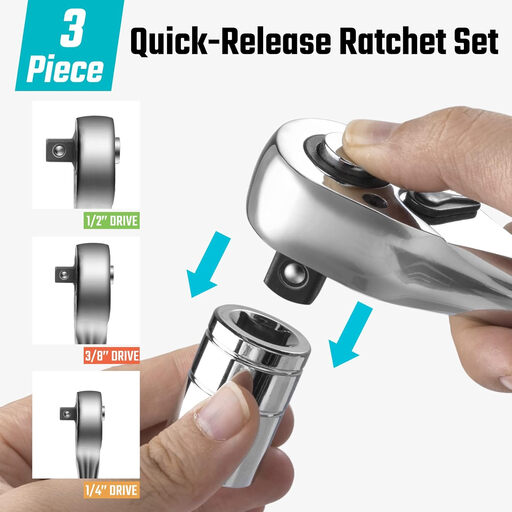
Why it suits this profile: Three drive sizes provide a versatile foundation for use at home, light car maintenance and DIY projects.
You are not limited to a single drive size. The set has 72 teeth and a stated working angle of 5°, so you need less space.
1/4-, 3/8- and 1/2-inch ratchets, quick-release function and a storage case.
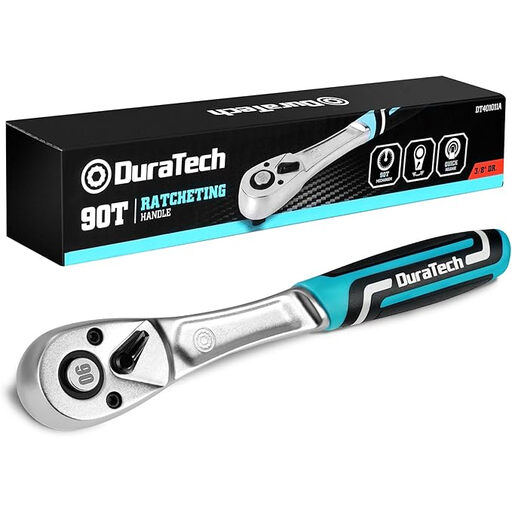
Why it suits this profile: Suitable for anyone looking for a compact 3/8-inch ratchet for regular maintenance and assembly work in confined spaces.
The product description specifies a fully enclosed ratchet head and 90 teeth with a 4° working angle. For heavy-duty work, always check the applicable load information.
Chrome-alloy steel, polished finish and a small operating angle.
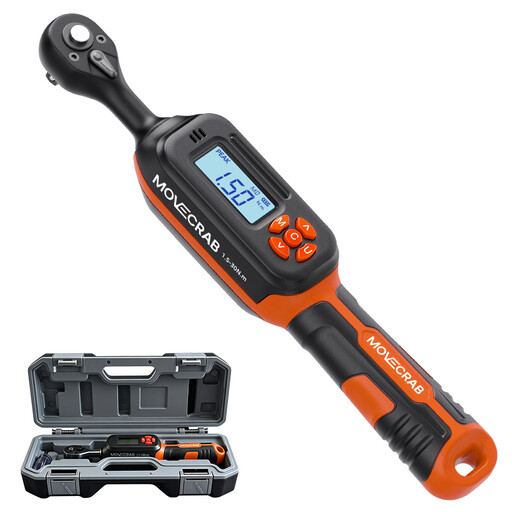
Why it suits this profile: For car, motorbike and bicycle maintenance where a specified tightening torque matters more than speed alone.
You use a measuring instrument rather than a standard ratchet when the manufacturer specifies an exact torque. The product information states ±2% accuracy and three warning types.
Range of 4.2-85 Nm, Nm/in.lb/ft.lb/kg.cm, LED, audible and vibration alerts.
An electric ratchet can save time when working on multiple bolts in succession. According to the product description, the EAFC 12V 3/8-inch model specifies a maximum torque of 45 Nm, a 2500 mAh battery configuration and LED lighting. The DURATECH electric set specifies 65 Nm, two batteries, eight sockets and an adapter.
Use an electric ratchet primarily for efficient loosening and tightening. For final tightening to a specified torque, a separate torque wrench is required unless the electric tool has been specifically designed for this purpose. Also check the battery voltage, charging time, weight and availability of replacement batteries.
We have put together a complete, up-to-date list of products that fully meet these strict selection criteria and the applicable European safety regulations.
For many jobs, a 3/8-inch ratchet handle is a useful mid-sized option. Choose 1/4 inch for smaller fasteners and 1/2 inch when larger sockets or greater leverage are required. Also check which metric socket sizes are used on your vehicle.
The number of teeth mainly indicates the working angle, not the strength by itself. A 72-tooth ratchet often has a slightly larger return angle, while a 90-tooth ratchet can provide finer operation in confined spaces. Always compare the material, handle length, drive size and stated load information.
Its service life depends on the load, maintenance, moisture, dirt and how it is used. Do not use a ratchet as a hammer or extend the handle unless this is permitted. Clean the mechanism according to the product instructions, keep the ratchet dry and use a suitable torque wrench for accurate tightening.
