
Party baker making lots of buns
You want to plan several batches with ease, and are mainly comparing tray size, internal capacity and usable shelf positions.


Start by working out how many raisin buns you want to bake in each batch. Check the internal dimensions, compatible baking trays and usable shelf positions, not just the capacity in litres. Then choose between a built-in oven for a suitable housing unit and a freestanding oven if you don’t have one. Also check that the oven setting suits your recipe and that the oven can be installed in your kitchen.
You want to plan several batches with ease, and are mainly comparing tray size, internal capacity and usable shelf positions.
You’re looking for a freestanding oven and need to check that you have enough worktop space, ventilation and a suitable electrical connection.
You also want to use your oven for other dishes or reheating, and are weighing up its oven functions against any microwave or steam functions.
For a family gathering, usable baking space is a good place to start. Next, consider the oven setting, where it will go and how you’ll use it in your kitchen.
| What to consider | What should you check? | Who is this important for? |
|---|---|---|
| Enough buns per batch | Measure the internal space and baking trays, and check which shelf positions can be used at the same time. | For a family gathering, I want to know how many buns of my chosen size will fit on the trays, with space between them. Around 36% of consumers prioritise baking capacity. |
| The right oven setting | Check the oven settings, temperature controls and baking instructions in your recipe. | When I bake my recipe, I want to be able to select the right oven setting. Around 29% of consumers give suitable oven settings and temperature control top priority. |
| Suitable installation | For a built-in oven, measure the housing unit. For every model, check the required ventilation space and connection in the manual. | If I don’t have a suitable built-in housing unit, I want to know whether a freestanding model can be placed safely in the space available. Around 21% of consumers prioritise installation and connection requirements. |
| Energy use and cleaning | Where relevant, compare energy use per cycle on a like-for-like basis and check the cleaning instructions. | If I bake regularly, I want to take energy use and cleaning into account. Around 14% of consumers put these practical considerations ahead of other factors. |
The capacity doesn’t tell you how many buns will actually fit on a baking tray. An oven with several shelf positions doesn’t necessarily come with several baking trays either.
Measure the internal space and trays, and check how many buns of your chosen size will fit with enough room between them.
If the usable space isn’t as large as you expected, you may need to bake in extra batches.
Appliance types and models can vary in their oven functions and available baking space.
Check that the appliance has an oven-baking function and that its oven setting and baking tray are suitable for your recipe.
An oven can only be installed in the intended spot if the housing unit, ventilation and connection meet the model’s instructions.
Before buying, compare the manual and installation diagram with your kitchen. If you’re unsure, ask for advice about the electrical connection.
A rating on its own doesn’t tell you which size and energy use will best suit your needs. Milieu Centraal points out that a smaller oven with a lower rating can use less energy in practice than a larger oven with a higher rating.
Choose an oven with enough baking space, then, where possible, compare energy use per cycle for the same cooking setting.
Built-in ovens for those with a suitable housing unit who want to consider baking on multiple shelf levels.
Freestanding ovens for kitchens without a suitable built-in housing unit.
Built-in ovens with extra features for those considering steam assistance too.
Built-in ovens with separate cooking zones for those who want to use different settings.
Multifunctional built-in ovens to compare by their features and available shelf positions.
These oven options on Joybuy are for anyone looking to bake raisin buns, with both freestanding and built-in models included.
 No image available
A freestanding model to consider if you don’t have a built-in housing unit.
Capacity: 65 litres. Power: 2000 W.
 No image available
A built-in model to consider if your kitchen has a suitable housing unit and you’re looking for 3D Hotair.
Capacity: 71 litres. Feature: 3D Hotair.
Check that the housing unit and electrical connection meet the model specifications.
 No image available
A built-in model to compare if you’re looking for an oven with 3D Hotair.
Capacity: 66 litres. The product name lists five cooking programmes.
Check that the housing unit, ventilation and connection suit your kitchen, in line with the model specifications.
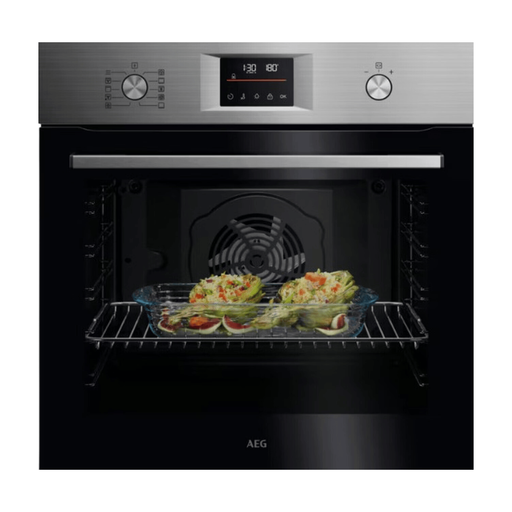 No image available
A built-in model to consider if its larger stated capacity suits your baking plans.
Capacity: 72 litres. The product name lists pyrolytic cleaning.
Check that the housing unit and connection meet the installation instructions.
 No image available
A built-in model to consider if you want to use steam assistance as well as oven settings.
Capacity: 71 litres. The product name lists steam cooking and pyrolytic cleaning.
Check that the housing unit, ventilation and connection suit your kitchen.
You’ll need an oven or a combination microwave with an oven-baking function to make raisin buns. If you’re using a combination microwave, check that its oven setting and available space suit your baking tray.
Follow the settings in the recipe you’re using. Koopmans recommends 200 °C for currant buns baked in a conventional electric oven, or 180 °C in a fan oven; a recipe for cinnamon and raisin buns gives different temperatures. Recipes aren’t necessarily interchangeable.
Measure the housing unit and compare the dimensions with the model’s installation diagram. Also check the required ventilation space and electrical connection in the manual; the Consumentenbond advises checking the exact oven and housing unit dimensions.
Where possible, compare energy use in kWh per cycle for the same cooking setting, and take the size of the oven into account. Milieu Centraal points out that a smaller oven with a lower rating can use less energy in practice than a larger oven with a higher rating.
Not every oven is covered by the European rules on oven energy labels. The European Commission lists small and portable ovens as categories outside the scope of these rules, so check which product category applies before comparing labels.