
Vandaag of morgen in huis

Kwaliteit gegarandeerd

Welkomstaanbiedingen ontgrendelen: GRATIS bezorging | Tot 80% korting | Gratis 30 dagen JoyPlus-proefperiode
Download de app
An outdoor wall light can make an entrance, balcony, patio, exterior wall or driveway easier to see. But the difference between a useful purchase and a poor one often comes down not to appearance, but to the combination of power supply, brightness, protection and installation.
Look out for these common pitfalls:
A solar wall light doesn’t need a permanent power cable. This makes it relatively easy to install, for example on a garden shed, balcony wall or fence. However, positioning matters: the solar panel needs to receive enough daylight. Also take into account shade from trees, overhanging roofs and neighbouring buildings.
A mains-powered LED outdoor light generally provides consistent performance, but needs a suitable connection. Hardwired models, including various GU10 and E27 fittings, should be connected by a qualified electrician, as stated in the product information. Switch off the power at the consumer unit before any installation work begins.
A rechargeable wall light with a USB connection can be placed flexibly, but needs charging from time to time. It’s a practical option for spots without a power outlet and with little sunlight.
The IP rating shows how well a fitting is protected against solid particles and moisture. An IP44 outdoor wall light is protected against splashes from different directions. This makes it suitable for many sheltered exterior walls, balconies and patios, but not for spots where the light will be exposed to direct water jets for long periods.
For weather-resistant outdoor lighting, also check:
A higher IP rating may be more suitable for a very exposed spot. Always check the specific product details rather than relying on claims such as “suitable for all weather conditions”.
Lumens describe the amount of light. A softer glow is often enough to create an inviting atmosphere on a patio. An entrance, garage path or driveway may benefit from a higher light output. A motion sensor stops the light from staying on continuously when it isn’t needed.
Colour temperature is measured in kelvins:
With an integrated LED, the light source usually isn’t designed to be replaced by the user. With a GU10 or E27 fitting, you can choose and replace the bulb yourself, provided the fitting, wattage and light are compatible.
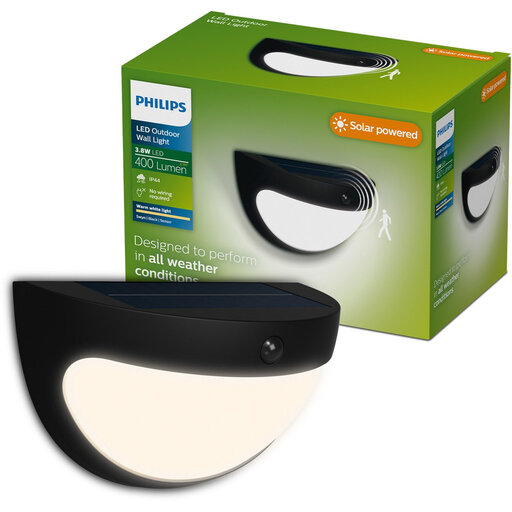
Why it suits this profile: This solar outdoor light works without permanent wiring and has an integrated LED providing 400 lumens per light. Its two modes and motion sensor make it a practical choice for an entrance, balcony or garden shed.
The IP44 rating makes it clear that the light is protected against splashes, not waterproof. It still needs to be installed away from direct streams of water.
Solar power, warm white light at 2700 K, two lighting modes and a motion sensor.
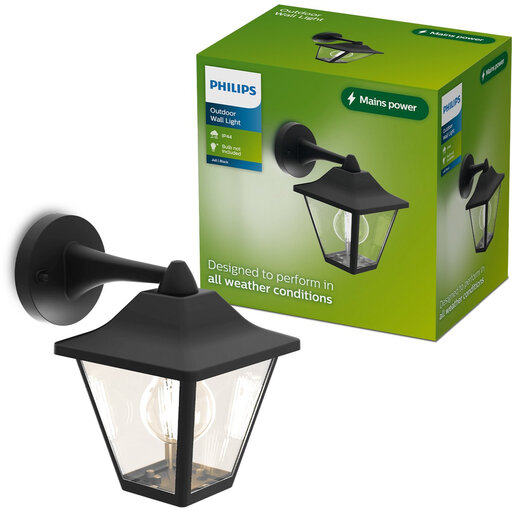
Why it suits this profile: The classic black design complements an entrance, veranda or patio. The E27 fitting lets you choose the brightness and colour temperature yourself.
The product information clearly states that the E27 bulb isn’t included. You can choose a suitable LED bulb in advance and check the maximum wattage.
E27 fitting, IP44 rating, aluminium construction and the freedom to choose your own LED bulb.

Why it suits this profile: With 1000 lumens, a motion sensor and a colour temperature of 3000 K, this solar wall light is designed for an entrance, garage path or other spot where you want plenty of light when needed.
The stated light output makes it easier to compare this light with others than a vague claim such as “extra bright”. Just make sure the installation spot gets enough sun.
1000 lumens, integrated LED, solar power and motion detection.

Why it suits this profile: This rechargeable LED outdoor light has a magnetic mount and USB-C connection. It’s handy for a balcony or anywhere you’d rather not drill into the exterior wall for permanent wiring.
The light doesn’t rely on sunlight, but it does need regular charging. Its IP44 rating means it’s splash-resistant, not waterproof.
300 lumens, 3000 K, motion sensor, integrated battery and magnetic mount.
We’ve put together a complete, up-to-date list of products that meet these strict selection criteria and comply with the applicable European safety regulations.
Before buying, check whether you need a permanent connection, solar panel or charging point. A mains-powered outdoor wall light should be installed by a qualified electrician. Use fixings suited to the wall and make sure the light can’t come loose in wind or through vibration.
Clean the solar panel and sensor regularly with a soft cloth. Don’t use harsh cleaning products. With a fitting that has an integrated LED, bear in mind that the light source may not be replaceable. When replacing a bulb in an E27 or GU10 fitting, check the wattage and dimensions of the new bulb.
It can be, as the light only switches on when it detects movement. Actual energy use depends on the brightness, how long it stays on and its settings. A solar outdoor light draws power from its battery; for a mains-powered model, electricity use depends on how often it’s used.
Lifespan varies by model and operating conditions. Some product descriptions, for example, state 10,000, 20,000 or 25,000 hours of use. These figures are stated product specifications, not a guarantee of the same lifespan in every outdoor setting in the Netherlands. The batteries in solar and rechargeable models may also need attention sooner than the LED itself.
No. IP44 is suitable for splashes, but not for submersion or direct water jets. Choose a sheltered installation spot and check that the connections, wall and fixings are suitable for the location.
