Who is this guide for?

Photographing complete models

You want to show the shape and colour of an origami model clearly against a white background. You don’t always need 1:1 magnification for a complete composition; as Adobe explains, a controlled setup with good lighting and a clean background helps with product photography.

Photographing fold details

You want to capture small folds or the texture of the paper at a larger size, so you need to consider both magnification and depth of field. Sony describes 1:1 as the classic macro ratio. For close-up photography, taking a series of shots at different focusing distances can help you get more of a stationary model in focus, as Canon explains.

Photographing with a compact lighting setup

You photograph close to the model and want enough room to position your lighting without obscuring the subject. Pay attention to the working distance in front of the lens, which is different from the minimum focusing distance.

What should you look for when choosing?

Less than 1:1

Choose this if: you mainly want to frame complete models or larger folds.

Bear in mind: the word ‘macro’ alone doesn’t guarantee 1:1 magnification.

1:1 macro

Choose this if: you want small folds or paper texture to fill the frame, and the lens mount fits your camera.

Bear in mind: depth of field is shallow at close range, and you’ll need room to light the subject.

More than 1:1

Choose this if: you want a particularly small fold to fill the frame and your camera supports a suitable lens.

Bear in mind: extra magnification isn’t necessary for a complete model; you may need several shots at different focus distances to capture different folds.

Consideration What to check before buying Who should prioritise this?
Lens mount Check the exact mount and version for your camera; the brand name or focal length alone isn’t enough. I want to keep using my existing camera, so I need to make sure the lens fits first. Around 33% of consumers put camera mount compatibility first.
Framing the whole model Compare the size of your origami with the framing you want, and check whether the lens can focus at a practical distance. I want to photograph the whole model with some space around it, not just a small detail. Around 27% of consumers prioritise this wider framing.
Magnifying small folds Compare the maximum reproduction ratio of the exact lens. Sony explains that 1:1 projects the subject onto the sensor at life size; Canon specifies a maximum of 1.4× for the RF 100mm F2.8L Macro IS USM. I want to capture a small fold or paper texture so it fills the frame, so I look for magnification and sharpness across the folds. Around 20% of consumers put these small details first.
Room for lighting Check the working distance at the magnification you want to use, and take a test shot with your lighting and white balance. I photograph close up and want to position my lighting without casting a shadow on the model. Around 20% of consumers prioritise space for their lighting setup.

Common buying mistakes

  • Assuming ‘macro’ means 1:1

    A lens with a maximum magnification of 0.5× captures the subject differently from a 1:1 macro lens. If small folds don’t appear large enough in the frame, the lens you’ve chosen may not give you the framing you want.

    Compare the maximum reproduction ratio of the exact lens with the details you want to photograph.

    You may eventually need a second lens to capture the level of detail you want.

  • Confusing minimum focusing distance with working distance

    Minimum focusing distance is measured from the sensor plane, so it doesn’t tell you how much space is left in front of the lens. That clear space can determine whether your light source can illuminate the model without being blocked by the lens.

    Check the working distance for the exact model and magnification you plan to use.

    With an awkward setup, you may need to move your lighting or use extra equipment.

  • Expecting a different lens to fix dull or discoloured whites

    Choosing a lens won’t, by itself, correct an unwanted colour cast or poorly controlled lighting. Nikon describes white balance as the camera setting that helps match colour reproduction to the lighting.

    Take a test shot of the model and background, then adjust the lighting and white balance before assuming the lens is the cause.

Brands to compare

Canon

RF lenses for photographers with a compatible EOS R camera. The RF 100mm F2.8L Macro IS USM is an option when very small details call for extra magnification.

  • Canon specifies a maximum magnification of 1.4× and a minimum focusing distance of 0.26 m for this model.
  • Minimum focusing distance isn’t the clear space in front of the lens, and 1.4× magnification isn’t necessary for every complete origami model.

Nikon

The NIKKOR Z MC 105mm f/2.8 VR S is a 1:1 option for capturing details with a compatible Z camera.

  • Nikon lists 1:1 magnification, vibration reduction and manual focusing for this model.
  • Nikon’s claims about sharpness and autofocus are manufacturer claims, not independent measurements for origami photography.

Sony

The FE 90mm F2.8 Macro G OSS (SEL90M28G) is an E-mount option that Sony says offers 1.0× magnification and optical stabilisation.

  • Sony specifies a minimum focusing distance of 0.28 m for this model.
  • Minimum focusing distance isn’t the same as working distance, and stabilisation doesn’t increase depth of field.

Sigma

The 105mm F2.8 DG DN MACRO | Art is available in separate versions for Sony E and L-Mount.

  • Sigma specifies 1:1 magnification and a minimum focusing distance of 29.5 cm for this model.
  • Choose the right mount; dimensions and weight vary by version. Sigma’s statements about optical quality are manufacturer claims.

Tamron

The 90mm F/2.8 Di III MACRO VXD is a 1:1 option that Tamron lists in versions for Sony E and Nikon Z.

  • Tamron lists a minimum focusing distance of 0.23 m for this lens range.
  • Weight varies by mount. Tamron’s claims about flat-field correction and edge sharpness come from the manufacturer and haven’t been independently verified here for origami photography.

Joybuy products

This lens option is intended for wider framing of complete models, where modest close-up magnification is enough; it isn’t a 1:1 macro lens for making small folds fill the frame.
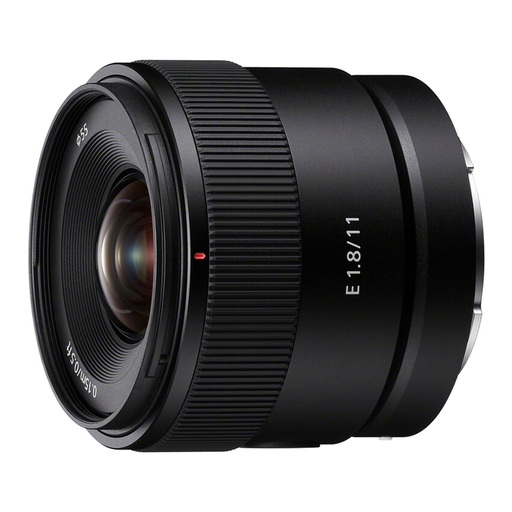
Sony E 11mm F1.8 APS-C wide-angle lens (SEL11F18)

Sony E 11mm F1.8 APS-C wide-angle lens (SEL11F18)

The wide angle of view may suit you if you want to frame a complete model with more space around it; don’t choose this lens if you need small folds to fill the frame.

Version: Sony E-mount, APS-C.

Focal length: 11 mm. Maximum aperture: F1.8.

View on Joybuy

Frequently asked questions

Do you need a 1:1 macro lens for every origami model?

No. First decide whether you want to photograph the whole model or make a small detail fill the frame. Sony explains that 1:1 projects the subject onto the sensor at life size, while 0.5× projects it at half size. Choose the ratio that suits the framing you want, rather than relying on the ‘macro’ label alone.

Why aren’t all the folds in focus at once?

Depth of field is shallow at close macro distances. With a stationary model, you can focus carefully and, if needed, combine shots taken at different focusing distances. A stable camera helps keep the series aligned.

How can you stop white paper from looking discoloured?

Check your lighting and set the white balance to match it. Nikon explains that an incorrect white balance can create a colour cast, even when your other camera settings are correct.

What should you check when fitting and maintaining a lens?

Before buying, check the exact lens mount and version. Follow the instructions and service channels for the model you’ve bought when cleaning it or arranging repairs; a shared brand name doesn’t guarantee compatibility.

What are your rights when buying a lens online in the Netherlands?

For eligible distance purchases, you generally have 14 days to change your mind, although there are exceptions. The Dutch government distinguishes between buying from a business and buying from a private individual. You’re also covered by the statutory guarantee: according to the Netherlands Authority for Consumers and Markets, there isn’t a fixed period for all products, and the seller is responsible for providing an appropriate solution if a product is faulty.
